Italy ANAC & BDNCP : Official Tender Search Portal
09 Oct 2026
Introduction Businesses looking for Italian government tenders need to understand more than the names of procurement websites. They need to know how official tender information is published, how public contract records are organised, where procurement notices can be searched and how to verify information before deciding whether to bid. In Italy, two essential terms in this process are ANAC and BDNCP. ANAC, the Autorità Nazionale Anticorruzione, is Italy's National Anti-Corruption Authority. BDNCP, or Banca Dati Nazionale dei Contratti Pubblici, is the National Database of Public Contracts managed by ANAC. Together with the Piattaforma Contratti Pubblici, certified digital procurement platforms and other connected services, this infrastructure supports the digital management, publication and transparency of public procurement. For suppliers, contractors, consultants and international companies, understanding ANAC and BDNCP can improve the way they search for Italy public procurement opportunities, research contracting authorities, identify contract records and examine tender outcomes. The official systems also provide an important verification layer when information is discovered through commercial tender-search platforms. This guide explains the relationship between ANAC and BDNCP, the role of the national procurement database, how to search official tender notices, how CIG and CPV information can support research, and how procurement data can be used for better business-development decisions. Table of Contents What Is ANAC in Italian Public Procurement? What Is BDNCP? Difference Between ANAC and BDNCP Italy's Digital Public Procurement Ecosystem Official Tender Publication Through BDNCP How to Search Italy Tenders on the Official ANAC Portal Using Advanced Search Filters Searching by CIG Searching by CPV Code Finding Procurement Information by Authority Understanding Notices, Outcomes and Contract Records BDNCP Open Data and Procurement Research What Is FVOE and How Does It Relate to BDNCP? Why ANAC and BDNCP Matter to Suppliers Limitations of Official Tender Search From Official Data to Procurement Intelligence Search Italy Tenders with ItalyTenders.com Conclusion What Is ANAC in Italian Public Procurement? ANAC stands for Autorità Nazionale Anticorruzione, Italy's National Anti-Corruption Authority. Its responsibilities include public procurement oversight, transparency and the administration of important digital services associated with public contracts. Within the procurement ecosystem, ANAC manages the BDNCP and operates services supporting the digitalisation of public contracts. These include the Piattaforma Contratti Pubblici, procurement-related data services, legal publication functions and the Fascicolo Virtuale dell'Operatore Economico (FVOE). For a business researching Italian government tenders, ANAC is important because it provides access to official procurement information rather than relying exclusively on third-party summaries. The authority's systems help connect procurement records, publication information and contract lifecycle data. ANAC should not be confused with a commercial tender aggregator or a purchasing marketplace. Its role is institutional. Companies use its public-facing services to research official information, while contracting authorities and authorised users interact with relevant services to manage procurement activities. Official resource: ANAC institutional website. What Is BDNCP? BDNCP is the abbreviation for Banca Dati Nazionale dei Contratti Pubblici, translated as the National Database of Public Contracts. It is managed by ANAC and provides access to information about public procurement notices and contracts across Italy. The database forms a central part of Italy's national digital procurement ecosystem. It receives procurement information through connected digital procurement systems and makes relevant data available through its services, including public consultation and data-access functions. BDNCP is useful for more than discovering new opportunities. Depending on the available record and search interface, users can research procurement notices, contract identifiers, contracting authorities, procurement classifications, outcomes and other information associated with public contracts. For example, a company interested in supplying laboratory equipment might use procurement data to identify relevant notices, find the purchasing organisations involved and examine previous procurement activity. An engineering company might use historical records to investigate public works contracts and identify authorities that regularly procure similar services. Official resource: ANAC's BDNCP information page. Difference Between ANAC and BDNCP ANAC and BDNCP are closely related, but they are not interchangeable terms. ANAC is the authority responsible for managing the relevant procurement infrastructure, while BDNCP is the national database within that infrastructure. AspectANACBDNCP MeaningNational Anti-Corruption AuthorityNational Database of Public Contracts Primary roleInstitutional oversight and administration of procurement-related servicesCentral procurement database and associated information services Business useAccess official guidance, services and procurement informationResearch public procurement notices, records and contract data Data and transparencyManages relevant infrastructure and servicesSupports access to procurement information collected through the ecosystem RelationshipResponsible authorityDatabase managed by ANAC The distinction matters when searching online. A user searching for “ANAC Italy tenders” may be looking for official notices, whereas someone searching for “BDNCP database” may need contract data, records or open-data resources. Italy's Digital Public Procurement Ecosystem Italy's procurement system is built around connected digital services rather than a single standalone tender website. Under the digitalisation framework associated with Legislative Decree 36/2023, procurement lifecycle activities are managed through certified digital procurement platforms that interoperate with the national infrastructure. The main components include: Certified Digital Procurement Platforms (PAD): systems used by contracting authorities to manage electronic procurement procedures and lifecycle activities. Piattaforma Contratti Pubblici (PCP): ANAC's platform providing services that support the digital management of public contracts and connections to relevant procurement functions. BDNCP: the national database that receives and makes procurement information available through its services. FVOE: the virtual file used for relevant documentation and checks relating to economic operators. Legal-publication services: the official environment for publishing procurement notices and other relevant acts. European publication connections: the infrastructure supports the transmission of applicable notices for European-level publication. ANAC explains that the digital ecosystem connects certified platforms, BDNCP and other public databases through interoperable services. This enables procurement information to be exchanged across the relevant stages of the contract lifecycle. Read ANAC's digitalisation guidance. For suppliers, this means that the official publication interface, the system used by the contracting authority to conduct a tender and the database used to research procurement information may be related but are not necessarily the same interface. Official Tender Publication Through BDNCP Legal publication is one of the most important functions associated with Italy's digital procurement system. Since 1 January 2024, the national legal-publication process for relevant procurement notices has been managed through the BDNCP legal-publication infrastructure under the applicable framework. Contracting authorities and contracting entities transmit the required information through certified digital procurement platforms. The connected system supports the publication of notices and the fulfilment of applicable transparency and publication obligations. The public legal-publication interface includes sections for bandi e avvisi di indizione (tender notices and calls), esiti di gara (tender outcomes) and altri avvisi (other notices). These categories help users distinguish between an opportunity being advertised and information published later in the procurement process. Official search interface: ANAC Public Legal Publication Platform. Suppliers should still read the complete tender documentation and the contracting authority's instructions. A search result or summary is not a substitute for the official documents, eligibility requirements, submission rules and deadline applicable to the procedure. How to Search Italy Tenders on the Official ANAC Portal ANAC's public legal-publication platform provides a practical starting point for searching official Italian procurement notices. The general search interface supports searches using notice type, publication dates and text-based fields that can include keywords, CIG, CUP and contracting-authority information. To begin, open the official ANAC general search page and identify the search criteria most relevant to your requirement. Select the relevant notice type where the interface provides that option. Set a publication-date range if you need to restrict the results to a particular period. Enter a relevant product, service or procurement keyword. Use the CIG when researching a known procurement procedure. Use contracting-authority information to narrow the results to a particular buyer. Review the returned record and open the relevant official details or documents. Check the current status, deadlines, amendments and supporting documentation before deciding whether to participate. Search-interface fields and functions can change over time. Users should follow the options displayed on the live official portal rather than assume that every search filter is available in every view. Using Advanced Search Filters Advanced search is useful when a broad keyword produces too many irrelevant results. ANAC's advanced public search interface provides filters including publication dates, contracting-authority tax identification and CPV codes. The interface labels its advanced search as a beta-testing feature, and available options may evolve. Businesses can use a combination of filters to make procurement research more precise. For example, a supplier looking for medical equipment might combine a relevant CPV code with a publication-date range. A company researching a known public buyer can use the authority's identifier where appropriate. Useful search dimensions include: Publication date: focus on records published within a chosen period. Contracting authority: narrow results to a known public buyer. CPV code: search by procurement classification rather than relying only on wording. Keyword: find notices containing relevant product, service or project terms. Notice category: distinguish tender calls from outcomes or other notices where the interface permits. Official advanced search: ANAC Advanced Search. Searching by CIG CIG stands for Codice Identificativo di Gara, the identification code associated with a procurement procedure. It is a valuable search key when the user already knows which tender or contract record they need to investigate. Searching by CIG can be more precise than a general keyword search because it targets a specific procurement identifier. This is particularly useful when reviewing a tender document, researching an award, checking a record referred to by a contracting authority or comparing information across procurement sources. From 1 January 2024, CIG acquisition for relevant procurement procedures is handled through certified digital procurement platforms connected to BDNCP, according to ANAC's digitalisation framework. The code is used to identify procurement procedures and related contracts within the system. For a company monitoring competitors, the CIG can also help link information about a procedure across notices, outcomes and related records where those data are available. Official reference: ANAC guidance on financial traceability and CIG. Searching by CPV Code CPV stands for Common Procurement Vocabulary. It is the classification system used to describe the subject matter of public procurement contracts. CPV codes help standardise procurement descriptions across different contracting authorities and languages. Searching by CPV can be useful when the same product or service is described in different ways across Italian tender notices. For example, a supplier may encounter different wording for IT support, engineering services or medical supplies. A relevant CPV code can provide another way to identify related opportunities. For stronger search coverage, suppliers should combine CPV with Italian keywords, geography and authority information. The right CPV should be selected according to the actual product or service and the classification used in the procurement documentation. ANAC's advanced search includes CPV as a filter. However, the exact information returned depends on the available procurement record and the functionality of the search interface. Finding Procurement Information by Authority Searching by contracting authority is especially useful for businesses that already know their target buyers. Italian procurement authorities can include ministries, municipalities, regional bodies, public healthcare organisations, universities, transport entities and other contracting authorities covered by the applicable framework. Instead of monitoring every notice in Italy, a supplier can build a list of authorities that are likely to purchase its products or services. It can then investigate their procurement records, notice history and available award information. ANAC's advanced search supports filtering by contracting-authority identification information. Where an authority's official name is known, suppliers should also verify that they have identified the correct legal entity, as similar names may refer to different organisations or local units. Authority-level research becomes more powerful when combined with CPV and historical contract information. It helps companies identify recurring buyers and create a focused business-development plan. Understanding Notices, Outcomes and Contract Records Not every record in a procurement database represents an open tender. A search may return a call for tender, a notice of outcome, an amendment, another procurement notice or information relating to the execution of a contract. Businesses should distinguish between these stages before adding an opportunity to their bid pipeline. Tender notices and calls: information that may announce a procurement opportunity or procedure. Other notices: notices or communications that provide additional information about a procurement process. Tender outcomes: published information about results or award stages where available. Contract information: records associated with the contract and its lifecycle, subject to the available data. A notice appearing in search results does not automatically mean that bidding is still open. Always check the deadline, status, amendments and official documentation. An award record is useful for market research, but it is not an invitation to submit a bid. BDNCP Open Data and Procurement Research BDNCP is also relevant to researchers and businesses that need more than a list of current notices. ANAC provides public procurement data services and information about access to available data, including open-data and analytical resources. Depending on the dataset and interface, procurement data can support research into: Procurement activity across authorities and categories. Historical tender and contract records. Contract identification and procurement classifications. Published procurement outcomes and award information. Patterns in the purchasing behaviour of public authorities. Data-driven market research and supplier planning. ANAC documentation describes access to procurement data through public interfaces, data analysis functions and APIs. The precise availability, fields, coverage and reuse conditions depend on the particular dataset or service. Official resource: BDNCP open-data access. Companies using procurement data for commercial analysis should check the source, date, completeness and permitted use of the relevant dataset. They should not assume that every field is populated or that every record is updated at the same time. What Is FVOE and How Does It Relate to BDNCP? FVOE stands for Fascicolo Virtuale dell'Operatore Economico, or Virtual File of the Economic Operator. It is part of the Italian procurement ecosystem and supports the collection and verification of information and documents relevant to an economic operator's participation requirements. While BDNCP provides national procurement information, FVOE has a distinct role in supplier-related documentation and qualification checks. ANAC identifies access to FVOE as one of the services enabled within the broader Piattaforma Contratti Pubblici environment. For suppliers, the practical takeaway is that searching for a tender and demonstrating eligibility to participate are different activities. The first involves discovering and evaluating an opportunity; the second requires meeting the specific requirements and following the applicable process. FVOE access and use depend on the relevant roles, services and rules. Suppliers should consult the current official guidance and the individual tender documents rather than assume that access to public search automatically completes their qualification obligations. Why ANAC and BDNCP Matter to Suppliers For suppliers, the main value of ANAC and BDNCP is the ability to connect tender discovery with official procurement information. Rather than treating a tender notice as an isolated sales lead, businesses can use official records to support a more disciplined bid-decision process. A supplier can use the available data to identify the contracting authority, confirm the procedure reference, locate relevant notice information, review published outcomes and investigate related procurement activity where records are available. This can improve bid planning in several ways: Opportunity verification: check the official notice and associated records. Buyer research: identify the contracting authority and relevant procurement history. Category targeting: use CPV codes and keywords to focus on suitable opportunities. Competition analysis: review published award information where available. Compliance checks: review the actual tender documents and applicable participation requirements. Pipeline management: distinguish open opportunities from completed or awarded procedures. Official procurement information is particularly valuable before committing time and resources to preparing a bid. It helps reduce reliance on incomplete summaries and outdated third-party listings. Limitations of Official Tender Search Official procurement search is essential, but it does not remove every challenge faced by tender researchers. Users may need to understand Italian terminology, navigate different interfaces, interpret procurement codes and inspect documents published in different formats. Search results can also vary according to the filters used, the data fields available and the publication stage of a procedure. A keyword search alone may miss a notice described using different terminology. A record may also relate to a completed procedure rather than an open bidding opportunity. For these reasons, professional tender research should combine several methods: Use the official ANAC interfaces to verify records and search notices. Combine keywords with CPV codes and authority identifiers where available. Check the publication date, status and deadline. Review the original procurement documents and amendments. Use TED and relevant regional or authority platforms when the target opportunity requires additional source coverage. Use procurement intelligence tools to organise discovery and monitoring, while retaining official-source verification. These practices help suppliers avoid treating every database result as an actionable tender. From Official Data to Procurement Intelligence Procurement intelligence turns individual records into a broader understanding of the market. Instead of asking only which tenders are currently published, a company can investigate which authorities buy its products, which categories recur, what previous outcomes reveal and where its commercial capabilities may fit. For example, an IT supplier might use CPV codes and keywords to identify relevant tenders, then research the contracting authorities and examine published award records. A construction company might analyse historical works contracts to understand which authorities procure similar projects and which procurement categories are relevant to its services. ANAC and BDNCP provide an important official-data foundation for this work. A commercial tender intelligence platform can complement that foundation by organising information across multiple sources, helping users search consistently and monitoring opportunities over time. The best approach is not to replace official procurement systems. It is to combine official verification, structured tender discovery and historical procurement analysis so that business-development teams can identify relevant opportunities more efficiently. Search Italy Tenders with ItalyTenders.com Businesses researching Italian procurement can combine official ANAC and BDNCP resources with a dedicated tender-search workflow. ItalyTenders.com provides sections for exploring tender opportunities, researching contract awards and investigating contracting authorities. Use Italy tender search to explore procurement opportunities and Italy contract awards to investigate published procurement outcomes. These two views serve different purposes: active tender discovery supports bid planning, while award research can help with competitor and buyer intelligence. Companies can create an account through ItalyTenders registration and access their account through ItalyTenders login. Businesses requiring support can use the ItalyTenders contact page. For buyer-focused research, the Italy procurement authorities section provides another route for investigating contracting entities. Regardless of the search platform used, suppliers should verify the official tender documents, applicable requirements and current deadline before making a bid decision. Conclusion ANAC and BDNCP are foundational components of Italy's digital public procurement ecosystem. ANAC is the national authority managing the relevant infrastructure, while BDNCP is the national database supporting access to procurement information and contract records. For suppliers, contractors, consultants and international businesses, the practical value lies in understanding how to search official notices, use CIG and CPV information, identify contracting authorities, examine published outcomes and verify procurement details before bidding. However, official search should be treated as one part of a broader procurement workflow. Combining ANAC and BDNCP with relevant procurement platforms, authority-level sources and structured tender intelligence can help businesses build a more reliable view of Italy's public procurement market. The next step is to understand how companies register and submit bids in Italy, including the relevant supplier requirements, digital procurement platforms and electronic submission procedures.
View Details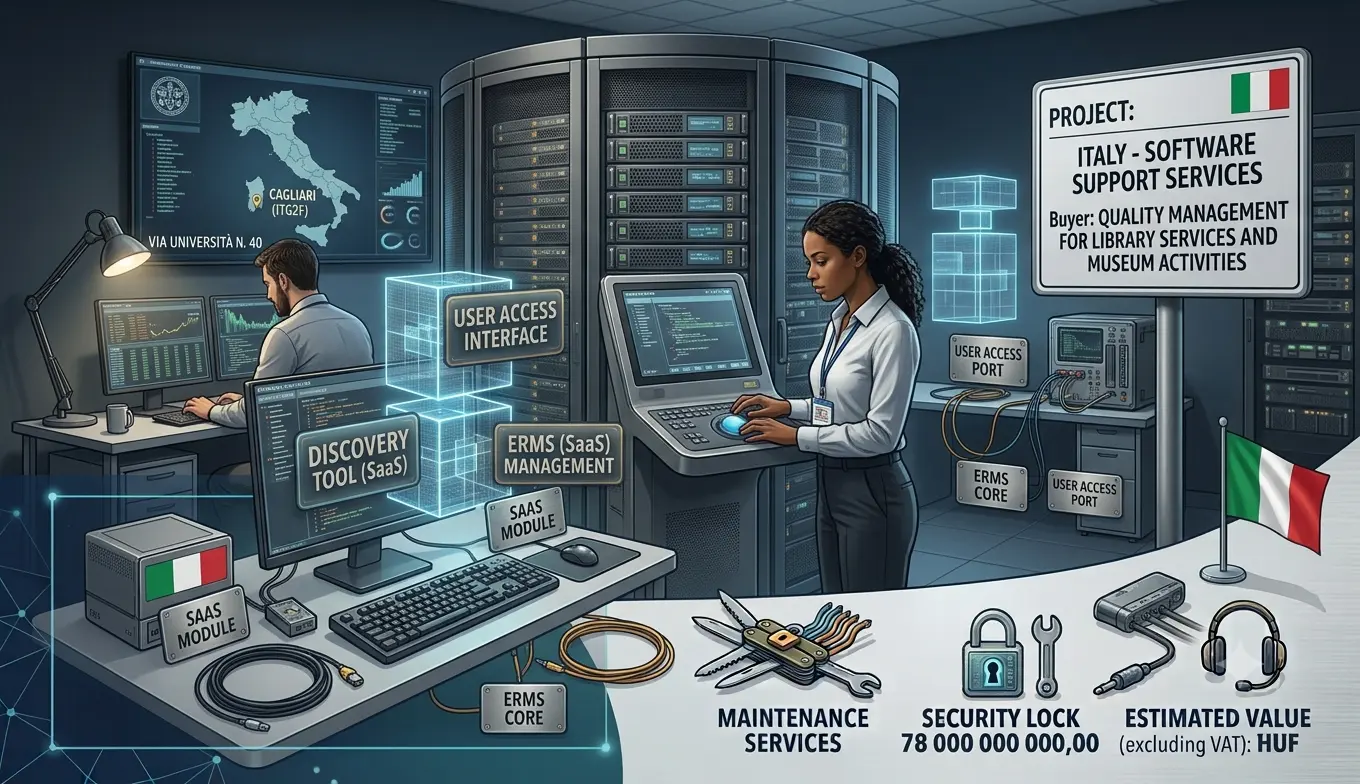
Cagliari University Picks OCLC for a Cloud Library System in a EUR 260,452 Contract
09 Oct 2026
Standfirst The University of Cagliari has awarded a 36-month contract for a Discovery Tool and Electronic Resource Management System in Software as a Service mode to OCLC B.V., a Netherlands-based library technology company. The contract, worth EUR 260,452.50, covers implementation of up to six months followed by three years of operation, with an option to extend by a further 36 months. Two tenders were received and the award was decided on the most economically advantageous offer, with price not the only criterion. Introduction Academic libraries have changed beyond recognition over the past two decades. Where a library once managed physical collections, it now manages access to thousands of electronic journals, databases, e-books and streaming services, each with its own licensing terms, authentication requirements and usage rules. Students and researchers expect to find what they need in a single search, whether it is a printed book on a shelf or an article in a journal the library subscribes to but does not own. Managing that environment requires specialised software. A Discovery Tool gives users a single search interface across all of a library's collections, physical and electronic. An Electronic Resource Management System, known as an ERMS, handles the behind-the-scenes work: tracking subscriptions, managing licences, maintaining access links, producing usage statistics and ensuring that the library knows what it has paid for and what it can access. The Università degli Studi di Cagliari, the University of Cagliari in Sardinia, has awarded a contract for both capabilities, delivered as a Software as a Service solution. The contract went to OCLC B.V., one of the world's largest library technology organisations, and covers implementation of up to six months followed by 36 months of operation. Two tenders were received, and the award was decided on the most economically advantageous offer. This article explains what was procured, who was involved, how the procurement was structured and what the award signals for suppliers in the European library technology market. Why This Contract Matters This contract matters because it shows how a mid-sized European university is modernising the digital infrastructure that underpins its research and teaching. The University of Cagliari is not a large institution by European standards, but it provides access to a substantial electronic collection for its students and researchers. Managing that collection effectively is essential to the university's academic mission. It also matters because of the delivery model. The university has chosen Software as a Service rather than an on-premises installation. That means the system is hosted and maintained by the supplier, and the university pays a subscription rather than buying a perpetual licence. SaaS has become the default model for library management and discovery systems, because it reduces the university's IT burden and ensures that the software is always up to date. The procurement also matters because of its structure. The contract is divided into an implementation phase of up to six months and an operational phase of 36 months, with an option to extend by a further 36 months. That structure recognises that implementing a discovery and ERMS system takes time and that the university wants to see the system working before committing to a long-term arrangement. Finally, the contract matters because of the competition. Two tenders were received, which is a modest level of competition for a specialist procurement of this kind. The library technology market is concentrated, with a small number of international suppliers dominating, and the fact that two suppliers bid suggests that the university's requirements were accessible to more than one provider. Contract Timeline Winner selected: 3 August 2026 Contract concluded: 5 October 2026 Notice dispatched: 8 October 2026 Notice published: 9 October 2026 Implementation period: Up to 6 months Operational period: 36 months Extension option: Further 36 months Contract Overview The contract covers the supply of a Discovery Tool and an Electronic Resource Management System, delivered in Software as a Service mode, for the University of Cagliari. It is classified as a services contract under CPV 72261000 (software support services), with an additional classification under CPV 48160000 (library software packages). It is a single-lot procurement, identified as LOT-0001, with the procedure reference C1-26. The place of performance is the university's library directorate at Via Università n. 40, Cagliari, in the Cagliari NUTS region (ITG2F). The total contract value at tender was EUR 338,250 excluding VAT and charges. Of that, EUR 180,250 covered the implementation and operational start-up plus 36 months of operation, and EUR 158,000 covered the option to extend by a further 36 months. The awarded value was EUR 260,452.50, which is below the tendered value. The contracting authority has not explained the difference. The procurement was conducted as an open procedure under Article 71 of Italian Legislative Decree No. 36/2023, which is Italy's public contracts code. The legal basis is Directive 2014/24/EU. The contract is not financed with EU funds and is not covered by the Government Procurement Agreement. It is not a framework agreement and does not use a dynamic purchasing system. The award criterion was the most economically advantageous offer, based on the best price-quality ratio. Price was not the only criterion. The notice states that all criteria are set out in the procurement documents, but it does not disclose them in the notice itself. Key Contract Details Notice ID 697221-2026 OJ S issue 196/2026 Publication date 9 October 2026 Contracting authority DIREZIONE QUALITA SERVIZI BIBLIOTECARI E ATTIVITA MUSEALI, Università degli Studi di Cagliari Contract type Services Main CPV code 72261000 – Software support services Additional CPV code 48160000 – Library software packages Procedure type Open procedure Legal basis Directive 2014/24/EU; Italian Legislative Decree No. 36/2023, Article 71 Lot LOT-0001 Winner OCLC B.V. Winning bid EUR 260,452.50 Tendered value EUR 338,250.00 excluding VAT Number of bids 2 Award criteria Most economically advantageous offer, based on best price-quality ratio; criteria detailed in the procurement documents Contract duration Up to 6 months implementation plus 36 months operation Maximum renewals 1 extension of 36 months Framework agreement No Dynamic purchasing system No EU funding No GPA covered No Subcontracting No Review body Tribunale Amministrativo Regionale per la Sardegna Project Scope The scope is the provision of a Discovery Tool and an Electronic Resource Management System in Software as a Service mode for the University of Cagliari. The notice describes the contract in Italian as the awarding of the service of Discovery Tool and management of electronic resources in SaaS mode. A Discovery Tool provides a single search interface that allows users to search across the library's physical and electronic collections at once. It aggregates metadata from the library catalogue, journal databases, e-book platforms and other sources, and presents results in a unified way. For students and researchers, it replaces the need to search multiple systems separately. An Electronic Resource Management System handles the administration of electronic resources. It tracks what the library subscribes to, manages licence terms and access rights, maintains links to content, produces usage statistics and supports renewal decisions. For library staff, it replaces spreadsheets and manual records with a structured management system. Delivering both capabilities as a Software as a Service solution means that OCLC hosts the system and the university accesses it over the internet. The university does not need to install or maintain the software on its own servers. Instead, it pays a subscription that covers hosting, maintenance, updates and support. The contract includes an implementation phase of up to six months and an operational phase of 36 months. The implementation phase covers configuration, data migration and testing. The operational phase covers live service delivery. The university has the option to extend by a further 36 months. The notice does not disclose the specific functional requirements, the number of users, the volume of electronic resources to be managed, or the technical integration requirements with the university's existing systems. The contracting authority has not disclosed this information. About the Contracting Authority The buyer is the DIREZIONE QUALITA SERVIZI BIBLIOTECARI E ATTIVITA MUSEALI, the Directorate for Library Services Quality and Museum Activities of the Università degli Studi di Cagliari. It is classified as a body governed by public law with education as its main activity. Its registration number is 80019600925, and its address is Via Università n. 40, Cagliari, postcode 09124, in the Cagliari NUTS region (ITG2F). The University of Cagliari is one of the main universities in Sardinia and serves thousands of students across a range of disciplines. Its library system provides access to physical and electronic collections for students, researchers and staff. The library directorate is responsible for managing those collections and the systems that support them. Its contact email is protocollo@pec.unica.it, and its telephone number is 070 6751. It is both the buyer and the organisation providing additional information about the procurement procedure and more information on review procedures. The directorate's decision to procure a Discovery Tool and ERMS as a SaaS solution reflects the broader shift in library technology away from on-premises installations and towards cloud-based subscription services. About the Organisations Involved DIREZIONE QUALITA SERVIZI BIBLIOTECARI E ATTIVITA MUSEALI The library directorate of the University of Cagliari is the contracting authority. It is responsible for the university's library services and museum activities. Its role in this procurement is as buyer, manager of the contract and provider of information about the procedure. It is registered in Cagliari, with registration number 80019600925. It defined the requirements for the Discovery Tool and ERMS, ran the open procedure, evaluated the two tenders and concluded the contract with OCLC B.V. It will manage the contract over its implementation and operational phases. OCLC B.V. OCLC B.V. is the winning bidder. It is classified as a large economic operator. Its registration number is NL817833092B01, and its address is Schipholweg n. 99, Leiden, postcode 2316XA, in the Netherlands. Its email address is ifnet@pec.it, and its website is oclc.org. OCLC, originally known as the Online Computer Library Center, is one of the world's largest library technology and research organisations. It provides cataloguing, discovery, resource sharing and management services to libraries around the world. Its Dutch subsidiary, OCLC B.V., serves European libraries and is the entity that contracted with the University of Cagliari. OCLC submitted the winning tender, identified as tender 1, for LOT-0001, with a value of EUR 260,452.50. It declared no subcontracting. Its role is as tenderer and winner of LOT-0001. It will implement the Discovery Tool and ERMS, host the system in Software as a Service mode and provide operational support over the contract term. The notice does not identify the non-winning bidder. It records that two tenders were received, but only the winner is named. No consortium members, framework participants or subcontractors are disclosed. Tribunale Amministrativo Regionale per la Sardegna The Tribunale Amministrativo Regionale per la Sardegna, the Regional Administrative Court of Sardinia, is listed as the review organisation. Its registration number is 80004710929, and its address is Via Sassari n. 17, Cagliari, postcode 09100. Its email address is tarca-segrprotocolloamm@ga-cert.it. Its role is to hear appeals from suppliers who believe the procurement has been conducted improperly. The notice refers to the applicable legislation for review deadlines. No complaints were recorded against this award. Procurement Analysis The procurement was conducted as an open procedure under Article 71 of Italian Legislative Decree No. 36/2023. The open procedure is the standard route for a contract of this size and allows any qualifying supplier to bid. The evaluation was based on the most economically advantageous offer, using the best price-quality ratio. That means the award was not decided on price alone. The notice states that all criteria are set out in the procurement documents, but it does not disclose them in the notice itself. The contracting authority has not disclosed the specific criteria or their weightings. Two tenders were received. That is a modest level of competition for a specialist procurement of this kind, but it is consistent with the structure of the library technology market. The market for Discovery Tools and ERMS systems is concentrated, with a small number of international suppliers dominating. Two bidders is enough to provide a genuine choice, but it is not a crowded field. The awarded value of EUR 260,452.50 is below the tendered value of EUR 338,250. The difference is EUR 77,797.50, which is approximately 23% of the tendered value. The notice does not explain this difference. It may be that the winning bid offered a lower price than the tender budget assumed, or that the tendered value included the extension option while the awarded value covers only the base contract. The contracting authority has not explained the discrepancy, and suppliers considering similar opportunities should seek clarification from the buyer rather than relying on the notice alone. The contract includes an implementation phase of up to six months and an operational phase of 36 months, with an option to extend by a further 36 months. The maximum renewals are recorded as one. The extension option is worth up to EUR 158,000 of the tendered value. Whether the university exercises the extension will depend on how well the system performs during the initial term. The contract is not covered by the Government Procurement Agreement and is not financed with EU funds. It is not a framework agreement and does not use a dynamic purchasing system. The winning bidder declared no subcontracting, meaning OCLC will deliver the full scope itself. The contract is governed by the general public sector directive rather than the utilities directive, which is appropriate for a university procurement. The use of Italian procurement law, specifically Article 71 of Legislative Decree No. 36/2023, reflects the fact that the contract is below the EU threshold for services in this category, although it was still published in TED. Additional Procurement Facts Legal basis: Directive 2014/24/EU; Italian Legislative Decree No. 36/2023, Article 71. Procedure: Open procedure, not accelerated. Award criterion: Most economically advantageous offer, based on best price-quality ratio; criteria detailed in the procurement documents. Number of bids: 2. Tendered value: EUR 338,250.00 excluding VAT, of which EUR 180,250 for implementation and 36 months of operation and EUR 158,000 for the extension option. Awarded value: EUR 260,452.50. Contract duration: Up to 6 months implementation plus 36 months operation. Extension option: 36 months, maximum renewals 1. EU funding: The procurement project is not financed with EU funds. GPA: Not covered by the Government Procurement Agreement. Framework agreement: None. Dynamic purchasing system: None. Subcontracting: The winning tenderer declared no subcontracting. Complaints: None recorded. Review body: Tribunale Amministrativo Regionale per la Sardegna. Data note: The awarded value is approximately 23% below the tendered value, and the notice does not explain the difference. Market and Industry Perspective The European library technology market is dominated by a small number of international suppliers. OCLC, Clarivate (through its Ex Libris business), EBSCO and a handful of others provide the discovery, management and resource-sharing systems that academic libraries depend on. These systems are complex, data-intensive and deeply integrated into library workflows, and switching suppliers is a significant undertaking. This contract reflects the structure of that market. The University of Cagliari received two tenders, which is typical for a specialist library technology procurement. The market is not large enough to support many suppliers, and the technical requirements are demanding enough to exclude generalist IT companies. The Software as a Service model is now the default for library discovery and management systems. Universities prefer it because it removes the need to host and maintain complex software on their own infrastructure, and because it ensures that the system is always running the latest version. Suppliers prefer it because it generates recurring revenue and gives them an ongoing relationship with the customer. The combination of a Discovery Tool and an ERMS in a single contract is also notable. These are related but distinct capabilities. Discovery is about the user-facing search experience. ERMS is about the back-office management of electronic resources. Buying them together makes sense, because they share data and because the library wants them to work as an integrated system. The strong presence of international suppliers in the Italian library technology market reflects the fact that library systems are increasingly standardised across Europe. A university in Sardinia can buy the same discovery system as a university in the Netherlands or Germany, with configuration tailored to its own collections and workflows. Economic Significance At EUR 260,452.50 over three years, with an option to extend to six years, this is a modest contract in absolute terms. It is small relative to the university's overall budget and small relative to the wider library technology market. Its economic significance lies mainly in what it enables: efficient management of the university's electronic collections and a better search experience for students and researchers. The contract also has a direct economic effect. The money flows to OCLC B.V., a Dutch subsidiary of a large international organisation. Because the winner declared no subcontracting, the economic benefit is concentrated in OCLC rather than spread across a local supply chain. That is a common feature of specialist library technology contracts, where the supplier base is international. The contract supports the university's academic mission indirectly. Efficient discovery and management of electronic resources allows students and researchers to find and use the materials they need, which supports teaching and research outcomes. That has economic value that is difficult to quantify but real. The extension option is economically significant for the supplier. If the university exercises the 36-month extension, the contract value could increase substantially, and the supplier's relationship with the university would continue for a further three years. That gives OCLC an incentive to deliver a good service during the initial term. Future Procurement Opportunities The most immediate future opportunity is the extension option. The university can extend the contract by a further 36 months, and the decision will depend on how the system performs during the initial term. Suppliers should note that the extension is at the university's discretion and is not guaranteed. Beyond this contract, the University of Cagliari will need to re-procure the Discovery Tool and ERMS when the contract expires. Library systems are not replaced frequently, but when they are, the procurement is significant. Suppliers not appointed this time should monitor the university's procurement activity for the next opportunity. More broadly, other Italian universities and research institutions operate similar library systems and face similar decisions about discovery and electronic resource management. Suppliers with a track record in the Italian academic library market will be well positioned to bid for that work. The European library technology market is stable but competitive. Suppliers should monitor the procurement activity of universities across the EU, particularly through TED and national procurement portals, for opportunities to supply discovery, management and resource-sharing systems. Opportunities for Suppliers Incumbent supplier: OCLC is the incumbent and will deliver the system under the contract. Its performance during the initial term will determine whether the extension is exercised. Future re-procurement: The contract will need to be renewed when it expires. Suppliers not appointed this time should prepare for the next procurement. Other Italian universities: Other universities in Italy operate similar systems and may procure discovery and ERMS solutions in the future. European academic libraries: The market for library discovery and management systems is pan-European. Suppliers with a proven track record can bid across member states. Adjacent services: Implementation, data migration, training and integration services may be required alongside the core system. Suppliers with these capabilities may find opportunities. Monitoring the buyer: The University of Cagliari's procurement activity can be monitored through the Italian national procurement portal and TED. What Businesses Should Watch Whether the extension is exercised: The university can extend the contract by 36 months. Suppliers should watch for a decision as the initial term progresses. Whether the awarded value gap is explained: The awarded value is approximately 23% below the tendered value. Suppliers should watch for clarification. Whether other Italian universities follow suit: If the University of Cagliari's approach works well, other Italian universities may procure similar systems. Whether the SaaS model delivers value: The university has chosen a subscription model rather than an on-premises installation. Suppliers should watch how this performs. Whether competition improves: Two tenders were received. Suppliers should watch whether future procurements attract more bidders. Whether the award criteria are disclosed: The notice does not disclose the specific criteria or weightings. Suppliers should seek the procurement documents for full details. ItalyTenders.com Procurement Intelligence This contract represents a broader trend in European higher education procurement: universities are moving their library systems to the cloud and buying discovery and electronic resource management as integrated subscription services. The Software as a Service model has become the default because it reduces the university's IT burden and ensures that the system is always current. The combination of a Discovery Tool and an ERMS in a single contract reflects the fact that these capabilities are increasingly seen as one integrated solution rather than separate purchases. The award is strategically important because it supports the University of Cagliari's ability to provide access to its electronic collections efficiently. A Discovery Tool improves the user experience for students and researchers, while an ERMS improves the library's ability to manage its subscriptions and licences. Together they support the university's academic mission in a way that is increasingly dependent on digital resources. Suppliers can learn several things from this procurement. First, the library technology market is concentrated. Only two suppliers bid, and the field is dominated by a small number of international providers. Second, the SaaS model is now standard. Universities expect to buy library systems as subscription services, not as on-premises installations. Third, integration matters. Buying discovery and ERMS together reflects the fact that these capabilities share data and need to work as a system. Fourth, price is not the only criterion. The award was based on the most economically advantageous offer, which means quality and technical merit carried weight. Fifth, data quality in published notices can be imperfect. The gap between the tendered value and the awarded value is not explained, and suppliers should seek clarification from the buyer rather than relying on the notice alone. Suppliers should position themselves accordingly. Library technology companies should ensure their discovery and ERMS offerings are available as SaaS solutions with proven implementation methodologies. They should be prepared to compete on quality as well as price. And they should monitor the procurement activity of universities across Europe, because the shift to cloud-based library systems is creating a steady pipeline of opportunities. Future contracts in this market are likely to evolve in two directions. First, more universities will consolidate their library systems into integrated discovery and management platforms delivered as subscription services. Second, the technical requirements will become more demanding as libraries seek better integration with research systems, learning platforms and open access repositories. Suppliers that can demonstrate proven capability, competitive pricing and strong integration will be well positioned. Suppliers that compete only on price will find themselves excluded from a market where quality and reliability matter more than the lowest bid. Supplier Takeaways The University of Cagliari awarded a 36-month contract for a Discovery Tool and ERMS in SaaS mode to OCLC B.V. The awarded value is EUR 260,452.50, below the tendered value of EUR 338,250. Two tenders were received, reflecting the concentrated nature of the library technology market. The award was based on the most economically advantageous offer, with price not the only criterion. The contract includes up to six months of implementation plus 36 months of operation, with an option to extend by a further 36 months. The winning bidder declared no subcontracting. The contract is not a framework agreement, not a dynamic purchasing system, not EU-funded and not GPA-covered. The awarded value is approximately 23% below the tendered value, and the notice does not explain the difference. The review body is the Tribunale Amministrativo Regionale per la Sardegna. The contract is governed by Directive 2014/24/EU and Italian Legislative Decree No. 36/2023, Article 71. Key Takeaways The University of Cagliari awarded a contract for a Discovery Tool and Electronic Resource Management System in Software as a Service mode to OCLC B.V. The contract value is EUR 260,452.50, against a tendered value of EUR 338,250. The contract covers up to six months of implementation and 36 months of operation, with an option to extend by a further 36 months. Two tenders were received. The award was based on the most economically advantageous offer, not price alone. The contract is a services contract classified under CPV 72261000 (software support services) and CPV 48160000 (library software packages). The procurement was an open procedure under Directive 2014/24/EU and Italian Legislative Decree No. 36/2023, Article 71. The contract is not financed with EU funds and is not covered by the Government Procurement Agreement. The winning bidder, OCLC B.V., is a large Netherlands-based library technology company and declared no subcontracting. The notice does not disclose the award criteria weightings or the reasons for the gap between tendered and awarded values. The review body is the Tribunale Amministrativo Regionale per la Sardegna. Conclusion The University of Cagliari has taken a practical step towards modernising its library services by awarding a contract for a Discovery Tool and Electronic Resource Management System in Software as a Service mode to OCLC B.V. The contract, worth EUR 260,452.50, covers implementation of up to six months and 36 months of operation, with an option to extend by a further 36 months. The procurement attracted two tenders, which is consistent with the concentrated structure of the library technology market. The award was based on the most economically advantageous offer, not on price alone, and the winning bid came in below the tendered value. The notice does not explain the gap between the tendered and awarded values, and suppliers considering similar opportunities should seek clarification from the buyer. For suppliers, the contract reinforces the importance of cloud-based delivery, integrated discovery and management capability and quality differentiation in the academic library market. For the university, the challenge will be to implement the system effectively and to realise the benefits of improved discovery and resource management for its students and researchers. The notice leaves some questions unanswered, but the core award is clear: OCLC will deliver the Discovery Tool and ERMS, and the University of Cagliari will use them to manage its electronic collections over the next three years. Source: Tenders Electronic Daily (TED), Contract Award Notice 697221-2026, Official Journal of the European Union, OJ S 196/2026, published on 9 October 2026.
View Details
Where to Find Italy Government Tenders and Public Procurement Opportunities
08 Oct 2026
Introduction Finding the right public procurement opportunities in Italy is not as simple as visiting one government tender website and searching for a keyword. Italy has a distributed procurement ecosystem involving national procurement infrastructure, Consip and Acquisti in Rete, European tender publication through TED, regional e-procurement platforms, contracting-authority portals and specialised procurement databases. For companies searching for Italy tenders, Italy government tenders, Italian public procurement opportunities or gare d'appalto, understanding where different types of opportunities appear is just as important as knowing how to search. A construction company looking for municipal infrastructure contracts may need to monitor a different source from an IT supplier targeting national public administrations. A healthcare supplier may need Consip and regional healthcare procurement sources, while an international company seeking larger European opportunities may find TED particularly useful. This guide explains where to find government and public procurement opportunities in Italy, which tender sources businesses should monitor, how Italian and international suppliers can search more effectively, and how to combine official sources with procurement intelligence to create a practical tender-monitoring strategy. Table of Contents Where to Find Italy Tenders Official Italian Tender Sources ANAC and BDNCP Procurement Information Consip Tender Opportunities Acquisti in Rete PA MEPA Procurement Opportunities SDAPA Opportunities TED: European Tender Opportunities in Italy Regional E-Procurement Platforms Contracting Authority and Government Portals How to Search Italy Tenders Effectively Italian Tender Search Keywords Searching Italy Tenders by CPV Searching by Region and City Searching by Industry and Sector Tender Alerts and Continuous Monitoring Why Tender Intelligence Matters Italy Tender Search with ItalyTenders.com Finding Italian Tenders for Foreign Suppliers Conclusion Where to Find Italy Tenders There is no single source that should be treated as the complete answer to the question “Where can I find Italy tenders?” The most effective approach is to understand the different source layers and use each one for the type of procurement information it is best suited to provide. SourceBest Use ANAC and BDNCPNational procurement information, contract data and transparency ConsipConsip-led procurement procedures and national purchasing activity Acquisti in Rete PAPublic-sector electronic procurement instruments and supplier activity MEPAElectronic marketplace opportunities and purchases involving enabled suppliers SDAPADynamic purchasing system opportunities TEDEuropean-level public procurement notices Regional platformsRegional, local and sector-specific procurement Authority portalsDirect information from individual contracting authorities Tender intelligence platformsAggregated search, monitoring, historical data and procurement intelligence The important point is that these sources are complementary. A supplier that monitors only one platform may see only part of the market relevant to its business. Official Italian Tender Sources Official procurement sources should be the starting point for verifying tender information. They provide authoritative information about procurement procedures, contracting authorities, documents, deadlines, amendments, outcomes and other legally relevant information. The Italian procurement environment includes national infrastructure managed through ANAC, procurement activities operated through Consip and Acquisti in Rete, European publication through TED and numerous regional or contracting-authority systems. For a professional tender-search strategy, official sources should be combined rather than treated as competitors. One source may be excellent for a particular procurement mechanism but not intended to provide the same type of information as another. ANAC and BDNCP Procurement Information ANAC, the Autorità Nazionale Anticorruzione, is a central institution in Italy's public procurement system. Its procurement infrastructure includes the Banca Dati Nazionale dei Contratti Pubblici, or BDNCP. For tender researchers, ANAC-related services are particularly important when researching procurement information, contract data, legal publication and transparency. ANAC also provides access to open procurement data and services associated with the digitalisation of public contracts. Businesses should distinguish between finding an opportunity and researching procurement data. A tender search may begin with an active notice, while procurement intelligence may require looking at historical contracts, contracting authorities, CPV classifications and award information. ANAC's procurement-data infrastructure therefore has significance beyond simply locating an individual tender. Consip Tender Opportunities Consip is one of the most important names to understand when researching Italian public procurement opportunities. It operates procurement activities within Italy's public purchasing framework and provides procurement tools for public administrations. Consip maintains a dedicated Ricerca gare environment where users can search procurement procedures. Its search interface allows filtering by tender type, status, contract type, category, dates, award criteria, procurement instrument and other characteristics. This is valuable for suppliers because the search process can move beyond a generic keyword. For example, a company can distinguish between services, supplies and works and examine procurement activity according to specific commercial categories. Consip's tender environment also includes different stages of procurement activity, including notices, tenders and outcomes. This makes it useful not only for discovering opportunities but also for understanding procurement history. Acquisti in Rete PA Acquisti in Rete PA is the digital procurement environment associated with Italy's public purchasing programme. It is particularly important for suppliers that want to participate in electronic public procurement. The platform brings together several procurement instruments and activities. Depending on the purchasing requirement and procedure, businesses may encounter MEPA, SDAPA, conventions, framework agreements and other electronic purchasing mechanisms. For suppliers, this means that “Italy government tender search” should not be limited to traditional tender notices. Some commercial opportunities are connected to digital procurement mechanisms where supplier enablement and platform participation are important. A supplier entering the Italian market should therefore understand the difference between searching for an open tender and being positioned to participate in electronic procurement. MEPA Procurement Opportunities MEPA, the Mercato Elettronico della Pubblica Amministrazione, is an important electronic procurement marketplace in Italy. MEPA is particularly relevant to companies supplying products and services to public administrations. The system allows enabled economic operators to participate in digital purchasing activities according to the applicable categories and procedures. For search purposes, businesses should consider terms such as MEPA Italy, MEPA tenders, MEPA supplier opportunities, gare MEPA and acquisti MEPA. However, MEPA should not be treated as the entire Italian tender market. It represents one important procurement mechanism within a much larger ecosystem. SDAPA Opportunities SDAPA, the Sistema Dinamico di Acquisizione della Pubblica Amministrazione, is another important electronic procurement mechanism. Businesses should monitor SDAPA when their products or services fall within relevant categories and when they are positioned to participate in the corresponding procurement process. One important search distinction is that a supplier should not look only for the phrase “Italy tenders.” It should also understand the procurement mechanism through which a buyer may acquire the relevant product or service. This distinction becomes particularly important for suppliers targeting recurring government demand, framework-style purchasing and technology, healthcare or other specialised categories. TED: European Tender Opportunities in Italy TED, Tenders Electronic Daily, is the European Union's online procurement notice platform. It is one of the most important sources for businesses searching for European public procurement opportunities involving Italy. TED allows users to search procurement notices using criteria such as country, business sector and procurement classification. It is especially useful for larger European-level procurement opportunities that fall within the publication framework. For an Italy-focused search, users can combine Italy with CPV codes, keywords and other search parameters. International suppliers should also understand that searching TED does not necessarily provide a complete picture of every procurement opportunity in Italy. Many opportunities exist through national, regional, local and electronic procurement systems that require additional monitoring. Regional E-Procurement Platforms Regional procurement is one of the most important areas for companies that want broad coverage of Italian public tenders. Italy has regional procurement systems and platforms used by regional authorities, municipalities, healthcare organisations and other public bodies. Examples include Sintel in Lombardia and SATER associated with Emilia-Romagna's Intercent-ER procurement environment. Regional platforms can contain opportunities that are highly relevant to local suppliers and companies targeting specific geographic markets. For example, current SINTEL procurement records demonstrate opportunities from entities including the Comune di Milano, ATS Milano and other organisations, with procurement covering works, services, supplies and market investigations. Similarly, the Emilia-Romagna Intercent-ER environment publishes procurement procedures with information such as contracting authority, procurement value, procedure status, publication date and offer deadline. This makes regional procurement platforms particularly valuable for companies using a region + sector strategy. Contracting Authority and Government Portals Not every supplier should rely exclusively on national procurement portals. Individual contracting authorities may operate procurement pages or electronic tender environments containing their own procedures and procurement documents. Government departments, municipalities, public universities, healthcare organisations, transport authorities, public utilities and other entities can publish procurement information through dedicated environments. For example, the Italian Ministry of Infrastructure and Transport's Portale Gare d'Appalto provides sections for tenders and procedures, award notices and outcomes, economic-operator registration notices and links to BDNCP-related information. Its search functionality demonstrates why authority-level research can be valuable: tender records can be filtered by contracting authority, title, CIG, status, procurement type, publication date, deadline and other characteristics. For a supplier with a defined target-buyer list, monitoring authority-level procurement can therefore be much more precise than performing a generic national search. How to Search Italy Tenders Effectively A strong Italy tender-search strategy should use several filters simultaneously. Product or service: What exactly does your company sell? Italian terminology: How would an Italian contracting authority describe it? CPV: Which procurement classifications represent the product or service? Geography: Which regions, provinces or cities are commercially relevant? Authority: Which government buyers regularly purchase your category? Value: What contract size can your organisation realistically deliver? Procedure: Which tender procedures and procurement mechanisms are relevant? Deadline: Is sufficient time available to prepare a compliant bid? The objective should not be to find the largest possible number of tenders. The objective should be to identify the largest number of relevant and actionable opportunities. Italian Tender Search Keywords International suppliers often make a basic search mistake: they search only in English. Italian procurement terminology should be incorporated into the search strategy. Important terms include: appalti pubblici gare d'appalto bandi di gara gara pubblica gare telematiche ricerca gare d'appalto ricerca bandi di gara avviso pubblico manifestazione di interesse operatore economico stazione appaltante esito di gara aggiudicazione These terms should be combined with commercial terminology. For example, an IT company might search for Italian terms related to software, cybersecurity, cloud services or digital transformation instead of relying only on “IT tenders Italy.” This dual-language approach can improve opportunity discovery because the actual procurement notice may use terminology that differs substantially from the supplier's English product description. Searching Italy Tenders by CPV CPV, or Common Procurement Vocabulary, provides a structured way to classify the subject matter of public procurement. Keyword searches are useful but can miss opportunities because contracting authorities may describe similar products differently. CPV searching can provide another layer of precision. A professional search strategy should therefore combine keyword + CPV + geography + authority rather than relying on only one method. CPV is particularly useful for companies with clearly defined products or service categories and for organisations that want to monitor procurement activity consistently over time. A dedicated guide in this Italy procurement series will examine CPV codes and Italy tender searching in greater detail. Searching by Region and City Geographic targeting can dramatically improve tender relevance. Instead of searching for every tender in Italy, a company can build regional searches around markets where it has sales coverage, operational capacity, partners or existing customers. Examples include: Lombardia tenders Milan public tenders Lazio tenders Rome government contracts Veneto tenders Emilia-Romagna procurement Toscana public tenders Piemonte tenders Campania public procurement Puglia government tenders Sicilia tenders Sardegna public procurement Geographic search is especially useful for construction, facilities management, healthcare, transport, environmental services, education, municipal services and other areas where procurement demand can be strongly linked to local authorities. Searching by Industry and Sector Italy's public procurement market spans a broad range of sectors. A supplier should therefore define its sector vocabulary before beginning continuous tender monitoring. Construction and infrastructure Information technology and telecommunications Healthcare and medical equipment Engineering and architecture Energy and utilities Transport and mobility Environmental services and waste management Security and defence-related procurement Consultancy and professional services Education and training Facilities management Industrial equipment and machinery Office supplies and general goods Sector searches become much stronger when combined with CPV codes, Italian terminology and target authorities. Tender Alerts and Continuous Monitoring Finding one tender is not the same as building a tender pipeline. Public procurement is continuously changing: new notices are published, deadlines approach, procedures are amended, tenders are cancelled or extended, and awards are eventually published. For businesses actively pursuing government contracts, continuous monitoring is therefore more useful than occasional manual searching. A tender-alert profile should ideally include: Target keywords Italian procurement terminology CPV codes Target regions Target contracting authorities Minimum and maximum contract value Relevant procurement categories Preferred procurement procedures Businesses should also monitor corrigenda, clarifications, deadline changes and outcomes because these can materially affect bid decisions. Why Tender Intelligence Matters The biggest difference between simple tender searching and procurement intelligence is the use of information beyond the active tender notice. A basic search asks: What tenders are open today? A procurement-intelligence strategy asks: Which authorities buy our products? How frequently do they procure? Which CPV categories do they use? Which competitors have won previous contracts? What was the historical contract value? Which regions have the strongest demand? Are similar opportunities likely to recur? Which opportunities fit our actual delivery capability? This approach changes tender research from reactive searching into business-development intelligence. Commercial platforms can add value by aggregating information from multiple official and procurement sources, normalising search fields and enabling businesses to analyse historical procurement and awards alongside current opportunities. Italy Tender Search with ItalyTenders.com For businesses that want a dedicated Italy-focused tender-search workflow, ItalyTenders.com provides a platform for exploring Italian tender opportunities and related procurement information. The Italy tender search section can be used as a starting point for companies looking for current procurement opportunities, while the contract awards section can support research into procurement outcomes and historical activity. Businesses can create an account through the registration section and use the login area for ongoing access to the platform. Companies requiring assistance can contact the ItalyTenders team directly. The authority section can also support buyer-focused research, which is important for companies that want to move beyond individual tender notices and identify recurring public-sector customers. A strong workflow is to use a tender intelligence platform for discovery and monitoring, then verify the final procurement requirements and official documents through the relevant contracting authority or official procurement source. Finding Italian Tenders for Foreign Suppliers Foreign companies should build their Italy tender-search strategy around the procurement categories where they have a realistic competitive advantage. Instead of monitoring every Italian tender, an international supplier can select target industries, CPV codes, regions, contracting authorities and contract values. It can then monitor both English and Italian search terminology. European suppliers may find TED particularly useful for relevant European-level notices, while suppliers targeting specific Italian public administrations may also need Consip, regional platforms and authority-level sources. Foreign companies should also pay attention to the language of tender documentation, qualification requirements, electronic submission procedures, digital requirements and any specific eligibility conditions in the tender documents. The most effective international strategy is therefore targeted Italian procurement monitoring, not indiscriminate tender collection. Conclusion Italy has a broad and distributed public procurement ecosystem. Businesses looking for government contracts should not depend on a single website or a single keyword. The most effective source strategy combines ANAC and BDNCP, Consip, Acquisti in Rete, MEPA, SDAPA, TED, regional e-procurement platforms and contracting-authority portals. Search quality improves further when companies combine Italian and English keywords with CPV codes, geographic filters, sector categories and target authorities. For serious suppliers, the next step is to move beyond tender discovery and develop procurement intelligence: monitor historical awards, identify active buyers, understand competitors, track recurring procurement and build a targeted pipeline of opportunities. Companies looking for Italy government tenders should therefore think of tender search as an ongoing commercial intelligence process rather than a one-time Google search.
View Details