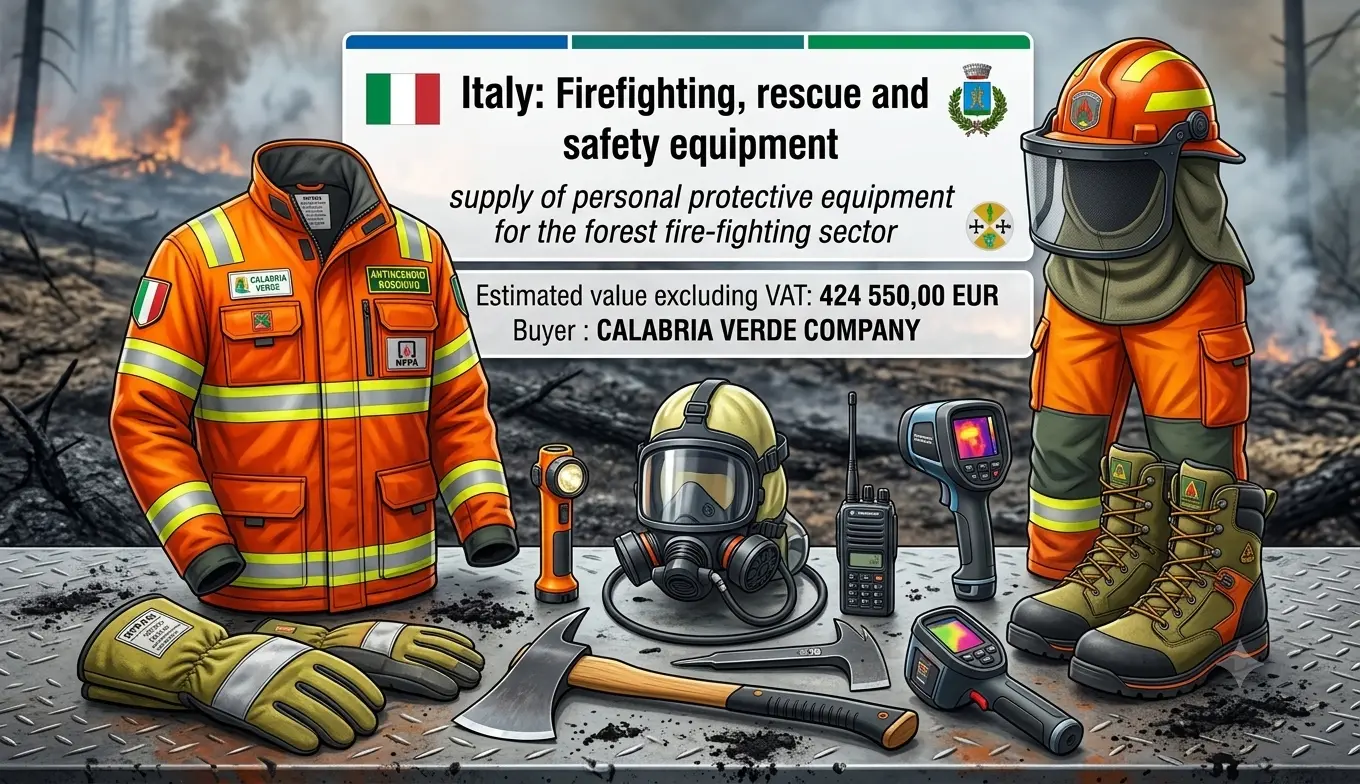
Calabria Buys Wildfire Crew Protective Gear for About 41 Percent Below Its Estimate
20 Oct 2026
Standfirst Crews who fight forest fires work in heat and smoke and on rough ground. Their clothing and boots and masks are the last line of protection. Azienda Calabria Verde has reported contracts worth EUR 250,160.50 for that equipment but the notice leaves some basic questions open. Introduction Wildfire seasons put pressure on southern European regions every summer. The firefighters who respond need equipment that resists flame and protects the eyes and lungs. They also need boots that hold up on steep terrain. Azienda Calabria Verde runs a forest firefighting sector from Catanzaro. It bought personal protective equipment for that sector in three lots. The Italian shorthand AIB stands for antincendio boschivo or forest fire fighting. The procurement is small by European standards but it is instructive. Prices fell far below the estimates and the notice carries several data problems that readers should understand before relying on its figures. Why This Contract Matters Protective equipment is not a discretionary purchase. If supply is late or poor the cost is paid in safety. A public body that buys such goods must balance speed and price and quality. This award shows what a pure price competition can deliver. All three lots were decided on lowest price. The result is a large saving against the estimate but the notice does not explain how quality was assured. The contracting authority has not disclosed this information. Contract Timeline 16/06/2026: the winner for lot 1 was chosen and the contract was concluded on the same day. 19/10/2026: the notice was dispatched. 20/10/2026: the notice was published. The notice was dispatched 125 days after the lot 1 signature (editorial calculation). Dates for lots 2 and 3 are not given. Each lot has an estimated duration of 60 days. If counted from 16/06/2026 that period would end on 15/08/2026 (editorial projection). The notice does not say when the period starts. The previous notice for the procedure is referenced as 20684 2026. Contract Overview The notice covers three supply lots delivered to Catanzaro. All use the open procedure and the lowest price rule. Lot 1: forest firefighting jackets and trousers and flame resistant underwear and socks and half sleeve polo shirts and belts and work polo shirts and high visibility safety vests. The estimate is EUR 213,500.00. Lot 2: forest firefighting boots and safety shoes. The estimate is EUR 92,000.00. Lot 3: masks and mask filters and mask holders and burn protection kits and bags and helmets with visor and neck protector and helmet liners. The estimate is EUR 119,050.00. Key Contract Details BuyerAzienda Calabria Verde WinnersLot 1: C.S. Emergenza SRL. Lots 2 and 3: no winner is named. The rank 1 tenderers are Calzaturificio Montebove SRL (lot 2) and ST Protect SRL (lot 3) TitleSupply of personal protective equipment for the forest firefighting sector (original: fornitura di dispositivi di protezione individuale per il settore Antincendio boschivo) ProcedureOpen procedure. Not accelerated Legal basisDirective 2014/24/EU CPV35110000 Firefighting and rescue and safety equipment Estimated valueEUR 424,550.00 excluding VAT Awarded valueEUR 250,160.50 (lot 1: EUR 130,768.75. lot 2: EUR 54,997.60. lot 3: EUR 64,394.15) Ceiling or maximumNot applicable. No framework agreement Award criteria and weightsLowest price only. No quality weighting Duration and renewals60 days per lot. No renewals stated Tenders receivedLot 1: 6. Lot 2: 7. Lot 3: 6 EU fundingNot financed with EU funds GPANot covered SubcontractingNot yet known Key datesLot 1 winner chosen and contract concluded 16/06/2026. Published 20/10/2026 Place of performanceCatanzaro Italy Review bodyTribunale amministrativo di Catanzaro Project Scope The scope is the supply of standard personal protective equipment. It spans clothing and footwear and respiratory and head protection. The notice describes the items only by name. It gives no quantities and no technical standards. The contracting authority has not disclosed this information. The lot titles and descriptions are identical in the notice. The procedure title and description are also identical. Readers get a list of goods and not an explanation of how they will be used. About the Contracting Authority Azienda Calabria Verde is classed as a regional authority with environmental protection as its activity. The department named in the notice is the forest firefighting sector. It is based at Via Lucrezia della Valle 34 in Catanzaro. The notice lists it as buyer and as the body that pays and signs and provides information and mediation. Bids were handled through the electronic platform named in the notice. About the Organisations Involved The notice names five organisations. Three are suppliers and two are public bodies. Azienda Calabria Verde The buyer holds every administrative role in the notice. It is the budget holder and the paying body and the signing body. C.S. Emergenza SRL The only named winner. It is a micro or small or medium sized company based in Manopello in the Pescara area. It won lot 1 at EUR 130,768.75 with a rank of 1. The notice lists no products or background. Calzaturificio Montebove SRL A micro or small or medium sized company based in Tolentino in the Macerata area. The name suggests a footwear maker but the notice does not say so. It is listed as a non winning tenderer in lot 2 at EUR 54,997.60 with a rank of 1. ST Protect SRL A micro or small or medium sized company based in Senago in the Milano area. It is listed as a non winning tenderer in lot 3 at EUR 64,394.15 with a rank of 1. Tribunale amministrativo di Catanzaro The regional administrative court in Catanzaro is the review body. The notice refers to the law in force for review deadlines and gives no number of days. Procurement Analysis The buyer used an open procedure and the lowest price rule. This suits standard goods where specifications are fixed and quality is controlled through technical requirements. It keeps evaluation simple and fast. It also places weight on the quality of the specification because price is the only competitive lever. The savings are large. Lot 1 came in 38.75% below its estimate and lot 2 came in 40.22% below. Lot 3 came in 45.91% below. Overall the awarded value of EUR 250,160.50 is 41.08% below the EUR 424,550.00 estimate and the difference is EUR 174,389.50 (editorial calculations). The lot values reconcile with the notice totals for both estimate and award. The gaps could reflect competitive bidding or generous estimates. The notice does not say which. Buyers should also watch that very low prices do not signal risk in delivery or quality. Competition looks strong. Six or seven tenders arrived per lot. All were electronic and all were from micro or small or medium bidders. The notice names only one tenderer per lot so the other bidders are not identified. The lot structure helps competition. Clothing and footwear and respiratory and head gear are different product families. Splitting them lets specialist makers bid for what they know and stops one large bidder from needing to cover everything. The three winning or rank 1 companies are all different which supports that reading (editorial analysis). The lowest price rule also means the notice reveals little about quality. It does not state certification requirements or sample testing. Suppliers should assume that technical conditions sit in the tender documents which the notice does not reproduce. Additional Procurement Facts Several points in the notice do not fit together and the figures should be used with care. Lots 2 and 3 name no winner although the status says at least one winner was chosen. The rank 1 tenderers appear under non winning tenderers. They are probably the winners (editorial interpretation) but the notice does not confirm it. Each lot reports that all tenders came from tenderers outside the European Economic Area yet every named company has an Italian address. The lowest and highest admissible tender values are identical in each lot despite six or seven tenders. The notice reports no contract conclusion date for lots 2 and 3. Descriptions repeat the titles and give no detail. Publication came long after signature as noted above. Only one CPV code is used for very different goods. Market and Industry Perspective Suppliers of protective clothing and footwear and respiratory equipment compete across Italy. The three named companies come from Abruzzo and the Marche and Lombardy. None is based in Calabria. That shows how public safety equipment is bought on a national market (editorial analysis). Lowest price tenders favour efficient makers and distributors with scale. Buyers often rely on technical standards and certificates to protect quality. Economic Significance At about EUR 250,000 the contract is modest. Its value lies in readiness. Proper equipment lets crews respond safely in fire season. The saving of EUR 174,389.50 against the estimate frees budget for other needs if the estimate was the allocated amount (editorial analysis). The notice does not say. Future Procurement Opportunities Protective equipment wears out and is replaced every season. Repeat purchases and replenishment orders are a natural follow on (editorial analysis). The notice states no renewal and no framework so each new need would require a new procedure. Related items such as tools and vehicle equipment for firefighting may also be bought separately. Opportunities for Suppliers Makers of certified protective clothing and boots and helmets can watch regional environmental agencies across Italy. The three lots allow specialists to bid for the product group they know best. Small suppliers can compete because the lots are of modest size. What Businesses Should Watch Watch for later notices from Azienda Calabria Verde. Watch for corrected data on lots 2 and 3. Watch also how quickly the buyer publishes future results. ItalyTenders.com Procurement Intelligence This award reflects a pattern in public safety purchasing. Buyers split equipment into lots by product family so that specialist makers can compete. They then decide on price alone and rely on technical rules to protect quality. The lesson for suppliers is that sharp pricing wins when specifications are fixed. A bidder must know its cost base and be ready to price well below the estimate. Future purchases may add quality criteria or environmental criteria. The notice shows none today (editorial analysis). Supplier Takeaways Lowest price decided every lot. Bids came in 39% to 46% below the estimates (editorial calculation). Competition drew six or seven bids per lot. Check the lot structure to bid where you are strongest. Key Takeaways Estimated value EUR 424,550.00 and awarded value EUR 250,160.50. Three lots were awarded in a price only competition. Only lot 1 names a winner. Several data fields in the notice are inconsistent. Conclusion Azienda Calabria Verde has secured protective equipment for its forest firefighting sector at a steep discount to its own estimate. The strong competition is encouraging. The inconsistent data on winners and tender origins is a reminder to read notices critically. Suppliers should treat the figures as a guide to price levels and not as a full record. Source: Tenders Electronic Daily (TED), Contract Award Notice 726333 2026, Official Journal of the European Union, OJ S issue 203/2026, published on 20/10/2026.
View Details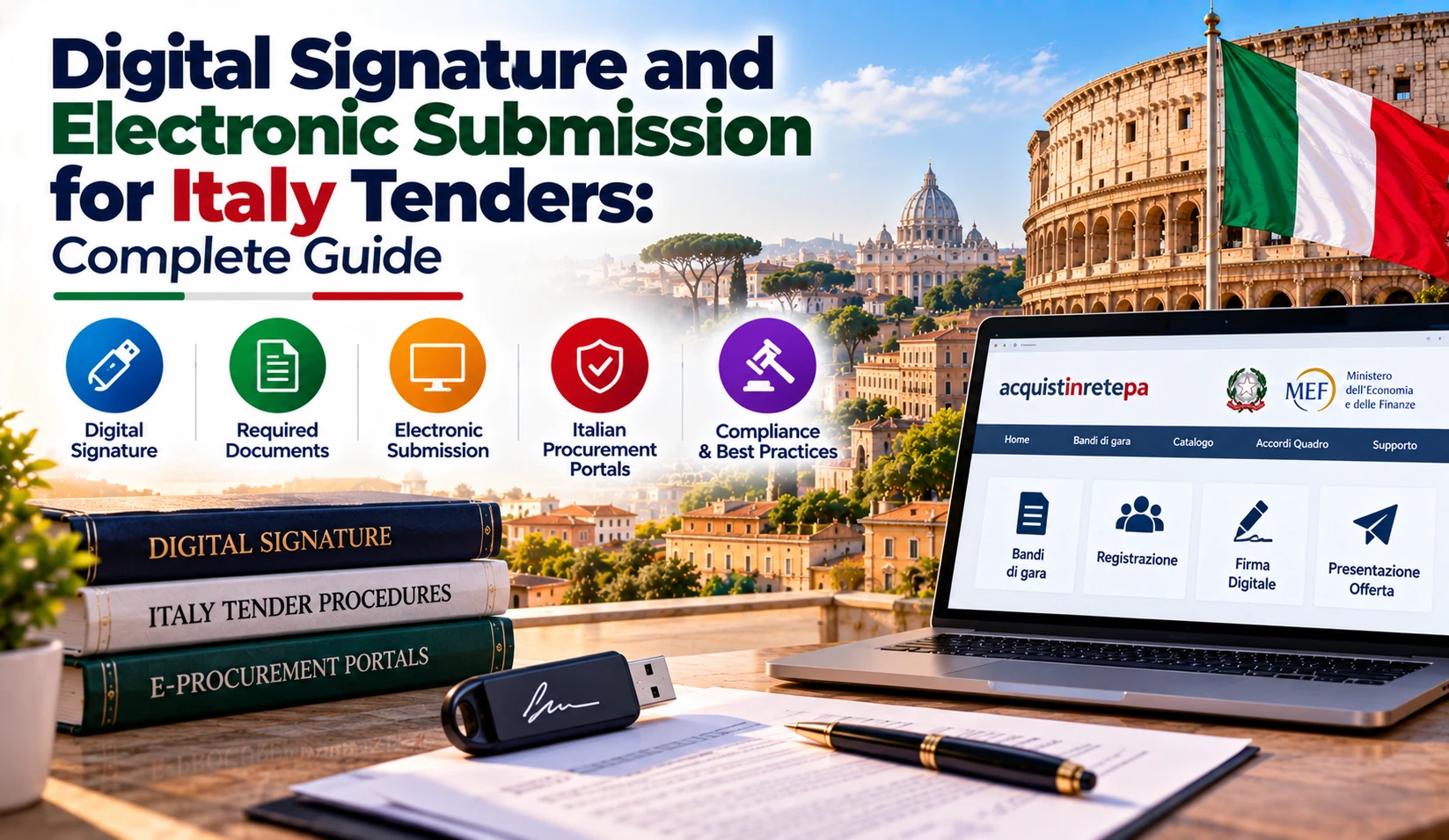
Digital Signature and Electronic Submission for Italy Tenders: Complete Guide
19 Oct 2026
Introduction Digital signatures and electronic tender submission are essential parts of participating in Italian public procurement. Companies bidding for government contracts must understand how to sign documents electronically, access procurement platforms, prepare the required files and submit their offers in accordance with the contracting authority's instructions. Italy's public procurement framework is governed principally by Legislative Decree No. 36/2023, or D.Lgs. 36/2023. Its digitalisation provisions became fully effective on 1 January 2024, establishing a digital framework for the relevant stages of public contracts, including publication, award and contract execution. Certified digital procurement platforms connect with the National Database of Public Contracts (BDNCP), managed by ANAC, to support the digital procurement ecosystem. For suppliers, the practical challenge is not simply uploading documents. A bid may require electronic identification, a valid digital signature, a prescribed file format, declarations signed by the correct individuals and submission through a specific platform before a strict deadline. Missing one of these requirements can put an otherwise competitive offer at risk. This guide explains digital signatures in Italy, the difference between electronic identification and signing, common signature formats, the electronic submission process, requirements for foreign companies and practical steps for avoiding technical and administrative errors. Always follow the instructions in the specific tender documents, because signature and submission requirements can vary by procedure and platform. Table of Contents What Is a Digital Signature in Italy? Legal Framework for Electronic Signatures Types of Electronic Signatures CAdES and PAdES Signature Formats SPID, CIE and Digital Signatures: Key Differences Electronic Tender Submission Platforms How to Submit an Italian Tender Electronically Documents Commonly Required for Electronic Submission Digital Signatures for Foreign Companies Common Digital Signature and Submission Errors Security and Bid Preparation Best Practices Electronic Tender Submission Checklist Finding Italian Tender Opportunities Official Sources Conclusion What Is a Digital Signature in Italy? A digital signature, commonly called firma digitale in Italian, is a form of qualified electronic signature used to authenticate electronically signed documents. It helps establish the signer's identity and protect the integrity of the signed document, making subsequent unauthorised changes detectable. Italy's Agency for Digital Italy, known as AgID, explains that a qualified electronic signature or digital signature enables documents to be exchanged online with legal validity. The legal effect of a signature depends on the applicable legislation, the type of signature and the circumstances in which it is used. In public procurement, a digital signature may be required for documents such as: Participation applications and formal declarations. Administrative forms and statements of eligibility. Technical and financial offer documents where the tender requires a signature. Power-of-attorney documents or other authorisations where applicable. Consortium, temporary grouping or subcontracting documents when the rules require signed evidence. Other declarations specified in the procurement documents. Not every uploaded document necessarily needs an individual digital signature. The contracting authority's instructions determine which documents must be signed, who must sign them and which signature formats are accepted. A digital signature should also not be confused with a scanned handwritten signature. An image of a signature pasted into a PDF does not, by itself, provide the same cryptographic verification as a qualified digital signature. Legal Framework for Electronic Signatures Electronic signatures used in Italy operate within a national and European legal framework. Two important references are Regulation (EU) No. 910/2014, commonly known as eIDAS, and Italy's Digital Administration Code, or Codice dell'Amministrazione Digitale (CAD). The eIDAS Regulation establishes a common European framework for electronic identification and trust services. It recognises different types of electronic signatures and provides that a qualified electronic signature has the equivalent legal effect of a handwritten signature. A qualified electronic signature based on a qualified certificate issued in one EU Member State is recognised as a qualified electronic signature in other Member States under the Regulation. The Italian Digital Administration Code contains national provisions relating to electronic documents and signatures. AgID provides information on signature types, qualified trust service providers, signature verification and related technical guidance. Public procurement has an additional digital framework under D.Lgs. 36/2023. Relevant procurement activities are carried out through certified digital procurement platforms, which interact with the national procurement ecosystem. ANAC provides guidance on digitalisation and the role of the BDNCP. These legal frameworks serve related but different purposes: eIDAS: Establishes the European framework for electronic identification and trust services, including qualified electronic signatures. Digital Administration Code: Provides Italian national rules concerning electronic documents and signatures. Public Procurement Code: Establishes the framework for digitally managed public procurement procedures. Tender documents and platform rules: Specify the operational requirements for the individual procurement, including signing and submission instructions. Suppliers should not assume that the existence of a legally recognised signature automatically means that every platform will accept every technical format. Legal recognition and platform compatibility are separate questions, and both must be checked. Types of Electronic Signatures The eIDAS framework distinguishes between electronic signatures, advanced electronic signatures and qualified electronic signatures. Understanding the difference helps suppliers identify the appropriate method for a particular tender. Electronic signature An electronic signature broadly refers to electronic data attached to or logically associated with other electronic data and used by the signatory to sign. Its legal effect and evidential value depend on the applicable rules and circumstances. A basic electronic signature should not automatically be treated as equivalent to a qualified electronic signature. Advanced electronic signature An advanced electronic signature must meet specific requirements, including being uniquely linked to the signatory, enabling identification of the signatory, being created using data under the signatory's control with an appropriate level of confidence, and being linked to the signed data so that subsequent changes can be detected. Qualified electronic signature or digital signature A qualified electronic signature meets the requirements for an advanced electronic signature and is created using a qualified signature creation device or the applicable qualified mechanism, based on a qualified certificate. It has the legal effect of a handwritten signature under eIDAS. For Italian public tenders, the required signature type must be determined from the procurement documents and applicable law. If the tender requires a digital or qualified electronic signature, a simple electronic signature or a scanned handwritten signature should not be assumed to satisfy that requirement. CAdES and PAdES Signature Formats Two commonly encountered digital signature formats are CAdES and PAdES. The correct choice depends on the platform's accepted formats and the instructions for the particular document. CAdES — commonly associated with .p7m files CAdES is a signature format based on Cryptographic Message Syntax. When a document is signed using a CAdES workflow, the resulting file commonly has a .p7m extension. For example, a signed document may appear as declaration.pdf.p7m. The signed file contains the signed content and signature information. Users may need compatible software to inspect the content and verify the signature. PAdES — signed PDF files PAdES is a digital signature format designed for PDF documents. A digitally signed PDF may retain the .pdf extension. The signature can be checked using compatible PDF software or a suitable validation service. Which format should a supplier use? There is no universal rule that every Italian tender requires CAdES or that every PDF must use PAdES. Some platforms and tender documents specify one or more accepted formats. Others may prescribe different requirements for different documents. Before signing, suppliers should: Check the tender documents and platform instructions for accepted formats. Confirm that the signing software produces the required format. Avoid renaming a file extension as a substitute for actually signing the document. Verify the signature after signing. Ensure that the signed file can be uploaded and read by the designated platform. AgID provides guidance on qualified electronic signatures and PDF signature formats. Its official information is a useful reference when selecting compatible signing and verification tools. SPID, CIE and Digital Signatures: Key Differences Electronic identification and digital signatures are related but distinct. A business may need to authenticate a user to access a procurement portal and separately sign documents submitted through that portal. TermMain purposeImportant distinction SPIDItalian public digital identity system used to access supported online services.Authentication does not automatically sign every uploaded tender document. CIEElectronic Identity Card used for digital identification and access to supported services.Access and authentication are different from signing a specific offer. Digital signatureSigns an electronic document and supports verification of the signer's identity and document integrity.The required signature type and format must be checked for each tender. Qualified electronic signatureA signature meeting the applicable eIDAS requirements for qualified electronic signatures.Has the legal effect of a handwritten signature under eIDAS. SPID may also be used as an identification method in certain digital signature services, depending on the service provider's process. That does not mean that every SPID login constitutes a digital signature. Companies should determine who needs access to the procurement platform, which identification method is accepted and who is legally authorised to sign each document. Where a company representative delegates tasks to another person, the authority to act and sign must be supported in accordance with the applicable rules and tender requirements. Electronic Tender Submission Platforms Italy's public procurement system uses certified digital procurement platforms, commonly referred to as piattaforme di approvvigionamento digitale (PAD), for the relevant activities in the public contract lifecycle. These platforms connect with the national digital procurement ecosystem and the BDNCP managed by ANAC. The contracting authority or procurement notice identifies the platform through which the procedure must be managed. Depending on the procurement, suppliers may encounter a central purchasing platform, a regional platform, a platform used by a contracting authority or another certified system. Acquisti in Rete PA Acquisti in Rete PA is the operational portal for the Italian public purchasing programme implemented through the Ministry of Economy and Finance and Consip. It supports tools and procedures used by public administrations and suppliers, including relevant tenders and qualification processes. The exact process depends on the purchasing instrument and procedure. Platform registration A supplier may need to create an account, verify its identity, associate the user with the company and complete the required supplier qualification or habilitation steps before participating. Account creation alone does not necessarily mean the company is enabled for every procurement instrument. Platform-specific instructions Each platform may have its own rules for file size, supported formats, naming conventions, form completion, signature validation and final submission. Suppliers should use the current guidance for the platform named in the tender rather than rely on instructions from another system. ANAC's digitalisation guidance explains the role of certified platforms and their relationship with the national procurement database. Suppliers can consult the relevant official information when familiarising themselves with Italy's digital tendering environment. How to Submit an Italian Tender Electronically Although the precise workflow varies, the following steps provide a practical starting point for preparing an electronic bid. Step 1: Read the tender notice and documents Identify the submission deadline, the designated platform, the required documents, signature rules, accepted file formats and any separate technical and financial envelopes or electronic sections. Review all amendments and official clarifications. Step 2: Complete platform registration Confirm that the company and the relevant user have access to the correct platform. Complete any required registration, supplier qualification or participation-enablement process well before the deadline. Step 3: Identify the authorised signatories Determine which documents must be signed and by whom. Check whether the signatory is the company's legal representative or another person with appropriate authority. Prepare any supporting authorisation or power-of-attorney evidence required by the tender. Step 4: Prepare the required documents Complete administrative declarations, technical documents, financial offers and other requested forms. Ensure that company names, registration details, amounts and other information are consistent throughout the submission. Step 5: Apply the required digital signatures Use compatible signing software or a qualified signing service to sign the documents that require a signature. Follow the prescribed format and avoid altering signed documents afterwards, as modifications can invalidate a signature. Step 6: Validate the signed files Use an appropriate signature-verification tool to check that the signature is valid and that the file has not been changed after signing. Confirm that the signatory information is correct and that the resulting file opens in compatible software. Step 7: Upload the files Upload the documents to the correct fields or sections of the procurement platform. Respect file-size limits, document naming rules and any requirements separating administrative, technical and financial content. Step 8: Complete the final submission action Some systems distinguish between saving a draft, uploading files and formally submitting the offer. Complete the final submission or confirmation action required by the platform. Do not assume that an uploaded document has been formally submitted. Step 9: Save the receipt Retain the platform's submission confirmation, receipt, reference number or other available evidence. Check the displayed status to ensure the offer is registered as submitted. Step 10: Monitor official communications Continue checking the platform and official communications for clarifications, requests or subsequent procedural updates. Keep a record of the submission and relevant correspondence. Documents Commonly Required for Electronic Submission The documents required depend on the tender and the type of supplier. A typical submission may include some of the following: Participation application or tender response form. Declarations relating to eligibility and exclusion grounds. Company registration and representative information where required. Technical proposal, specifications or supporting evidence. Financial offer or price schedule. Evidence of professional, financial or technical capacity. Required guarantees or other financial documentation. Consortium, temporary grouping or subcontracting documents, where applicable. Power of attorney or other evidence of signing authority where required. Additional declarations or forms specified in the tender documents. This is an indicative list, not a universal document requirement. Suppliers should use the official tender checklist and avoid submitting extra or substituted documents where the procedure prescribes a particular form. Digital Signatures for Foreign Companies Foreign businesses interested in Italian public procurement should review both the legal recognition of their electronic signatures and the technical requirements of the platform used for the tender. Under eIDAS, a qualified electronic signature based on a qualified certificate issued in one EU Member State is recognised as a qualified electronic signature in other Member States. This provides an important basis for cross-border electronic transactions within the European Union. However, cross-border recognition does not remove every practical requirement. A supplier must still confirm that the procurement platform can validate the signature, accepts its format and supports the required signing workflow. Tender-specific rules concerning the signatory, authorisation, declarations and document format also remain relevant. Companies established outside the EU should not assume that every foreign electronic signature is automatically equivalent to an EU qualified electronic signature. They should check the applicable legal framework and seek confirmation from the contracting authority or qualified trust service provider where necessary. Before submitting a bid, an international supplier should: Identify the authorised company representative and required signatories. Check whether the existing signature certificate meets the applicable requirements. Verify the signature format accepted by the designated platform. Test the signature with compatible validation software. Confirm whether translations, legalisation or other formalities are required for supporting documents. Complete platform registration and any supplier-enablement steps in advance. Common Digital Signature and Submission Errors Technical and administrative errors can undermine a tender submission even when the supplier's offer is commercially competitive. Common problems include: Using the wrong signature type: A simple electronic signature or scanned handwritten signature may not meet the tender's requirement for a digital signature. Using an unsupported file format: A signed document may be legally valid but still fail the platform's format checks. Signing with the wrong person: The document may be signed by someone without the required authority. Changing a document after signing: Subsequent changes can invalidate the digital signature. Uploading the wrong file: A draft, unsigned copy or obsolete version may be submitted accidentally. Exceeding file-size limits: Large files may need to be prepared according to the platform's instructions. Leaving submission until the last minute: Login, certificate, software or connectivity issues can delay completion. Failing to complete the final submission: Saving or uploading documents may not be enough if the platform requires a separate confirmation action. Failing to retain confirmation: Without the available receipt or status record, it may be harder to demonstrate that the submission was completed. If a technical problem occurs, suppliers should use the platform's official support channel immediately and retain relevant evidence, including timestamps and error messages. Do not assume that a technical issue automatically extends the deadline or authorises an alternative submission method. Security and Bid Preparation Best Practices Digital signatures are linked to identity and trust. The signatory should maintain control of signing credentials and devices and should not share private keys or authentication information with unauthorised persons. Businesses can reduce submission risk through the following practices: Use qualified trust service providers and compatible signing software. Keep certificates, signing devices and authentication credentials secure. Verify the certificate's validity and the signature after signing. Use clear document names and controlled versions. Assign separate responsibilities for document preparation, signature and final submission where practical. Maintain an internal deadline earlier than the official deadline. Keep the submission receipt and a copy of the final submitted files. Check official platform guidance whenever the interface or process changes. For higher-value or complex tenders, companies may benefit from a formal submission review in which a second person checks the documents, signatures, file formats and final submission status before the deadline. Electronic Tender Submission Checklist Confirm the official submission deadline and time displayed by the platform. Read the tender notice, specifications and all clarifications. Verify that the company account and authorised user can access the correct procedure. Identify the required signatories and confirm their authority. Check which documents require signatures and the accepted signature formats. Prepare the correct CAdES, PAdES or other permitted file format. Validate every signed document. Confirm that all required forms and attachments are complete. Upload files to the correct sections and check file-size limits. Review the final version of the technical and financial offer. Complete the platform's final submission action. Save the receipt or other available confirmation. Monitor the platform for official communications after submission. Finding Italian Tender Opportunities Digital signature readiness should be part of a wider tender participation strategy. Suppliers should identify relevant opportunities early enough to complete registration, check document requirements and prepare a compliant electronic submission. For official information on digital signatures and qualified electronic signatures, consult the AgID qualified electronic signature guidance. For the public procurement digitalisation framework, consult ANAC's guidance on digitalisation of public contracts. The Acquisti in Rete PA portal provides information and access to relevant public purchasing instruments and supplier participation processes. To discover opportunities across sectors and regions, businesses can explore ItalyTenders tender listings. Suppliers can also review contract award information to research previous procurement activity. Companies can create an account through the ItalyTenders registration page and access their account through the login page. For service-related questions, use the contact page. To research public buyers, consult the contracting authority directory. Tender-intelligence services can support opportunity discovery and market research, but they do not replace the official notice or the designated procurement platform. Before submitting an offer, always verify the latest requirements, signature rules, accepted formats and deadline in the official tender documents. Official Sources AgID - Qualified Electronic Signature: overview of digital signatures and their role in electronically signed documents. AgID - eIDAS Regulation: European framework for electronic identification and trust services. ANAC - Digitalisation of Public Contracts: guidance on the digital procurement framework. Acquisti in Rete PA: the operational portal for relevant public purchasing instruments and supplier processes. EUR-Lex - Regulation (EU) No. 910/2014: the eIDAS Regulation. Legal requirements and platform instructions can change. Verify the current official guidance and the specific tender documentation before signing or submitting procurement documents. Conclusion Digital signatures and electronic submission are central to participating in Italian public tenders. Suppliers must understand the distinction between electronic identification and document signing, use the signature type and format required by the tender, and complete the platform's submission process correctly. The most reliable approach is to prepare early, identify the authorised signatories, verify each signed file, follow the designated platform's instructions and retain evidence of successful submission. International businesses should additionally confirm the legal recognition and technical compatibility of their signatures before relying on them in an Italian procurement. By combining secure digital-signature practices with careful document control and early tender preparation, companies can reduce avoidable submission errors and improve their readiness to compete for public-sector opportunities in Italy.
View Details
Treviso Names a Parking Technology Winner After a Court Fight That Reached Italy's Highest Administrative Court
19 Oct 2026
Standfirst Every city centre has to decide who gets scarce kerb space and how the rules are enforced. Treviso has now reported the result of a EUR 4.67 million contract for a parking management system and the paid parking service around it. The notice also records two review stages before the contract was signed. Introduction Parking looks like a small municipal matter until a city tries to manage it. Residents need protected spaces and disabled drivers need reserved bays. Electric vehicles need reserved spaces and delivery vans need loading zones. Shoppers want short stays and the city wants fair turnover. Treviso bundled these needs into one procurement. The Comune di Treviso bought the supply and installation of a technological parking system plus the service of running it. The notice covers barrier systems and automatic payment machines as well as the paid parking areas of the municipality. The award notice was dispatched on 16/10/2026 and published on 19/10/2026. The contract itself was concluded on 20/11/2024. The long gap and the review history make this notice more instructive than its size suggests. Why This Contract Matters Parking management combines technology and daily operations. A city that buys only equipment still has to run it. A city that buys only a service may inherit hardware it does not control. This contract joins both so that one supplier answers for the whole chain. It also matters as a case study in procurement risk. The notice records two review stages before the contract was signed. A tender that looks routine can end up in court and the buyer must still deliver a working service at the end. Contract Timeline 2022: a previous notice for the procedure is referenced as 00428290 2022. 22/05/2023: the review entry for a challenge to the award by RTI Smart Parking Systems S.r.l. 17/04/2024: the review entry for an appeal before the Consiglio di Stato. 20/11/2024: the contract was concluded. 16/10/2026: the notice was dispatched. 19/10/2026: the notice was published. The notice was dispatched 695 days after signature (editorial calculation). The contract was signed 217 days after the second review entry (editorial calculation). The notice does not explain the delay in publication. The contract duration and any renewal terms are not stated. Contract Overview The notice records one lot. The main nature of the contract is services with supplies as an additional element. The scope covers a parking management technology system and a system of barriers and automatic pay stations. It also covers the management of those systems and of the paid parking areas. The parking areas named in the notice include spaces reserved for residents and disabled drivers and electric vehicles. They also include other reserved categories and loading and unloading areas and blue disc areas. The contracting authority has not disclosed how many spaces or sites are involved. Key Contract Details BuyerComune di Treviso WinnerRTI Smart Parking led by RTI Smart Parking Systems S.r.l. with S.I.S. Segnaletica Industriale Stradale S.r.l. TitleSupply and installation of a technological parking management system and management service for paid parking (original: Fornitura ed installazione di un sistema tecnologico per la gestione della sosta e servizio di gestione della sosta con parcheggio a pagamento) ProcedureOpen procedure Legal basisDirective 2014/24/EU CPV72268000 Software supply services Estimated valueThe contracting authority has not disclosed this information Awarded valueWinning tender EUR 4,392,073.00. Notice total of all contracts EUR 4,668,416.00 Ceiling or maximumNot applicable. No framework agreement Award criteria and weightsTechnical offer 70%. Economic offer 30% Duration and renewalsThe contracting authority has not disclosed this information Tenders received3 (all electronic) EU fundingNot financed with EU funds GPACovered by the Government Procurement Agreement SubcontractingNo Key datesContract concluded 20/11/2024. Notice published 19/10/2026 Place of performanceTreviso (Via Municipio 16) Italy Review bodyTribunale Amministrativo Regionale per il Veneto Project Scope The project has two layers. The first is technology. It consists of a parking management system and a barrier and automatic payment system. The second is operation. The winner must manage those systems and the paid parking areas. The notice gives no technical specification and no description of how enforcement or revenue sharing works. The contracting authority has not disclosed this information. Readers should not assume which party collects parking fees. About the Contracting Authority The Comune di Treviso is the municipality of Treviso in the Veneto region. The notice classes it as a regional authority with general public services as its activity. It sits at Via Municipio 16. The notice adds that the full notice is published on the municipal official notice board. About the Organisations Involved The notice names the buyer and the winning grouping and the review courts. It does not name the two other bidders. RTI Smart Parking RTI means raggruppamento temporaneo di imprese or temporary grouping of companies. The grouping is led by RTI Smart Parking Systems S.r.l. of Vicenza. The second member is S.I.S. Segnaletica Industriale Stradale S.r.l. of Perugia. The notice classes both companies as micro or small or medium sized. It does not state which member handles which task. The notice repeats the same winner entry twice. Comune di Treviso The buyer is the only contracting party named. The notice lists it with a Treviso address and the municipal website as buyer profile. Tribunale Amministrativo Regionale per il Veneto The regional administrative court in Venice is the review body. It handled the first instance review recorded in the notice. Consiglio di Stato The Council of State in Roma is the second instance body in the notice. It is Italy's highest administrative court. The notice lists it without a stated role in the organisation section. Publications Office of the European Union This body appears as the TED eSender and has no procurement role. Procurement Analysis Treviso used an open procedure. Any qualified company could bid. This suits a market where the buyer can define needs clearly and wants wide competition. Three tenders were received and all were electronic. Two came from medium sized companies and none from micro or small companies (the notice does not classify the third tender). No tender came from outside the European Economic Area or from another EEA country. The award criteria give 70% weight to the technical offer and 30% to the economic offer. That is a strong tilt toward quality. The buyer was buying a working system and a service for years and not the cheapest equipment. The notice states that the winning tender was ranked. The values need care. The winning tender is EUR 4,392,073.00. The notice states EUR 4,668,416.00 as the value of all contracts awarded. The difference is EUR 276,343.00 or about 6.3% (editorial calculation). The notice does not explain it. It could reflect options or other elements but the notice does not say so. The contracting authority has not disclosed an original estimated value so no comparison with a budget is possible. The review history is the heart of the file. The notice records a challenge to the award brought by the grouping now named as winner. The decision type is accepted and the remedy type is set aside. A second entry records an appeal against the first instance judgment before the Consiglio di Stato and the decision type is rejected for no irregularities. The notice does not name the original awardee and does not state who filed the second appeal. The applicant field is blank. Additional Procurement Facts The procurement is not under a framework agreement and no dynamic purchasing system applies. The CPV code is for software supply services but the description covers barriers and pay stations and parking management. The code understates the scope. The notice lists the winner twice with identical data. The leader name field begins with the letters RTI which belong to the grouping label and not to a company name. The review time limit is described by reference to Italian legislative decree 104/2010 and no number of days is given. The notice was published long after signature as flagged above. Of the three tenders two are classed as medium and the third is not classified. Market and Industry Perspective The winner is a grouping of two small or medium sized companies. That is notable because parking management is often associated with large operators. This award suggests that regional specialists can win public service contracts when quality carries 70% of the score (editorial analysis). The pairing of a parking technology company with a road signage company also fits the scope. The notice does not confirm their roles. Signage and barriers and pay stations sit close together in the work described. Economic Significance A contract of about EUR 4.4 to 4.7 million is meaningful for a medium sized city. The notice gives no duration so no annual cost can be calculated. The economic effect extends to local parking turnover and city centre access and the quality of reserved spaces for residents and disabled drivers. Future Procurement Opportunities Hardware and software upgrades and maintenance are the most likely follow on work. Electric vehicle bays are named in the scope so charging related services may arise (editorial analysis). The notice does not say whether the contract can be renewed so no renewal date can be projected. Opportunities for Suppliers Technology firms can partner with signage and civil works companies as this grouping did. Companies that supply payment machines and barrier systems can position themselves as members of future groupings. Bidders should prepare strong technical offers because the weighting rewards them. What Businesses Should Watch Watch other Italian municipalities that bundle equipment and service in one tender. Watch how long review proceedings take in similar cases. Watch for any modification of this contract which the notice does not describe. ItalyTenders.com Procurement Intelligence This award reflects a broader trend. Cities increasingly buy outcomes such as managed parking and not just equipment. That shifts risk to suppliers and ties payment to performance over time. It also shows that the award decision is only the middle of the story. A bidder that loses can challenge and sometimes win. Suppliers should keep documentation ready and treat review as part of the bidding timeline. Future contracts may place more weight on data and integration with electric vehicle charging and digital payments (editorial analysis). Supplier Takeaways Quality heavy weighting favours well prepared technical offers. Groupings of small and medium companies can win. Review rights are a real part of the process. Check the CPV code against the real scope. Key Takeaways One lot and one winning grouping. Winning tender EUR 4,392,073.00 and notice total EUR 4,668,416.00. Technical offer weighs 70% and economic offer 30%. Two review stages preceded the contract. Conclusion Treviso's parking contract shows how a modest looking municipal tender can carry real complexity. Technology and service were bought together and the award survived judicial review. The notice leaves open the duration and the reason for the value difference and the late publication. Suppliers should read it as both a market signal and a reminder of how long public procurement can take. Source: Tenders Electronic Daily (TED), Contract Award Notice 722263 2026, Official Journal of the European Union, OJ S issue 202/2026, published on 19/10/2026.
View Details