SOA Certification in Italy: Complete Guide for Public Works Contractors
17 Oct 2026
Introduction SOA certification is an important qualification requirement for companies seeking to execute public works contracts in Italy. It helps contracting authorities verify whether a construction company has the technical, financial, organisational and professional capacity required for particular categories of work and contract values. Under Article 100 of Legislative Decree No. 36/2023, Italy's Public Procurement Code, economic operators must hold the relevant qualification for public works contracts with an estimated value of €150,000 or more, subject to the applicable legal provisions. The system is further regulated by Annex II.12 of the Code and subsequent amendments, including Legislative Decree No. 209/2024. The qualification is documented through an attestazione SOA, issued by an authorised Società Organismo di Attestazione. The certificate identifies the general or specialised works categories in which a company is qualified and the corresponding value classifications. It does not automatically qualify a business for every construction tender in Italy. This guide explains what SOA certification means, when it is required, how OG and OS categories work, how the value classifications are structured and how contractors can prepare for an application. It also covers certificate validity, renewal, common mistakes and considerations for foreign construction companies interested in Italian public procurement. Table of Contents What Is SOA Certification? When Is SOA Certification Required? Legal Framework and ANAC's Role SOA Categories: OG and OS SOA Classifications and Contract Values Requirements for SOA Qualification How to Apply for SOA Certification Documents and Evidence to Prepare Validity, Three-Year Verification and Renewal SOA Certification Costs and Timing SOA Certification for Foreign Companies Using SOA Certification in Public Tenders Common Mistakes to Avoid Finding Italian Public Works Opportunities Official Sources Conclusion What Is SOA Certification? SOA stands for Società Organismo di Attestazione, the Italian term for an organisation authorised to assess and certify the qualification of companies executing public works. In everyday procurement language, “SOA certification” generally refers to the qualification certificate issued following this assessment. The certificate demonstrates that a contractor has met the relevant qualification requirements for specified categories of public works and the corresponding financial classifications. The assessment considers the evidence prescribed by the applicable legislation, including professional experience, economic and financial capacity, technical resources, personnel and other required conditions. For a construction company, SOA qualification is important because it defines the types of public works and the value levels for which the company can demonstrate the required qualification. A company qualified for civil and industrial buildings, for example, should not assume that the same certificate covers every specialist electrical, environmental or infrastructure activity. Three concepts should be distinguished: SOA certification: The qualification evidence used in the Italian public works procurement system. SOA category: The type of general or specialised work for which the contractor is qualified. SOA classification: The value class associated with the relevant category. SOA certification is primarily associated with public works. It is not a universal qualification required for every public contract involving supplies, consultancy or services. Those contracts are generally assessed under their own professional, financial and technical eligibility requirements. When Is SOA Certification Required? Article 100(4) of D.Lgs. 36/2023 provides for qualification of economic operators in public works award procedures with an estimated value of €150,000 or more. The required qualification must cover the relevant categories and classifications for the works being procured. This means a contractor considering a public works tender should check the estimated value, the categories identified in the tender documents and the classification required for each category. Examples of when qualification may matter A civil construction company considering a public contract to build or renovate public buildings. A road contractor bidding for road construction, maintenance or infrastructure works. An electrical engineering contractor seeking public contracts involving specialist installations. An environmental contractor bidding for remediation or environmental protection works. A specialist restoration company seeking work on protected historic buildings. The precise category and classification depend on the tender's scope. A project may include a principal category and additional separable categories. Contractors should not evaluate the requirement solely by looking at the headline contract value. For works below the relevant threshold, the contracting authority applies the alternative qualification and eligibility provisions available under the Code, including the applicable requirements in Annex II.12. Contractors should check the actual procurement documents and legal provisions rather than assume that every below-threshold contract requires the same SOA certificate. Legal Framework and ANAC's Role The principal legal reference is Article 100 and Annex II.12 of D.Lgs. 36/2023. Article 100 addresses special participation requirements and the qualification system for public works. Annex II.12 sets out detailed rules for qualifying works contractors, including categories, classifications and relevant evidence. Legislative Decree No. 209/2024 subsequently introduced corrective and supplementary provisions to the Public Procurement Code. Contractors should therefore refer to the consolidated version of the legislation, not rely exclusively on older summaries or the original 2023 wording. ANAC, Italy's National Anti-Corruption Authority, has an important role in the qualification system. SOA certification is issued by private-law bodies authorised by ANAC, which oversees the framework within its statutory responsibilities. The authority also publishes information and interpretative guidance relevant to qualification. Before applying, companies should check that the chosen SOA body is currently authorised. ANAC provides an official register and related information through its website. This is particularly important because an organisation's status may change following corporate transactions, suspension or cessation of activity. For legal verification, consult the current text of Article 100, Annex II.12, the applicable ANAC measures and the procurement documents for the individual contract. SOA Categories: OG and OS SOA categories are divided into two main groups: opere generali (OG), or general works, and opere specializzate (OS), or specialised works. The category identifies the type of work for which the company is qualified. General works categories — OG OG categories cover broad types of construction and infrastructure works. Examples include: CategoryGeneral description OG1Civil and industrial buildings. OG2Restoration and maintenance of protected buildings and cultural heritage property. OG3Roads, motorways, bridges, viaducts, railways and underground railways. OG4Underground works. OG6Aqueducts, gas pipelines, oil pipelines, irrigation and drainage works. OG9Electricity generation plants. OG10High- and medium-voltage transformation and electricity distribution systems, including public lighting. OG11Technological installations. OG12Environmental remediation and protection works and installations. OG13Naturalistic engineering works. This is a selection of commonly encountered categories, not a complete classification schedule. The exact definitions and scope of each category must be checked against the applicable legal annex and current rules. Specialised works categories - OS OS categories relate to particular specialist activities that may form part of a larger construction project. Examples include: OS3: Plumbing and sanitary installations. OS6: Finishing works involving wood, plastic, metal and glass materials, subject to the applicable category definition. OS28: Heating and air-conditioning systems. OS30: Internal electrical, telephone, radio and television installations. The precise scope of each category is determined by the legal classification. Similar-looking activities may fall into different categories depending on their technical nature and the definitions in the applicable rules. Why category selection matters A company may have extensive construction experience but still lack the required qualification for a particular category. Before applying for SOA certification, contractors should compare their documented experience and organisational capacity with the categories that match their actual business activities and target tenders. SOA Classifications and Contract Values Each SOA category is associated with a classification, commonly called a classifica. This indicates the value level for which the contractor is qualified in that category. The classification is important when checking whether the company meets the requirements stated in a tender. The commonly used classification schedule under the Italian qualification system is shown below. Contractors should confirm the applicable amounts and calculation rules against the current legal framework before submitting a bid. ClassificationNominal value limit IUp to €258,000 IIUp to €516,000 IIIUp to €1,033,000 III-bisUp to €1,500,000 IVUp to €2,582,000 IV-bisUp to €3,500,000 VUp to €5,165,000 VIUp to €10,329,000 VIIUp to €15,494,000 VIIIUnlimited classification, subject to the applicable legal rules. For qualification purposes, the amount conventionally associated with Class VIII is €20,658,000. Contracts above this value may involve additional requirements, including the requirements specified by Article 103 of the Code where applicable. Class VIII should not be interpreted as removing all other legal, financial or technical conditions for very large projects. The applicable rules also contain provisions concerning the extent to which a classification may be increased for participation purposes and how the rules operate for temporary groupings or consortia. These provisions are subject to conditions; contractors should not automatically add a percentage to a class value without checking the relevant legal requirements. When reviewing a tender, compare the required category and classification against the certificate itself. A suitable value classification in the wrong category may not satisfy the requirement. Requirements for SOA Qualification SOA qualification is based on a review of the company and its supporting evidence under Article 100 and Annex II.12. The precise documentation depends on the company's circumstances, the categories and classifications requested, its legal structure and the applicable rules. Important areas include: Professional registration: The company must have the appropriate registration in the relevant business or professional register and an activity consistent with the category requested. General eligibility: The company must satisfy the applicable legal requirements and not be subject to disqualifying circumstances under the Code. Economic and financial capacity: The SOA assesses the relevant financial evidence prescribed by the legislation. Technical and professional experience: Previous works and their documentation are assessed under the applicable qualification rules. Personnel and equipment: The contractor must demonstrate appropriate human resources, technical equipment and organisational capacity as required. Quality management: The applicable requirements include quality-system certification under the relevant rules. The requirements should be checked for the requested classification and category. The experience assessment is not simply a matter of listing completed projects. Supporting evidence must meet the applicable documentary requirements and be verifiable. Where previous works were performed for public authorities, the relevant certificates of execution may be important. Private-sector works may also be considered where they can be documented in the manner permitted by the legislation. Companies should discuss the requested categories and classifications with an authorised SOA body before assembling the final application. This can help identify missing evidence and avoid requesting a category for which the business cannot establish the necessary requirements. How to Apply for SOA Certification The process generally involves selecting an authorised SOA body, defining the categories and classifications required, preparing supporting evidence, signing the relevant agreement and completing the verification process. Step 1: Identify the required categories Review the company's completed works, technical capabilities and commercial plans. Identify the OG and OS categories that correspond to the projects the company intends to pursue. Step 2: Estimate the required classifications Examine relevant tenders and determine the contract values and classifications commonly required in the target market. Choose a realistic qualification scope supported by the company's evidence. Step 3: Select an authorised SOA body Check the current ANAC register and verify the organisation's authorisation status. Ask for a written explanation of the documentation, process, fees and anticipated timing. Step 4: Prepare the application documents Organise corporate registration records, financial information, personnel and equipment evidence, quality documentation and records of previous works. The precise list should be confirmed with the SOA body. Step 5: Complete the qualification assessment The SOA body examines the company's eligibility and supporting documents and may request additional information or clarification. The company should respond accurately and promptly. Step 6: Review the certificate Once issued, check the company details, categories, classifications and validity information. Any discrepancy should be raised with the issuing organisation. Application timing depends on the completeness of the evidence, the complexity of the requested qualification and the verification process. Businesses should begin well before a tender deadline rather than assume that certification can be completed immediately. Documents and Evidence to Prepare Although the exact document checklist varies, contractors can prepare the following records as a starting point: Company registration details and constitutional documents. Information about the company's business activities and legal representatives. Financial statements and other financial evidence required under the applicable rules. Records of completed works, contracts and relevant execution certificates. Invoices, accounting records or other supporting evidence where required to substantiate previous work. Personnel records, technical staff information and evidence of relevant professional capacity. Equipment records and other evidence of technical resources. Quality management system certification where applicable. Declarations and supporting records relating to general eligibility requirements. Documents explaining corporate changes, mergers, transfers or other relevant changes in the company's circumstances. These items are a preparation guide, not an exhaustive legal list. The SOA body must identify the documentation required for the particular application under the current rules. Companies should keep the names, dates, values and descriptions of completed works consistent across contracts, certificates and financial records. Inconsistencies may result in requests for clarification or difficulties substantiating the requested qualification. Validity, Three-Year Verification and Renewal Under Article 100(7), the qualification has a duration of five years, with verification of the continued possession of the relevant requirements within the third year, subject to the applicable legal provisions. Validity period The certificate's validity should be checked directly on the issued document. A company should not rely on an internal spreadsheet or an old copy when deciding whether it can use the qualification in a new procurement. Three-year verification The intermediate verification is intended to confirm that the company continues to satisfy the applicable requirements. Contractors should establish a calendar reminder well in advance and contact their SOA body to confirm the procedure, documents and deadline. Renewal Companies should start the renewal process early enough to address missing records, changes in the business and verification questions. Waiting until the certificate is close to expiry may create unnecessary risk for tenders with short submission periods. Changes in company circumstances Corporate restructuring, mergers, transfers and other changes may affect the information on which a qualification was issued. The Code provides for confirmation or other action in specified circumstances. A company should notify its SOA body and verify the applicable requirements instead of assuming that an existing certificate automatically remains appropriate after a material change. SOA Certification Costs and Timing SOA certification costs are not necessarily identical for every contractor. The applicable fee depends on the categories and classifications requested and the regulated fee calculation under the relevant rules. Additional commercial arrangements or taxes may also affect the final amount payable. When comparing quotations, businesses should consider: The categories and classifications included in the proposed qualification. The initial certification fee and any applicable taxes. The cost of the intermediate verification and renewal. Any additional work needed to organise or verify the supporting documents. The process for handling changes in company circumstances. There is no single universal price that can accurately describe every SOA application. Request a written quotation from an authorised body based on the precise categories and classifications required. Avoid selecting a qualification package based solely on the lowest headline price without confirming its scope. Timing also depends on the completeness of the application and the verification required. The company should confirm the applicable process and statutory timetable with the SOA body and avoid committing to a tender schedule on the assumption that certification will be issued by a particular date. SOA Certification for Foreign Companies International construction businesses may consider Italy for infrastructure, building, transport, energy and environmental projects. Foreign companies must assess the qualification requirements for the particular contract and how their corporate records, financial evidence and professional experience can be demonstrated under Italian procurement rules. For public works contracts subject to the SOA system, a foreign company's participation should not be based on the assumption that a certificate or contractor licence from another country automatically substitutes for the Italian qualification requirement. Equally, businesses should not assume that their overseas experience is irrelevant. The treatment of foreign documentation and the applicable participation route must be assessed under the Code and the tender documents. Before bidding, an international contractor should: Identify the required SOA categories and classifications in the tender notice. Ask an authorised SOA body how its foreign corporate and project documents can be assessed. Prepare evidence of completed works, financial capacity, personnel and equipment. Check whether certified translations, legalisation or other document formalities are required. Review the eligibility and participation rules applicable to its country of establishment and legal structure. Consider lawful participation arrangements with other qualified operators where permitted and commercially appropriate. Joint ventures, temporary groupings, consortia and other participation arrangements may be relevant in some circumstances, but they are governed by specific legal requirements. A foreign company should obtain appropriate professional advice before relying on such an arrangement to satisfy a tender's qualification conditions. Using SOA Certification in Public Tenders Once a company holds SOA certification, it should use the certificate as part of a broader tender-readiness process. The qualification is a gateway to relevant public works opportunities, not a guarantee that the company will be admitted to or win every tender. Before submitting an offer, check the following: The required category or categories match the company's certificate. The classification is adequate for the relevant works and the applicable rules. The certificate remains valid and any required verification has been completed. The tender's other eligibility, technical, financial and contractual requirements are satisfied. The offer is submitted through the specified procurement platform before the deadline. Any requirements concerning group participation, subcontracting or additional specialist works are addressed correctly. Companies should also track contract awards and recurring procurement activity in their target sectors. Understanding which authorities purchase particular types of works can help contractors prioritise relevant opportunities and plan future qualification needs. Common Mistakes to Avoid Choosing the wrong category: A category that does not cover the tender's work may not satisfy the qualification requirement. Underestimating the classification: The company may not have the necessary qualification for the required contract value. Assuming the certificate covers every construction activity: SOA qualification is category-specific. Using outdated legal guidance: The Code has been amended, so the consolidated legislation and current ANAC information should be checked. Ignoring the three-year verification: Failure to complete required checks can affect the continued validity of the qualification. Submitting incomplete evidence: Poorly organised project records or inconsistent company information can delay the assessment. Waiting until a tender deadline: The qualification process may take time and should be planned in advance. Assuming foreign certification automatically substitutes for SOA: The relevant legal requirements and participation conditions must be verified. Finding Italian Public Works Opportunities SOA qualification is most useful when combined with a systematic process for identifying suitable public works tenders. Contractors can monitor official procurement channels, contracting authority websites and the relevant certified digital procurement platforms. For official legal and qualification information, consult ANAC, including its information on SOA qualification and the current register of authorised certification bodies. The consolidated text of the Public Procurement Code is available through Normattiva. To discover relevant opportunities, businesses can browse ItalyTenders' tender listings and review contract award information to understand previous procurement activity. Companies can create an account through the registration page and access it through the login page. For questions about the service, use the ItalyTenders contact page. To research public buyers, consult the contracting authority directory. Tender intelligence can help contractors identify projects, monitor sectors and review award trends. However, the official tender notice and procurement documents remain the final reference for qualification requirements, deadlines and submission instructions. Official Sources Normattiva - Article 100 of D.Lgs. 36/2023: special participation requirements and SOA qualification for public works. ANAC - SOA Qualification: official information on the qualification system. ANAC - Register of SOA bodies: check the current status of authorised certification organisations. ANAC - Public Procurement Code FAQs: official interpretative guidance relating to D.Lgs. 36/2023 and Annex II.12. Always check the consolidated legislation and current ANAC guidance before making a qualification or tender-participation decision. Category definitions, document requirements and the effect of changes in company circumstances should be assessed under the applicable rules. Conclusion SOA certification is a key qualification mechanism for companies seeking Italian public works contracts with an estimated value of €150,000 or more. It demonstrates qualification in defined categories and value classifications, subject to the requirements of D.Lgs. 36/2023 and Annex II.12. Contractors should identify the right OG and OS categories, prepare reliable evidence of their experience and resources, use an authorised SOA body and keep the qualification valid through the required verification and renewal processes. International businesses should assess how their qualifications and overseas records fit the Italian framework before committing to a tender. Combining appropriate SOA qualification with regular tender monitoring and careful review of official procurement documents can help construction companies identify suitable public works opportunities and prepare more effectively for participation.
View Details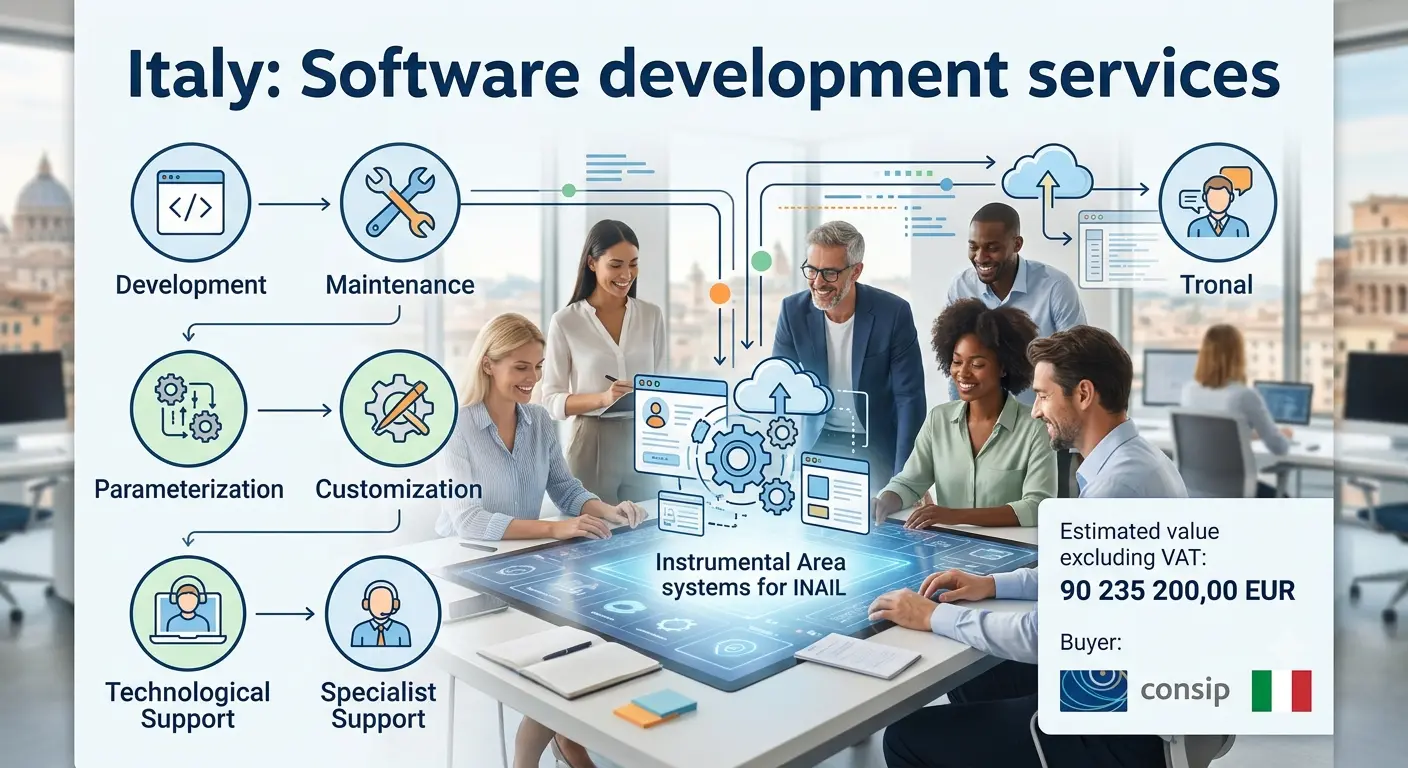
Italy's Workplace Injury Insurer Spreads a EUR 90.2 Million Software Framework Across Three Corporate Consortia
16 Oct 2026
Standfirst Behind every national insurance institute sits a layer of software that must keep working while rules and demands change. Italy's central purchasing body Consip has now put three large consortia under contract to maintain and develop that layer for INAIL. The framework carries a ceiling of EUR 90,235,200.00 and guarantees none of it to any supplier. Introduction Public institutions rarely win attention for their software. Yet the systems that record cases and process payments are often the difference between a service that works and one that stalls. When those systems age or need adjusting to new rules the institution needs skilled people on call. INAIL is the Italian national institute for insurance against workplace accidents. Its purchasing was handled by Consip S.p.A. under the procedure labelled ID 2898. The notice describes the subject as the second edition of a framework for the Area Strumentale systems. The contracting authority has not disclosed what the Area Strumentale systems contain in detail. Why This Contract Matters Software support for a national insurer is a long running need rather than a one off project. Applications must be corrected and extended while the technology around them shifts. A framework lets the buyer secure that capacity without tendering every task separately. The scale also matters. A ceiling of EUR 90.2 million is large for software services. It is a ceiling and not a budget commitment. Contract Timeline 09/07/2026: the winners were chosen. 30/09/2026: the contracts with RTI Enterprise and RTI Almaviva were concluded. 01/10/2026: the contract with RTI Accenture was concluded. 15/10/2026: the notice was dispatched. 16/10/2026: the notice was published in the Official Journal of the European Union. Between winner selection and signature lies a gap of 83 days for two consortia and 84 days for the third (editorial calculation). The notice says an appeal may be lodged with the regional administrative court within 30 days of publication in the Italian national public contracts database. The date of that national publication is not given. An editorial projection of the deadline is therefore not possible from the notice alone. The contract duration and any renewal terms are also undisclosed. Contract Overview The notice records a single lot. Parameterisation means configuring existing software to the buyer's needs without rewriting it. Consip ran an open procedure and concluded a framework agreement with more than one supplier and without reopening competition. Three groupings were appointed. The notice states the maximum value of the framework as EUR 90,235,200.00 and the estimated value as the same figure. Key Contract Details BuyerConsip S.p.A. (for the benefit of INAIL) WinnersRTI Accenture S.p.A. (lead) group; RTI Enterprise Services Italia S.r.l. (lead) group; RTI Almaviva S.p.A. (lead) group TitleID 2898 Inail AQ Strumentale edizione 2 (original Italian title: Accordo Quadro per l'acquisizione di servizi di sviluppo, manutenzione, parametrizzazione e personalizzazione di software, supporto tecnologico e supporto specialistico sui sistemi dell'Area Strumentale) ProcedureOpen procedure; framework agreement without reopening of competition Legal basisDirective 2014/24/EU and Italian legislative decree 36/2023 CPV72262000 Software development services Estimated valueEUR 90,235,200.00 excluding VAT Awarded valueNo separate awarded value is stated. Tender values total EUR 90,235,200.00 (editorial calculation) Ceiling or maximumEUR 90,235,200.00 Award criteria and weightsBest price quality ratio. The contracting authority has not disclosed the weights. Duration and renewalsThe contracting authority has not disclosed this information. Tenders received5 EU fundingNot financed with EU funds GPACovered by the Government Procurement Agreement SubcontractingYes for all three winners. Value and percentage not known in the structured fields. Declared shares for two groupings appear in the additional information. Key datesWinners chosen 09/07/2026. Contracts concluded 30/09/2026 and 01/10/2026. Published 16/10/2026 Place of performanceRoma (ITI43) Italy Review bodyTribunale Amministrativo Regionale per il Lazio Roma Project Scope The services cover software development and maintenance and parameterisation and customisation. They also cover technology support and specialist support on the systems concerned. The notice gives no volumes or application names. The contracting authority has not disclosed this information. The model is built around ongoing support and not a single delivery. About the Contracting Authority Consip S.p.A. is the buyer named in the notice. It is classed as a body governed by public law with general public services as its activity. It is based in Roma. Consip is widely known as Italy's national central purchasing body and buys on behalf of other public administrations. The title states that the framework is for the benefit of INAIL. The notice gives INAIL no separate role as a contracting party. A multi supplier framework suits a central purchaser because it sets the rules once and lets the end user order work later. About the Organisations Involved The notice names three winning groupings known in Italian as RTI. This stands for raggruppamento temporaneo di imprese or temporary grouping of companies. In each case the lead company is described as mandataria. The notice classes each grouping as a large economic operator. It does not state the responsibilities of individual members. RTI Accenture S.p.A. This grouping is led by Accenture S.p.A. with Sistemi Informativi S.r.l., Webgenesys S.p.A., IBM Italia S.p.A., Avanade Italy S.r.l., Deloitte Consulting S.r.l. Società Benefit, Intellera Consulting S.p.A. and Leonardo S.p.A. as members. Its tender value is EUR 45,117,600.00. The contract was concluded on 01/10/2026. The grouping is registered at an address in Milano. The notice records subcontracting as present and does not give shares. RTI Enterprise Services Italia S.r.l. This grouping is led by Enterprise Services Italia S.r.l. with EY Advisory S.p.A., CSA S.c.p.a., Digital360 Goc S.r.l., Net Service S.p.A. and Link Management and Technology S.p.A. as members. Its tender value is EUR 27,070,560.00 and its contract was concluded on 30/09/2026. The additional information states declared subcontracting shares of 50% for software maintenance and repair services and 50% for IT support services. RTI Almaviva S.p.A. This grouping is led by Almaviva S.p.A. with Consorzio Reply Public Sector, Deda Next S.r.l., Indra Italia S.p.A., KPMG Advisory S.p.A. and Datamanagement S.p.A. as members. Its tender value is EUR 18,047,040.00 and its contract was concluded on 30/09/2026. The notice states declared shares of 49% for specialist technical and application support and 70% for the other development and maintenance services. Tribunale Amministrativo Regionale per il Lazio Roma This regional administrative court is the review body. Suppliers that wish to challenge the award must bring the matter before it within the 30 day window described above. The notice does not name the two unsuccessful tenderers. The contracting authority has not disclosed this information. One data point deserves a flag. The contact email shown for the Enterprise grouping carries an Almaviva address and the notice does not explain it. Procurement Analysis Consip used an open procedure. Any qualified company could bid. The notice cites a framework without reopening of competition and allows one or more operators. The result is three suppliers sharing one ceiling. Competition was real but narrow. Five tenders were received and three were selected. The award criterion is best price quality ratio. The notice does not give the split between price and quality. The contracting authority has not disclosed this information. The values need care. The three tender values are EUR 45,117,600.00 and EUR 27,070,560.00 and EUR 18,047,040.00. They sum to EUR 90,235,200.00 (editorial calculation). They equal exactly 50% and 30% and 20% of the ceiling (editorial calculation). They therefore look like allocated shares of the ceiling and not prices offered by each bidder. The notice does not confirm this interpretation. The ceiling is not guaranteed supplier revenue. The original estimate and the framework maximum are identical and no separate awarded spend exists. The notice does not say how work will be distributed in practice. Frameworks without reopening usually rely on pre agreed rules such as ranking or rotation. The contracting authority has not disclosed this information here. Additional Procurement Facts The procedure identifier is 74e888f9 1e43 4bf1 8bd0 1b847d45fee3 and the internal reference is ID 2898. The procedure is not accelerated and no dynamic purchasing system applies. The procurement is covered by the GPA and is not financed with EU funds. The notice level maximum matches the sum of the lot value so no total discrepancy arises. The additional information quotes one CPV code with seven digits for software maintenance. This looks like a typing slip and the notice does not clarify it. Market and Industry Perspective All three winning groupings are classed as large operators and each combines many companies. The members range from software houses to advisory firms and technology groups. This mix suggests that public IT frameworks of this size reward bidders able to assemble broad capability under one lead company. For suppliers outside these groupings the route to work is indirect. Subcontracting is the open door. Two groupings have declared shares that point to meaningful use of outside providers (editorial analysis). The actual volume of subcontracted work is not known. Economic Significance A ceiling of EUR 90.2 million supports a significant pool of skilled IT work in and around Roma. The notice gives no duration so no annual figure can be offered. Future Procurement Opportunities The title calls this the second edition. That signals a recurring approach. A later edition may follow when the ceiling is used or the term ends (editorial analysis). The notice gives no dates so timing cannot be projected. The more immediate opportunities lie in subcontracting under the three groupings. Specialist application support is the area where one grouping has declared a share of 49%. Opportunities for Suppliers Smaller software and support firms can approach the three lead companies. Skills in maintenance and application support appear closest to the declared subcontracting lines. What Businesses Should Watch Watch the national contracts database for the publication that starts the 30 day appeal window. Watch also for how the three groupings are given work. That will show whether the shares in the notice are firm allocations. ItalyTenders.com Procurement Intelligence This award reflects a trend in European public IT buying toward multi supplier frameworks for continuing services. The buyer secures capacity and avoids dependence on a single contractor. The suppliers accept that appointment is only a licence to deliver and not a promise of revenue. The award matters because it concentrates a large share of INAIL's software support among three well resourced groupings. It also shows a pattern where advisory firms and technology groups bid side by side. A supplier reading this should note that membership of a strong grouping appears to count as much as individual scale. Positioning therefore starts before the tender. Companies should build relationships with likely lead bidders and prepare a clear specialist offer. Future editions may add reopening of competition (editorial analysis). Supplier Takeaways Appointment to a framework does not guarantee work. Consortium strength appears decisive in large public IT frameworks. Subcontracting is the practical entry route for smaller firms. Specialist application support is an area with declared outside capacity. Key Takeaways The framework ceiling is EUR 90,235,200.00 excluding VAT. Three consortia were appointed after five tenders. No reopening of competition applies between the suppliers. Tender values equal shares of 50% and 30% and 20% of the ceiling (editorial calculation). Conclusion This notice shows how a central purchaser can organise ongoing software support for a national institution. Three consortia now hold places in a framework that could be worth up to EUR 90.2 million. How much work actually flows to each will depend on rules the notice does not reveal. For the market the message is clear. Capability is bought in groups and long term demand is steady for firms that can join the right team. Source: Tenders Electronic Daily (TED), Contract Award Notice 716863 2026, Official Journal of the European Union, OJ S issue 201/2026, published on 16/10/2026.
View Details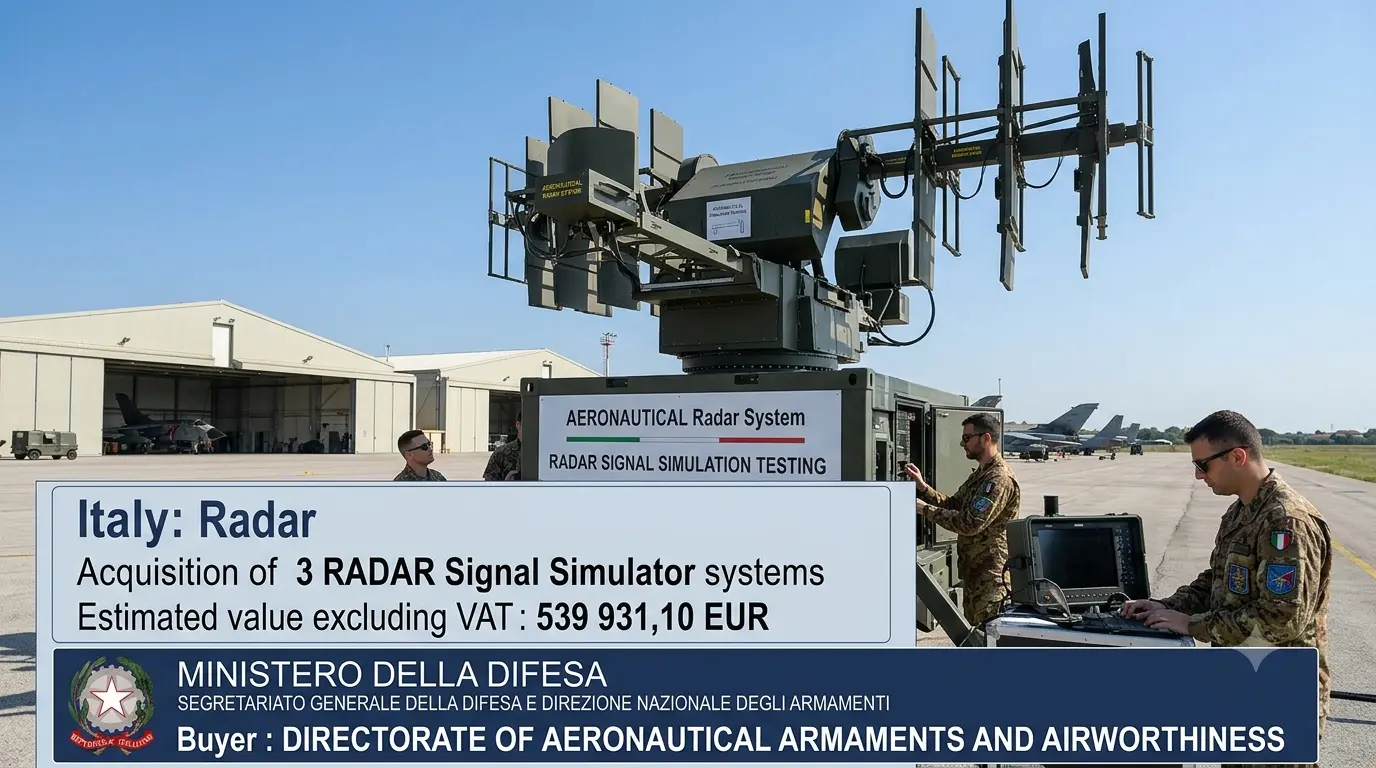
Italian Aeronautical Armaments Directorate Closes Failed Radar Signal Simulator Tender for C-130J Fleet
15 Oct 2026
Standfirst The Italian Directorate of Aeronautical Armaments and Airworthiness has closed a procurement for radar signal simulators without selecting a winner. The tender aimed to acquire three systems for the C-130J fleet. A critical data contradiction exists in the notice regarding the number of bids received versus the stated reason for cancellation. Introduction Modern military transport aircraft require advanced electronic warfare training capabilities to ensure mission success. The Italian Armed Forces rely on realistic simulation to maintain crew proficiency against evolving radar threats. This procurement addressed the specific need to acquire three radar signal simulators for the C-130J aircraft line. Executed through an other multiple stage procedure under defence directives this tender sought to balance technical complexity with competitive pricing. Publishing such contract updates on the official Tenders Portal provides vital market intelligence for defence contractors. It illustrates how public procurement navigates the challenges of acquiring highly specialized military simulation equipment. The strategic allocation of capital toward simulation infrastructure reflects a long term commitment to force readiness. Supply chain impact is concentrated on firms possessing the necessary security clearances and technical certifications. This ensures that critical defence training assets remain supported by validated industrial partners. Why This Contract Matters Operational readiness is the primary driver for this acquisition. Radar Warning Receiver and Electronic Support Measure simulators form the core of electronic warfare training. Failure to provide adequate simulation environments can delay crew certification and compromise mission safety during actual deployments. The failure to secure a winning bid highlights the niche nature of the defence simulation sector. It suggests that the barriers to entry for military radar simulation are substantial. These barriers include stringent technical requirements and the need for established track records with armed forces. This procurement outcome drives continuous improvement through procedural review. By formally closing the competition the buyer must now reassess the technical specifications or budget allocations. This structured approach ensures that future iterations will better align with market capabilities and realistic pricing. Contract Timeline The competition was formally closed without a winner selection date. The notice was published in the Official Journal of the European Union on 15/10/2026. The review deadline is set at 30 days from the publication date to allow for potential appeals. The estimated duration for the contract was 10 months with no renewal options. The absence of a contract conclusion date confirms the complete termination of this specific procurement cycle. Future attempts will require a new timeline and updated procedural notices. Contract Overview This agreement was intended to cover the acquisition of three radar signal simulators. The total estimated value was 539,931.10 EUR. The arrangement was planned as a specific contract rather than a framework agreement. Supplier responsibilities included the delivery of the simulation systems alongside a comprehensive training session. The scope also required a 24 month initial logistics support period with an option to extend the warranty and help desk services by 12 months. Key Contract Details Contract Titleacquisizione di n 3 sistemi RADAR Signal Simulator per la stimolazione degli apparati Radar Warning Receveir RWR ed Electronic Support Measure ESM della linea C 130J Contracting AuthorityDIREZIONE DEGLI ARMAMENTI AERONAUTICI E PER L’AERONAVIGABILITÀ Contract Value539,931.10 EUR (Estimated) Procedure TypeOther multiple stage procedure Number of Bids Received0 (stated reason) / 3 (statistical section) Winner(s)None (Competition closed) Contract Conclusion DateNot applicable Main CPV Code35722000 Radar Project Scope The deliverables encompassed three radar signal simulators designed to stimulate Radar Warning Receiver and Electronic Support Measure apparatuses. The systems were specifically targeted for the C-130J aircraft line to ensure accurate threat replication. Technical requirements demanded strict adherence to military aviation standards. The geographic scope of performance was centered in Rome Italy. The contractor was also responsible for providing on site hardware and software support on call throughout the support period. About the Contracting Authority The buyer is the Directorate of Aeronautical Armaments and Airworthiness. This central government authority manages procurement activities for the Italian Air Force. Its primary responsibility is ensuring the armed forces possess the necessary equipment to fulfill defence mandates. It operates under strict national and European public procurement regulations specific to the defence sector. About the Organisations Involved DIREZIONE DEGLI ARMAMENTI AERONAUTICI E PER L’AERONAVIGABILITÀ Acting as the primary buyer this entity oversees defence acquisitions. It ensures all procurement activities comply with applicable legal frameworks and security requirements. TAR LAZIO This body functions as the review organisation. It provides oversight and handles any potential disputes or appeals related to the procurement process ensuring legal compliance. Procurement Analysis The other multiple stage procedure resulted in a closed competition without a winner. A critical data quality issue must be flagged regarding the bid count. The winner selection status explicitly states that no tenders requests to participate or projects were received. However the statistical information section reports that three tenders were received. This direct contradiction in the official notice requires careful interpretation. It may indicate that three entities expressed interest or submitted preliminary documents but none were deemed admissible or complete by the evaluation committee. The award criteria relied on the most economically advantageous tender. The buyer evaluated proposals based on qualitative and quantitative metrics rather than lowest price alone. This structure indicates a mature procurement baseline where technical capability is prioritized over pure cost savings. Additional Procurement Facts The procurement project is not financed with European Union Funds. The legal basis for this procedure is Directive 2009/81/EC. This specific directive governs defence and security procurement across the European Economic Area. The use of this directive allows the buyer to apply specific procedures tailored to military needs. It provides the necessary flexibility for acquiring critical defence infrastructure while maintaining core principles of transparency and equal treatment. Market and Industry Perspective The military simulation sector operates under unique constraints regarding technical complexity and security. Suppliers must maintain specialized engineering teams and secure facilities to handle classified tactical data. This creates high barriers to entry and naturally limits the number of active bidders in any given tender process. Future RFPs and RFQs in this domain will likely continue to emphasize the integration of advanced electronic warfare scenarios. Suppliers must align their proposals with detailed BOQs and respond promptly to GPNs. The market will reward firms that can demonstrate both technical excellence and strict adherence to operational requirements. Economic Significance This contract was intended to inject direct financial value into the Italian defence technology sector. It would have supported specialized software engineering jobs and sustained advanced technical capabilities within the domestic industrial base. The multiplier effect extends beyond the primary contractor. Local hardware providers and specialized logistics firms would have benefited from the sustained operation of this critical system. The current failure temporarily stalls these economic benefits for the Rome region and surrounding supply chains. Future Procurement Opportunities The most immediate opportunity lies in the expected retendering of this requirement. Suppliers interested in defence simulation should actively monitor the official Tenders Portal. Tracking Active Tenders and Live Notices for Tenders is essential for capturing early market intelligence on revised requirements. Military branches across the region are likely to issue similar requirements as they modernize their training infrastructure. Companies should prepare to respond to upcoming live tender opportunities by maintaining updated security certifications and clear capacity statements. Opportunities for Suppliers The contract structure creates immediate opportunities for niche equipment manufacturers. Firms offering specialized hardware components or advanced software modules can position themselves as valuable partners through subcontracting arrangements. Building relationships with prime contractors before a tender is announced is a highly effective strategy. Suppliers must monitor Latest Active Tenders Procurement updates to identify these collaborative opportunities early and align their service offerings with market needs. What Businesses Should Watch Industry participants must track the enforcement of quality criteria in future awards. Shifts in the weighting between price and technical merit signal changing buyer priorities in defence simulation and evolving training methodologies. Observing government defence budget allocations is also critical. Increases in virtual training funding will directly correlate with a higher volume of public procurement notices in the simulation sector. This will create new tenders opportunities across the armed forces. ItalyTenders.com Procurement Intelligence Strategic trend analysis reveals a clear shift toward virtual and simulation based training in European defence procurement. Buyers are moving away from exclusive reliance on live exercises and specifying simulator upgrades that offer superior tactical preparation at a fraction of the operational cost. The importance of this notice lies in its demonstration of budgetary or technical friction in public procurement. When a competition closes without a winner it highlights the critical need for buyers to conduct rigorous market soundings before committing to fixed specifications for rapidly evolving technology sectors. The future evolution of this market will likely incorporate stricter interoperability mandates with allied air networks. Defence contractors will need to prove that their simulation solutions meet both national security protocols and allied interoperability requirements. This will drive innovation in secure software architecture. Supplier Takeaways Specialized defence simulation markets often yield failed outcomes due to high technical barriers and restrictive specifications. Data contradictions in official notices require careful verification during market analysis and bid preparation. Quality criteria focusing on technical merit directly address the operational risk of inadequate training environments. Suppliers must maintain strict security certifications and specialized engineering teams to participate in future public procurement. Key Takeaways The estimated contract value was 539,931.10 EUR for three radar signal simulators. The competition was closed without a winner due to a stated lack of received tenders. A critical data discrepancy exists as the statistical section reports three received tenders despite the cancellation reason. The award criteria relied on the most economically advantageous tender rather than lowest price alone. The procurement is governed by Directive 2009/81/EC for defence and security acquisitions. Conclusion This failed procurement highlights the complex intersection of military training requirements and specialized market capacity. The expected retendering of this requirement will be a critical event for suppliers monitoring the European defence simulation sector. Source: Tenders Electronic Daily (TED), Contract Award Notice 713724-2026, Official Journal of the European Union, published on 15/10/2026.
View Details