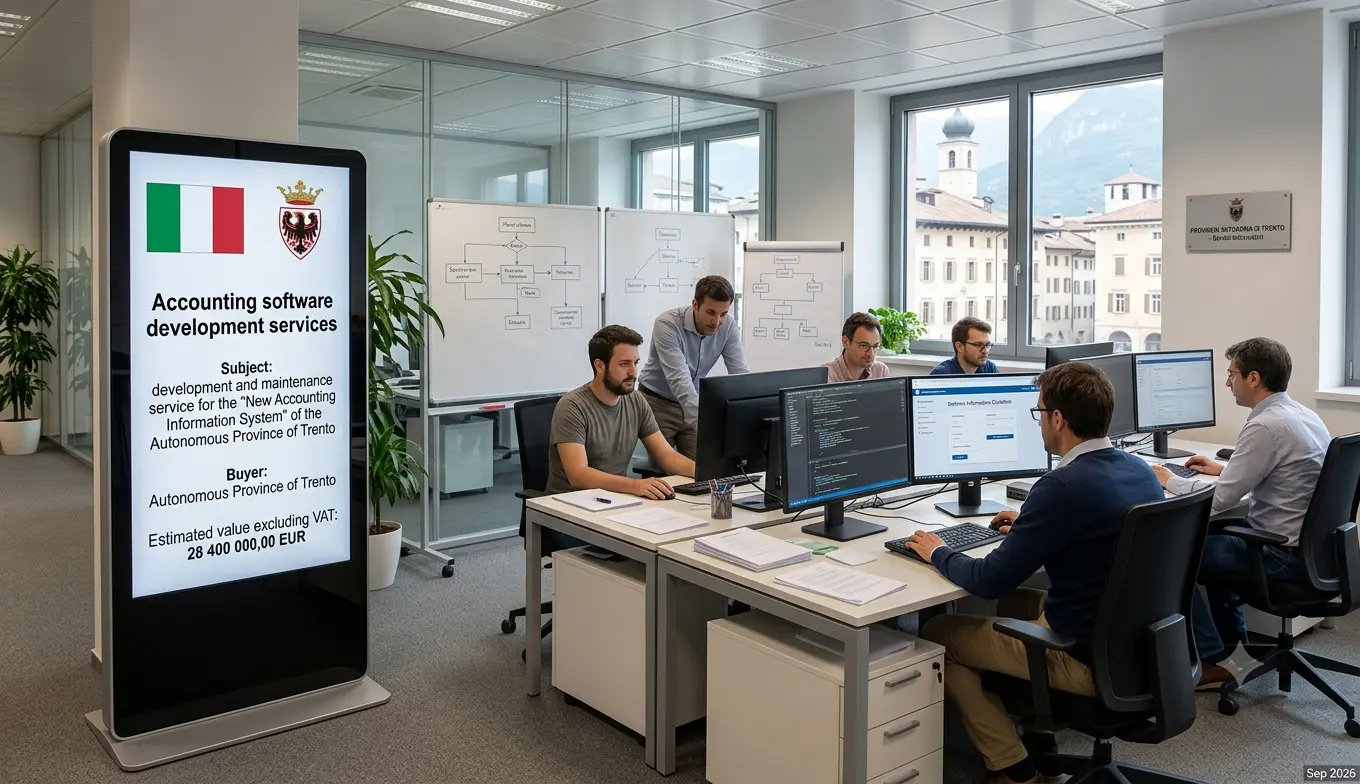
GPI and EY Secure 14.5 Million Euro Accounting Software Contract for Trento Province
15 Sep 2026
Standfirst A consortium led by GPI S.P.A. and including EY SPA has been awarded a major contract to develop and maintain a new accounting information system for the Autonomous Province of Trento. The agreement carries a total awarded value of 14.5 million euros and is partially funded by the European Regional Development Fund. This tender result highlights the ongoing digital transformation of regional public administration in Italy through competitive negotiated procedures. Introduction The modernization of public sector financial management systems represents a critical priority for regional governments across Europe. In Italy, the Autonomous Province of Trento has initiated a targeted procurement strategy to replace legacy financial software with a modern, integrated accounting information system. This recent contract award ensures that the provincial administration can manage public funds with greater transparency, efficiency and alignment with contemporary digital standards. By executing this procurement through a restricted procedure with negotiation, the contracting authority ensured that only prequalified vendors with proven expertise could participate. The selected consortium will be responsible for the complete lifecycle of the software, from initial development to long term maintenance and support. This holistic approach guarantees that the new system will be fully tailored to the specific regulatory and operational needs of the provincial government. Why This Contract Matters This procurement is vital for ensuring that the provincial administration can process financial data accurately and securely. The development of a new accounting information system directly supports broader national strategies to enhance digital governance and improve public service delivery. For the domestic IT sector, securing a position in this high value public procurement validates the technical capabilities of the awarded firms. It also demonstrates how public funds are actively deployed to upgrade critical administrative infrastructure and promote sustainable digital growth. Contract Timeline The procurement process concluded with the formal selection of the winning bidder on September 9, 2026. Following standard administrative procedures and mandatory standstill periods, the formal contract was signed on September 14, 2026. The official contract awards notice was published in the Official Journal of the European Union on September 15, 2026. This timeline reflects a streamlined acquisition process typical for well defined software development projects in the Italian public sector. Contract Overview The agreement covers the development and maintenance of the new accounting information system for the Autonomous Province of Trento. The total value of contracts awarded in this notice is 14.5 million euros, with the winning consortium securing a tender value of 7.25 million euros. The supplier is responsible for ensuring all delivered software meets the strict technical and regulatory specifications outlined in the procurement documents. This turnkey service model places the responsibility for maintaining operational security and regulatory compliance squarely on the awarded consulting firms. Key Contract Details Contract Title Invito dal Bando PI174360-25 Contracting Authority Provincia Autonoma di Trento Total Awarded Value 14,500,000.00 EUR Procedure Type Restricted procedure with negotiation Number of Bids Received 6 Winners RTI GPI S.P.A. and EY SPA Contract Conclusion Date September 14, 2026 Main CPV Code 72212443 (Accounting software development services) Project Scope The core scope involves the development and ongoing maintenance of the new accounting information system for the provincial government. The project requires the supplier to deliver a fully functional software solution that integrates seamlessly with existing provincial databases and complies with Italian public accounting regulations. The contractor must also provide continuous technical support, system updates and user training for provincial staff. This extensive responsibility requires the winning bidder to possess strong project management capabilities and deep familiarity with local public sector financial workflows. About the Contracting Authority Provincia Autonoma di Trento is the primary buyer for this procurement. It is a regional public authority responsible for managing general public services and administrative functions within the autonomous province of Trento, Italy. About the Organisations Involved Provincia Autonoma di Trento is the contracting authority and buyer. It manages regional public services and drives the procurement of specialized IT systems to modernize provincial administration. GPI S.P.A. is the leader of the successful tendering consortium and a large economic operator. It specializes in information technology services and software development for public and private clients, bringing significant operational capacity to this award. EY SPA is a member of the successful tendering consortium and a large economic operator listed on a regulated market. The company provides extensive expertise in business consulting, auditing and technology integration, complementing the technical delivery capabilities of the consortium leader. Tribunale regionale di giustizia amministrativa di Trento is the review organisation. This regional administrative court handles any legal appeals or disputes related to public procurement procedures in the Trento region, ensuring fair competition. ANAC AUTORITA NAZIONALE ANTICORRUZIONE is the procurement service provider. This National Anti-Corruption Authority oversees the integrity of public procurement processes in Italy and provides guidance on regulatory compliance. Publications Office of the European Union acts as the TED eSender. It is responsible for the official publication of procurement notices to ensure transparency and equal market access across the European continent. Procurement Analysis The restricted procedure with negotiation attracted six bids, demonstrating focused competition in the Italian public sector IT market. The evaluation criteria balanced financial proposals with technical expertise, assigning an 80 percent weight to technical merit and a 20 percent weight to price. This balanced evaluation method indicates that the baseline technical requirements were strict, ensuring that only highly capable firms with proven track records could advance to the financial scoring phase. Consequently, the competition focused on delivering optimal value without compromising the quality of the software architecture or the expertise of the human resources provided. Additional Procurement Facts The procurement is not covered by the Government Procurement Agreement, reflecting its status as a domestic regional contract governed primarily by Italian national legislation and EU Directive 2014/24/EU. The project is fully or partially financed with European Union funds under the European Regional Development Fund Programme 2021 to 2027. Market & Industry Perspective The Italian public sector software market remains highly competitive, with agile technology firms leveraging their specialized knowledge to secure major government contracts. The requirement for a negotiated procedure reflects a broader industry trend toward collaborative problem solving, allowing buyers to refine technical specifications with prequalified vendors before final bids are submitted. Suppliers must continuously update their certifications, methodologies and security protocols to meet evolving compliance standards outlined in public procurement documents. The dominance of large economic operators in this space suggests that future RFPs and RFQs will continue to favor established contractors with proven financial stability and extensive technical resources. Economic Significance An investment of 14.5 million euros represents a targeted injection of capital into the domestic IT consulting and software development sector. This supports high skilled jobs in software engineering, system architecture and technical support within Italy, fostering local technological sovereignty. By retaining these specialized services within the national economy, the public sector stimulates the growth of local technology hubs and ensures that critical expertise remains available to defend against cyber threats targeting public infrastructure. Future Procurement Opportunities Suppliers who were not successful should monitor the official Tenders Portal for upcoming digital transformation and software renewals in other Italian regional administrations. As regulatory requirements tighten, public institutions will continuously generate new tenders opportunities for compliance auditing, network defense and secure cloud migration services. Stakeholders should also track the Latest Active Tenders Procurement notices to anticipate upcoming infrastructure projects in the broader European technology sector. The dynamic nature of public procurement means that new Live Notices for Tenders will emerge as regional authorities update their data privacy requirements and seek to modernize their legacy IT environments. Opportunities for Suppliers While the primary development contract has been awarded, specialized training providers, niche software vendors and cybersecurity laboratories can find valuable subcontracting opportunities with the primary winners. Companies offering automated threat intelligence feeds, secure endpoint detection platforms, or specialized data migration tools may also position themselves to complement the manual consulting services and enhance the overall security posture of the contracting authority. What Businesses Should Watch Industry observers should closely monitor the deployment timeline of the new accounting system to gauge the actual integration challenges facing Italian regional administrations. The performance of the winning consortium in meeting the strict technical and security requirements will set a benchmark for future live tender announcements requiring embedded IT personnel and managed detection capabilities. Stakeholders should also review Live Notices for Tenders to anticipate upcoming data privacy modernization projects funded by national programs or European recovery funds. Additionally, businesses should watch for any legal challenges filed with the review organisation, although none are indicated in the current notice. ItalyTenders.com Procurement Intelligence This contract represents a clear and accelerating trend in European public procurement toward the strategic outsourcing of complex software development to specialized consortia. By weighting the award criteria heavily toward technical merit at 80 percent, the contracting authority signaled that functional capability and architectural design are far more critical than marginal cost savings. This approach is highly effective for mission critical administrative systems, allowing public buyers to secure high quality solutions that ensure long term operational stability and regulatory compliance. Strategically, this award is important because it demonstrates how regional authorities can leverage European Union funding to accelerate digital transformation initiatives. Suppliers can learn that forming joint ventures or temporary associations of enterprises is often necessary to meet the stringent financial and technical qualification thresholds of large scale IT projects. To position themselves for future contracts, relevant suppliers should focus on demonstrating deep domain expertise in public sector accounting and proven track records in system integration. Future contracts in this market are likely to evolve by incorporating stricter data sovereignty and cybersecurity mandates alongside traditional functional requirements. As public institutions face increasing pressure to protect sensitive financial data, companies that proactively develop secure, cloud native architectures and offer transparent supply chain practices will hold a distinct advantage. Suppliers must also prepare for increased scrutiny on subcontracting arrangements, making robust governance and compliance tracking essential for future public procurement success. Supplier Takeaways Embedded technical expertise and managed software services are increasingly prioritized over standalone software licensing in public sector IT procurement. Consortium formation is essential for competing in large scale software development tenders to meet combined financial and technical thresholds. Evaluation criteria balancing price and technical experience require suppliers to maintain high staff certification levels to pass initial qualification gates. Subcontracting opportunities exist for niche software vendors and specialized training providers supporting the primary consortium winners. Key Takeaways A consortium led by GPI S.P.A. and including EY SPA won the 14.5 million euro accounting software contract. The procurement covers the development and maintenance of a new accounting information system for the province. Six bids were received, indicating focused competition among domestic and European IT service providers. The award criteria were balanced at 80 percent technical merit and 20 percent price. The project is partially financed with European Union funds under the FESR 2021 to 2027 programme. Conclusion This contract secures vital technical intelligence and rapid deployment capabilities for a historic Italian regional authority. The transparent procurement process ensures optimal value for public money while supporting the domestic IT consulting industry and safeguarding the financial data of the provincial administration. Source: Tenders Electronic Daily (TED), Contract Award Notice 633493-2026, Official Journal of the European Union, published on 15/09/2026.
View Details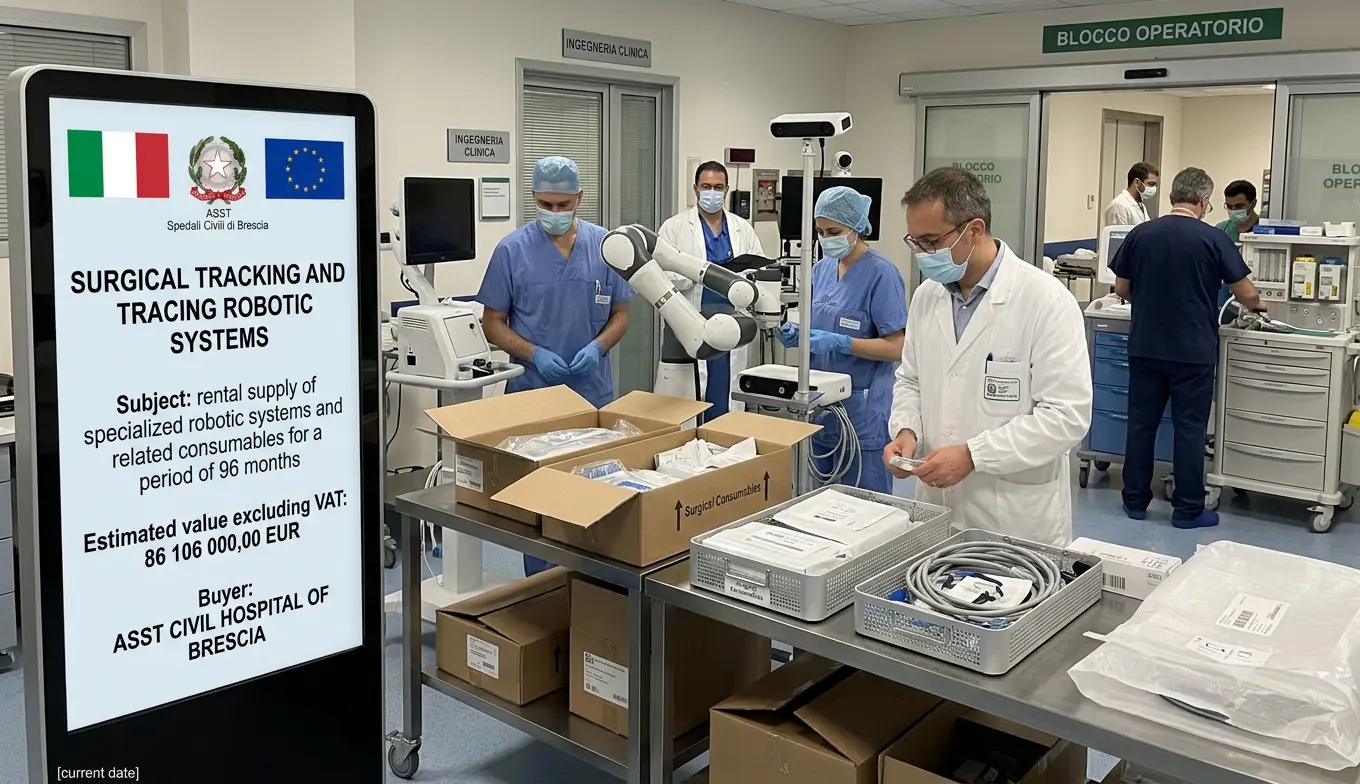
Brescia's Civil Hospitals Secure an Eight-Year Deal for Single-Port Robotic Surgery
14 Sep 2026
Standfirst ASST Spedali Civili di Brescia, one of Italy's largest hospital trusts, has awarded AB Medica SpA a framework agreement worth up to 30.76 million euros for the rental supply of a multi-specialist robotic surgical system using single-access technology, together with its related consumables, over an eight-year term. The tender attracted only one bidder, and the agreement includes a clause allowing another major Italian hospital to join later. Introduction Surgical robotics has moved from novelty to necessity in many of Europe's leading hospitals, and nowhere is that shift more visible than in the growing demand for single-access, or single-port, systems, platforms that let surgeons operate through a single small incision rather than the several ports traditional laparoscopic robotic surgery requires. Fewer incisions generally mean less trauma, faster recovery and reduced scarring for patients undergoing procedures across a range of specialties. ASST Spedali Civili di Brescia, the public hospital trust serving Italy's Lombardy region from its base in Brescia, has just secured exactly this kind of technology through a long-term rental arrangement rather than an outright purchase, a structure increasingly common for hospitals seeking to keep pace with rapidly evolving robotic surgery platforms without locking themselves into owning equipment that may be superseded within a few years. Why This Contract Matters This is not a simple equipment purchase. It is a framework agreement running for 96 months, eight full years, structured as a rental arrangement covering both the robotic system itself and its ongoing consumable supplies, the disposable components single-access robotic surgery depends on for every procedure. Renting rather than buying gives the hospital trust flexibility to manage a rapidly advancing technology category without the capital risk of ownership, while still securing guaranteed access to the platform and its consumables for the better part of a decade. The contract also carries a notable clause allowing IRCCS San Matteo di Pavia, another significant Italian research hospital, to subsequently adhere to the same agreement on the same terms, a structure that could see this single procurement exercise ultimately extend robotic surgical capability to a second major hospital without either institution needing to run its own separate competitive tender. Contract Timeline The winner was selected and the contract concluded on the same date, 10 September 2026. The notice recording this award was dispatched on 10 September 2026 and published in the Official Journal of the European Union on 14 September 2026, under OJ S issue 177/2026. The lot's service period runs from 1 January 2026 to 31 December 2033, an eight-year term that had already effectively begun before this specific award notice was formally published, with an option for a further twelve-month extension available beyond that. Contract Overview ASST Spedali Civili di Brescia ran an open procedure under Directive 2014/24/EU and Italy's national procurement code, Legislative Decree 36/2023, for a framework agreement covering the rental supply of specialist robotic systems and related consumables over a 96 month period. The classification is CPV code 33169500, Surgical tracking and tracing systems. The overall procedure, which appears to cover multiple lots beyond the one addressed in this notice, carries an estimated value and maximum framework value of 86,106,000.00 EUR excluding VAT. This specific notice covers Lot 5, titled "Sistema robotico multispecialistico con tecnologia a singolo accesso", a multi-specialist robotic system using single-access technology. Its estimated value and maximum framework ceiling is 30,756,000.00 EUR excluding VAT. The buyer's own additional notes clarify that this estimated value is calculated to account for every possible contractual option set out in the tender documents, including the potential twelve-month extension and the subsequent adhesion clause for IRCCS San Matteo di Pavia, which is why the figure sits considerably higher than the base auction value used to actually run the competitive tender. Only one tender was received for this lot. The winning bid, from AB Medica SpA, came in at 7,691,013.38 EUR, a figure dramatically lower than the 30.76 million euro ceiling, reflecting the difference between a framework's theoretical maximum value across every contractual scenario and the actual signed contract value reflecting realistic anticipated usage by Brescia's hospital trust alone. Key Contract Details Contracting AuthorityASST Spedali Civili di Brescia Winning BidderAB Medica SpA Contract TitleOpen procedure for a framework agreement for rental supply of specialist robotic systems and related consumables, 96 months Lot CoveredLot 5, Multi-specialist robotic system with single-access technology Procedure TypeOpen procedure, not accelerated Legal BasisDirective 2014/24/EU and Italian Legislative Decree 36/2023 CPV Code33169500 Surgical tracking and tracing systems Overall Procedure Estimated/Maximum Value (excl VAT)86,106,000.00 EUR Lot 5 Estimated/Maximum Framework Value (excl VAT)30,756,000.00 EUR Actual Awarded Tender Value (excl VAT)7,691,013.38 EUR Award CriteriaMost economically advantageous tender, Quality 70 points, Price 30 points Framework StructureFramework agreement without reopening of competition Service Period1 January 2026 to 31 December 2033 (96 months) OptionsPossible 12 month extension; subsequent adhesion clause for IRCCS San Matteo di Pavia Tenders Received1 SubcontractingNo EU FundingNot financed with EU funds Covered by GPAYes Winner Selected / Contract Concluded10 September 2026 Review OrganisationTAR Lombardia, Sezione di Brescia Project Scope The contract covers the rental supply, rather than outright purchase, of a multi-specialist robotic surgical system built around single-access technology, together with the related consumables the system requires to remain operational across the full eight-year term. Single-access, or single-port, robotic platforms are designed to allow complex minimally invasive procedures to be performed through one small incision rather than the multiple ports required by earlier generations of robotic and laparoscopic surgery, a distinction that matters clinically for patient recovery time, cosmetic outcome and infection risk. The description "multispecialistico" indicates the system is intended to support procedures across several surgical specialties rather than being limited to a single clinical application, giving the hospital trust flexibility in how it deploys the technology across its surgical departments over the contract's long term. About the Contracting Authority ASST Spedali Civili di Brescia ASST Spedali Civili di Brescia is registered as a body governed by public law with health as its classified activity, based in Brescia in Lombardy. It is one of Italy's largest hospital trusts, operating the Spedali Civili hospital complex, a major academic and clinical centre serving a substantial population across northern Italy. Its procurement decisions in advanced surgical technology carry weight both for its own clinical capability and, through mechanisms like the adhesion clause included in this contract, for other hospitals that may subsequently draw on the same agreement. About the Organisations Involved AB Medica SpA AB Medica SpA, based in Cerro Maggiore in the Milan area, won this contract as the sole tenderer, with its bid formally ranked first and confirmed at 7,691,013.38 EUR. No subcontracting was declared, meaning AB Medica will deliver both the robotic system and its ongoing consumable supply directly over the contract's eight-year life. AB Medica is an established Italian medical technology company with a specific focus on advanced surgical and robotic systems, a niche segment of the broader medical device distribution market. TAR Lombardia, Sezione di Brescia The Tribunale Amministrativo Regionale della Lombardia, Brescia section, is named as the review organisation for this procurement, the standard body for hearing challenges to public procurement decisions in this part of Lombardy. Review deadline information in the notice simply refers bidders to the applicable statutory provisions rather than specifying a fixed number of days directly. Procurement Analysis This procurement was decided through a most economically advantageous tender methodology weighting quality at 70 points against price at just 30, a heavily technical evaluation that reflects how central clinical performance, safety and system capability are when a hospital is committing to a specific robotic surgery platform for the better part of a decade. In advanced surgical technology of this kind, the practical difference between competing systems, precision, range of compatible procedures, ergonomics for the surgical team and long term reliability, tends to matter far more to the buyer than marginal differences in rental price. Only one tender was received for this lot, an outcome that is not unusual in the specialised market for single-access robotic surgical platforms, where the number of manufacturers capable of offering a genuinely multi-specialist system with this specific single-port capability remains relatively small globally. A single bidder scenario in this kind of technically demanding, clinically specific procurement often reflects genuine market concentration rather than any flaw in how the tender itself was structured or advertised. The substantial gap between the lot's 30.76 million euro ceiling and the 7.69 million euro actual awarded value is worth understanding correctly rather than treating as any kind of inconsistency. The buyer's own additional notes explain this directly: the ceiling figure was deliberately calculated to cover every possible contractual scenario disclosed in the tender documents, including the potential twelve month extension option and, critically, the possibility that IRCCS San Matteo di Pavia exercises its right to adhere to the same contract later. The actual signed contract value reflects only Brescia's own anticipated usage as things currently stand, a much more modest, realistic figure. This is precisely the kind of framework agreement structure where readers should treat the ceiling as a theoretical maximum rather than assume the hospital trust is committing to spend anywhere near that amount. Additional Procurement Facts The contract is not financed with EU funds and is covered by the Government Procurement Agreement, meaning suppliers registered in GPA member countries outside the EU were also entitled to compete for this contract. No framework agreement reopening of competition mechanism applies, and no dynamic purchasing system is used. The procurement was run through Sintel, the Lombardy Region's telematic intermediation platform, with results published both on the hospital trust's own website and on the Sintel platform itself. Under article 120 of Italy's Legislative Decree 36/2023, the contract permits certain contractual modifications without requiring a new procurement procedure, regardless of the value involved, giving both parties some built in flexibility to adjust specific terms as the eight-year relationship progresses. Payment terms follow the operational instructions issued by ANAC, Italy's National Anti-Corruption Authority. Market and Industry Perspective Single-access robotic surgery represents one of the more technically advanced and commercially concentrated segments of the global medical device market, dominated by a handful of manufacturers capable of delivering platforms with genuine multi-specialty applicability through a single incision point. AB Medica's position as sole bidder for this specific lot reflects both its established relationship with Italian public hospitals in advanced surgical technology and the genuinely narrow field of credible competitors for this precise technical specification. The rental structure adopted here, rather than outright capital purchase, also reflects a broader trend across European public hospital systems, where the pace of innovation in robotic surgery makes long term ownership commitments increasingly risky compared with rental or managed service arrangements that build in review points and extension options rather than locking a hospital into a single generation of technology for its full useful life. Economic Significance At an actual signed value of 7.69 million euros over eight years, this is a substantial, sustained investment in advanced surgical capability for Brescia's hospital trust, translating into a meaningful annual commitment once spread across the contract's full term. Should IRCCS San Matteo di Pavia exercise its adhesion right and join the agreement, the overall commercial scale of this contract for AB Medica could grow considerably closer to the lot's disclosed 30.76 million euro ceiling, though that outcome remains contingent rather than confirmed. Future Procurement Opportunities The subsequent adhesion clause built into this contract is the clearest near term development worth watching, since it could bring a second major Italian hospital, IRCCS San Matteo di Pavia, into the same agreement without any further competitive procurement process. The disclosed twelve month extension option is a further point to monitor as the contract's initial eight-year term approaches its 2033 conclusion. Opportunities for Suppliers Given the single bidder outcome and the specialised, technically demanding nature of single-access multi-specialty robotic surgery, direct competitive opportunity for other suppliers on this specific contract has now passed. However, manufacturers developing comparable single-port robotic platforms should watch closely for how this contract's adhesion mechanism and eventual renewal unfold, since Italian public hospital demand for this category of technology shows clear signs of expanding rather than contracting. What Businesses Should Watch Surgical robotics manufacturers and distributors should watch for whether IRCCS San Matteo di Pavia exercises its adhesion right under this contract, and should monitor how ASST Spedali Civili di Brescia's other lots within this same 86.1 million euro overall procedure are eventually resolved, since this notice covers only one part of a considerably larger multi-lot robotic surgery framework. ItalyTenders.com Procurement Intelligence This award offers a clear window into how Italian public hospitals are managing the genuinely rapid pace of change in surgical robotics, choosing long term rental commitments with built in flexibility rather than outright capital purchase, and structuring contracts with adhesion clauses that let other hospitals piggyback on a single competitive process rather than each running its own separate, resource intensive tender. Its strategic importance lies in what the heavily quality weighted evaluation and single bidder outcome together reveal about this specific technology category. With quality carrying more than double the weight of price, and only one manufacturer coming forward with a qualifying bid, this segment of surgical robotics remains a genuinely specialised, concentrated market where clinical capability and proven reliability, not competitive pricing pressure, are what actually determine which supplier a major hospital trust chooses to work with for the better part of a decade. Suppliers evaluating whether to enter this segment of the Italian public hospital market should recognise that success here depends less on undercutting an incumbent on price and more on developing genuinely differentiated single-access robotic technology capable of clearing the kind of rigorous, quality dominant evaluation processes Italian hospital trusts are now running for this category of equipment. The adhesion clause structure used in this specific contract is also worth studying closely, since it offers a template other Italian public hospital groups may increasingly adopt to extend the reach of a single successful procurement across multiple institutions without duplicating the administrative and clinical evaluation effort each time. Supplier Takeaways Quality carried 70 of 100 available points, with price weighted at just 30, reflecting the clinical priority placed on proven surgical capability Only one tender was received, consistent with the genuinely narrow global field of manufacturers offering multi-specialty single-access robotic platforms The contract's 30.76 million euro ceiling reflects every possible contractual scenario, not the actual 7.69 million euro signed value A subsequent adhesion clause could extend this same contract to IRCCS San Matteo di Pavia without a further competitive tender The rental structure, rather than outright purchase, reflects a broader European hospital sector shift away from capital ownership of rapidly evolving robotic technology Key Takeaways ASST Spedali Civili di Brescia has awarded AB Medica SpA a framework agreement for single-access robotic surgery, with a lot ceiling of 30,756,000.00 EUR and an actual signed value of 7,691,013.38 EUR The contract runs for 96 months, from January 2026 to December 2033, with a possible 12 month extension Only one tender was received for this lot, and the contract was concluded on 10 September 2026 A subsequent adhesion clause allows IRCCS San Matteo di Pavia to potentially join the same agreement Award criteria weighted quality at 70 points against price at 30 points Conclusion This award gives Brescia's civil hospitals a long term route to advanced single-access robotic surgery capability, secured through a rental structure that balances clinical ambition against the practical risk of committing capital to a fast moving technology category. For AB Medica, it is a significant, multi year engagement that could grow further still if a second major Italian hospital chooses to join the same agreement. For Italy's broader surgical robotics market, this contract is a clear signal that quality and proven clinical capability, not price competition, remain the decisive factors in how the country's leading public hospitals choose their robotic surgery partners. Source: Tenders Electronic Daily (TED), Contract Award Notice 630994 2026, Official Journal of the European Union, OJ S issue 177/2026, published on 14/09/2026.
View Details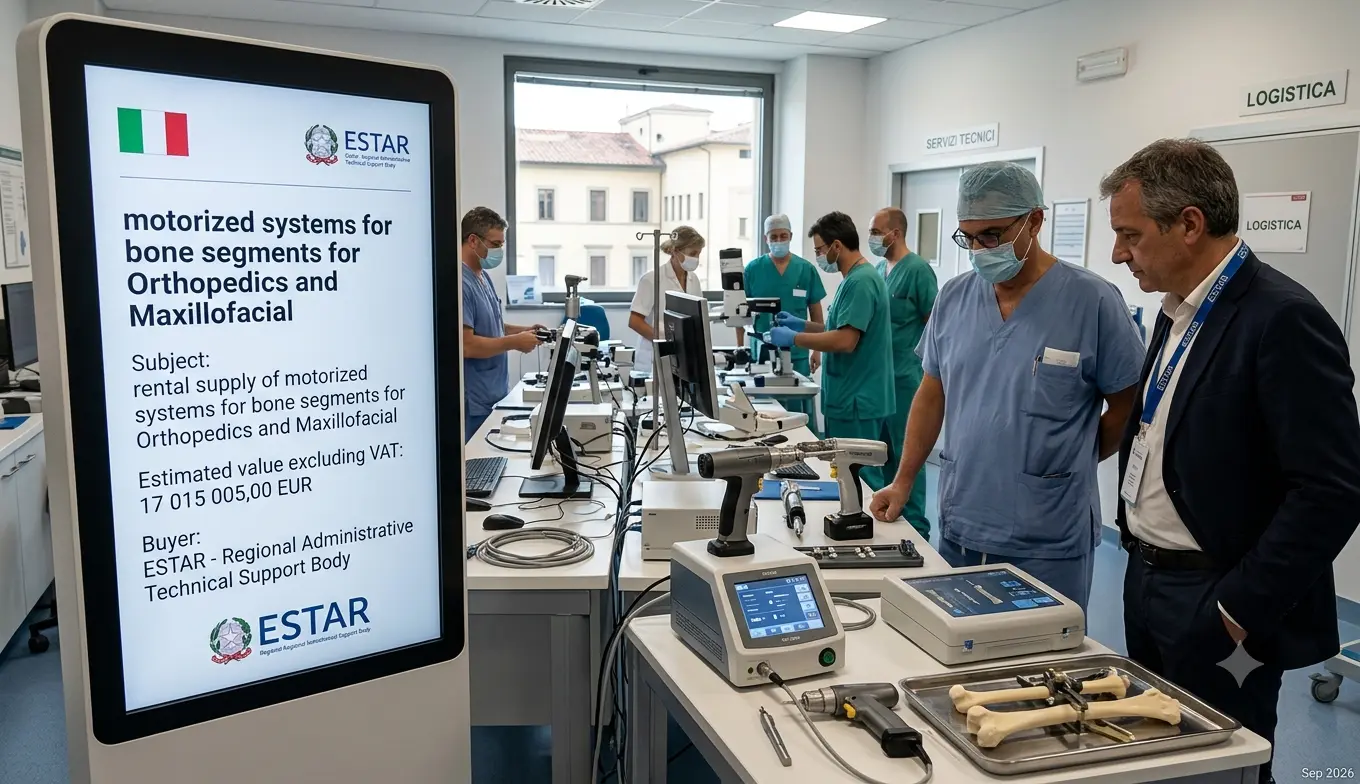
Stryker Sweeps Tuscany's Surgical Motor System Rental Contract, Sharing One Lot With J&J
11 Sep 2026
Standfirals ESTAR, Tuscany's regional healthcare support body, has awarded a four year framework worth a combined 8.6 million euros for rented motorized bone-cutting systems used in orthopedic and maxillofacial surgery. Stryker Italia won all three lots outright or in part, sharing the largest lot with Johnson & Johnson Medical. Introduction Orthopedic and maxillofacial surgeons rely on precisely engineered motorized tools to cut, shape and reposition bone during procedures ranging from joint replacement to facial reconstruction. Rather than buying this equipment outright, many Italian regional health systems rent it through long term framework agreements that bundle in maintenance and technical support. Tuscany's regional health support agency has just closed exactly this kind of framework, securing rental supply of these motorized bone cuttign systems for its hospitals and for a neighbouring health authority in the Marche region. Why This Contract Matters This framework keeps operating theatres across the Tuscany Regional Health Service and at AST Ancona in the Marche region, equipped with the specialised motorized instruments surgeons need for bone segment procedures in orthopedics and maxillofacial surgery. Renting rather than purchasing this equipment allows the health system to keep pace with technology upgrades without committing to outright ownership of rapidly evolving surgical hardware. Contract Timeline The notice recording these awards was dispatched on 10 September 2026 and published in the Official Journal of the European Union on 11 September 2026, under OJ S issue 176/2026. The framework runs for four years. Contract Overview ESTAR ran an open procedure under Directive 2014/24/EU for a four year framework agreement for the rental supply of motorized bone segment systems for orthopedic and maxillofacial surgery, serving the health authorities of the Tuscany Region and AST Ancona in the Marche region. The classification is CPV code 33162000, Operating theatre devices and instruments. The overall estimated value and maximum framework value, both confirmed at 17,015,005.00 EUR excluding VAT, is split across three lots. Lot 1 covers motorized systems for large, small and medium bone segments, using battery power, estimated at 11,779,412.50 EUR, with a confirmed awarded value of 6,016,240.75 EUR and 22 tenders received. Lot 2 covers a cable powered electric motorized system for mini-fragments, estimated at 3,253,965.00 EUR, awarded at 1,657,600.00 EUR with 7 tenders received. Lot 3 covers an electric motorized system for maxillofacial procedures, estimated at 1,981,627.50 EUR, awarded at 969,450.00 EUR with 14 tenders received. Combined, the three lots total 8,643,290.75 EUR in confirmed awarded value, roughly half the overall estimated ceiling, consistent with framework agreement ceilings representing a maximum rather than guaranteed spend. Key Contract Details Contracting AuthorityESTAR - Ente di Supporto Tecnico Amministrativo Regionale Winning BiddersStryker Italia S.r.l. (Lots 1, 2, 3); Johnson & Johnson Medical S.p.A. (Lot 1) Contract TitleFour year framework agreement for rental supply of motorized bone segment systems for orthopedics and maxillofacial surgery Procedure TypeOpen procedure, not accelerated Legal BasisDirective 2014/24/EU CPV Code33162000 Operating theatre devices and instruments Overall Estimated/Maximum Framework Value (excl VAT)17,015,005.00 EUR Lot 1Large/small/medium segment battery systems; estimated 11,779,412.50 EUR; awarded 6,016,240.75 EUR; 22 tenders Lot 2Cable powered mini-fragment system; estimated 3,253,965.00 EUR; awarded 1,657,600.00 EUR; 7 tenders Lot 3Maxillofacial electric system; estimated 1,981,627.50 EUR; awarded 969,450.00 EUR; 14 tenders Combined Confirmed Awarded Value8,643,290.75 EUR Award CriteriaMost economically advantageous tender, technical score 80 points, price score 20 points Framework StructureFramework agreement without reopening of competition EU FundingNot financed with EU funds Covered by GPANo Review OrganisationTAR Toscana Project Scope The framework covers rental supply of motorized systems used to cut and shape bone during surgery. Lot 1 covers battery powered systems for both large and small to medium bone segments, the broadest category and by far the largest lot by value. Lot 2 covers a specialised cable powered electric system designed for mini-fragment procedures, typically used in more delicate reconstructive work. Lot 3 covers an electric motorized system specifically for maxillofacial surgery, addressing facial bone procedures distinct from general orthopedic applications. About the Contracting Authority ESTAR ESTAR, the Ente di Supporto Tecnico Amministrativo Regionale, is a body governed by public law controlled by a regional authority, with health as its classified activity, based in Florence. It is Tuscany's regional technical and administrative support body for the health service, running large scale procurement on behalf of hospitals and health authorities across the region and, in this case, for AST Ancona in neighbouring Marche as well. About the Organisations Involved Stryker Italia S.r.l. Stryker Italia S.r.l., based in Rome and listed on a regulated market, won all three lots in this framework, either alone or shared. Stryker is a globally recognised medical technology manufacturer with a strong presence in orthopedic and surgical instrument markets and this sweep across all three lots confirms its dominant position in Italy's motorized surgical instrument rental segment. Johnson & Johnson Medical S.p.A. Johnson & Johnson Medical S.p.A., based in Pomezia and also listed on a regulated market, won Lot 1 alongside Stryker, meaning the two companies hold parallel positions on the framework's largest lot. The notice does not explain how call-offs will be divided between them, though the framework's structure without reopening of competition suggests each supplier holds a direct, ongoing position rather than facing further competitive rounds. Procurement Analysis All three lots drew strong competitive interest, with Lot 1 attracting 22 tenders, an unusually high number for a specialised surgical equipment category, followed by 14 for Lot 3 and 7 for Lot 2. Award criteria weighted technical quality heavily, at 80 points against just 20 for price, reflecting how clinically critical this category of surgical instrumentation is; ESTAR clearly prioritised proven technical performance over cost savings. Lot 1's dual award to both Stryker and Johnson & Johnson Medical, within a framework structured without reopening of competition, is notable. Rather than a single winner serving the entire lot, two major manufacturers hold parallel positions, likely allowing individual hospitals within the served health authorities some choice between the two suppliers' specific product lines for battery powered systems. Additional Procurement Facts None of the three lots are financed with EU funds and none are covered by the Government Procurement Agreement. ANAC, Italy's National Anti-Corruption Authority, served as procurement service provider for this tender. Market and Industry Perspective Stryker's sweep across all three lots and its position as sole winner on two of them, reflects its established strength in Italy's surgical motor system market, a segment where a small number of major global medical device manufacturers, Stryker and Johnson & Johnson Medical among them, dominate due to the highly specialised, clinically validated nature of these instruments. Economic Significance At a combined 8.6 million euros in confirmed awarded value, against a 17 million euro estimated ceiling, this framework represents a significant rental commitment supporting surgical capability across Tuscany's hospital network and AST Ancona over the next four years. Future Procurement Opportunities With the framework running for four years, ESTAR is unlikely to re-tender this specific equipment category again until that term approaches expiry, offering competing manufacturers a defined future window to challenge Stryker's current dominance. Opportunities for Suppliers Medical device manufacturers specialising in surgical motor systems should note the strong 22 tender field on Lot 1, confirming genuine competitive depth in this market even though Stryker and Johnson & Johnson Medical ultimately prevailed and should prepare technically strong proposals given the 80 point weighting placed on quality. What Businesses Should Watch Surgical instrument manufacturers should watch for how call-offs are divided between Stryker and Johnson & Johnson Medical on Lot 1 over the framework's term and should monitor ESTAR's broader medical equipment rental tender pipeline for related opportunities. ItalyTenders.com Procurement Intelligence This award illustrates how Italian regional health systems secure specialised, rapidly evolving surgical technology through rental rather than outright purchase and how heavily weighted technical quality criteria, 80 points here, shape outcomes in categories where clinical performance is paramount. Its strategic importance lies in the dual award structure on Lot 1, giving hospitals served by this framework a genuine choice between two major manufacturers for its largest and most broadly applicable equipment category, rather than locking the entire framework into a single supplier relationship. Supplier Takeaways Technical quality carried 80 of 100 points across all three lots, with price weighted at just 20 Lot 1, the largest by value, was awarded to two suppliers in parallel, Stryker and Johnson & Johnson Medical All three lots drew strong competitive interest, with Lot 1 attracting 22 tenders The framework operates without reopening of competition, giving winners direct, ongoing positions rather than facing further competitive rounds Key Takeaways ESTAR has awarded a four year framework worth a combined 8,643,290.75 EUR for rented motorized bone segment surgical systems Stryker Italia won all three lots, sharing Lot 1 with Johnson & Johnson Medical The overall framework ceiling is 17,015,005.00 EUR across all lots Award criteria weighted technical quality at 80 points against price at 20 points The framework serves Tuscany's regional health service and AST Ancona in Marche Conclusion This framework keeps Tuscany's hospitals and AST Ancona equipped with essential motorized surgical instrumentation for orthopedic and maxillofacial procedures over the next four years, secured through a heavily quality weighted evaluation that ultimately favoured two of the sector's most established manufacturers. For Stryker Italia in particular, sweeping all three lots reinforces its dominant position in this specialised corner of Italy's medical device rental market. Source: Tenders Electronic Daily (TED), Contract Award Notice 626087-2026, Official Journal of the European Union, OJ S issue 176/2026, published on 11/09/2026.
View Details