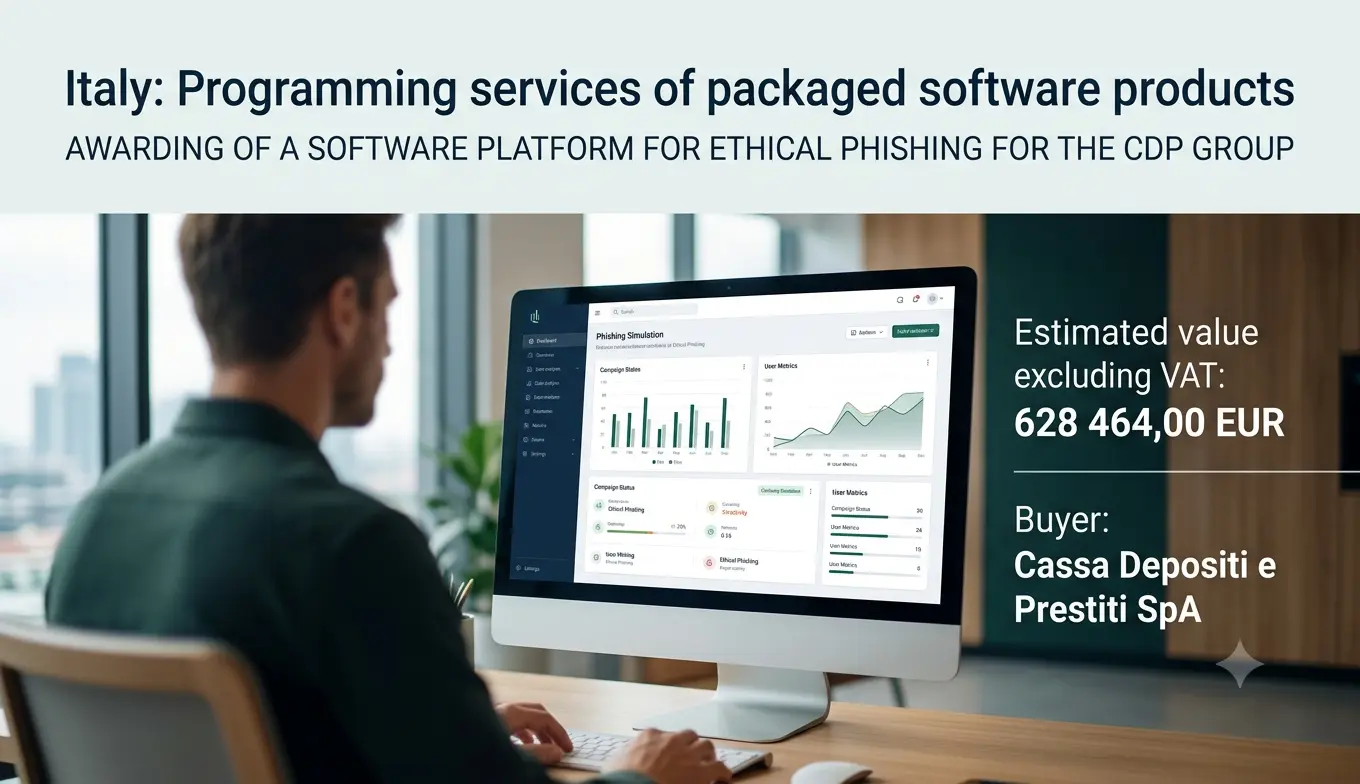
Italy's CDP Group Buys an Ethical Phishing Platform to Test Its Own Defences
13 Oct 2026
Standfirst Cassa Depositi e Prestiti, the Italian state development bank, has awarded a contract for an ethical phishing software platform to Accenture SpA. The contract is worth EUR 556,230 and runs for 90 months, making it a long-term commitment to simulated cyber attack testing across the CDP Group. Five bidders submitted offers through the official procurement portal, and the contract was awarded on the most economically advantageous tender. The platform will be used to test how employees respond to phishing attempts and to strengthen the group's human firewall. Introduction Most cyber attacks do not begin with a technical exploit. They begin with a person. An employee receives an email that looks like it comes from a colleague, a supplier or a bank. The email asks them to click a link, open an attachment or confirm a payment. If the employee complies, the attacker is inside the organisation. That technique is called phishing, and it remains one of the most effective ways into a corporate or public sector network. Defending against phishing is not only a technical problem. Firewalls and email filters catch many attempts, but some always get through. The last line of defence is the employee, and employees can be trained. That is where ethical phishing comes in. An ethical phishing platform allows an organisation to send simulated phishing emails to its own staff, measure who clicks, and use that data to target training where it is needed most. The goal is not to punish employees but to build awareness and resilience. Cassa Depositi e Prestiti, known as CDP, is Italy's national promotional institution. It is a state-controlled body governed by public law that finances infrastructure, supports Italian businesses and manages public savings. Its group includes subsidiaries operating across finance, infrastructure, venture capital and advisory services. For an institution of that kind, protecting systems and data is not optional. CDP has now awarded a contract for an ethical phishing platform to Accenture SpA. This article explains what was procured, who was involved, how the procurement was structured and what the award signals for suppliers in the Italian public sector cybersecurity market. Why This Contract Matters This contract matters because it addresses one of the most persistent vulnerabilities in any large organisation: the human factor. Technical defences can be strong, but a single successful phishing email can give an attacker access to systems, data and funds. An ethical phishing platform allows CDP to test its own staff continuously and to measure whether its security awareness training is working. It also matters because of its duration. The contract runs for 90 months, which is seven and a half years. That is an unusually long term for a software platform contract, and it signals that CDP views ethical phishing as a permanent capability rather than a one-off project. Over seven and a half years, the platform will be used repeatedly to test employees across the CDP Group, and the data it generates will inform the group's security training and policy. The contract also matters because of its scope. The title refers to the "Gruppo CDP" — the CDP Group — not just the parent company. That means the platform will be used across CDP and its subsidiaries, covering a wider population of employees and a more complex organisational structure. Group-wide security testing is more demanding than single-entity testing, because different entities may have different systems, different policies and different risk profiles. Finally, the contract matters because of the competition. Five bidders submitted offers, which is a healthy level of competition for a specialist security procurement. It shows that the Italian market for ethical phishing platforms is competitive, and that suppliers were willing to invest in bidding for a long-term contract with a major public financial institution. Contract Timeline Contract concluded: 9 October 2026 Notice dispatched: 9 October 2026 Notice published: 13 October 2026 Contract duration: 90 months Contract Overview The contract covers the supply of an ethical phishing software platform as a service for the CDP Group. It is a services contract, classified under CPV 72210000 (programming services of packaged software products). It is a single-lot procurement, identified as LOT-0001. The place of performance is Roma, postcode 00198, in the Roma NUTS region (ITI43), Italy. The estimated value excluding VAT was EUR 628,464, and the awarded value was EUR 556,230. The procurement was conducted as an open procedure under Article 71 of Italian Legislative Decree No. 36/2023, which is Italy's public contracts code. The legal basis is Directive 2014/24/EU. The contract is not a framework agreement and does not use a dynamic purchasing system. It is not financed with EU funds and is not covered by the Government Procurement Agreement. The contract duration is 90 months. The notice does not disclose a start date, but the contract was concluded on 9 October 2026, so it is likely to run into 2033 or beyond. The award criterion was the most economically advantageous tender, which means quality and price were both evaluated, though the notice does not disclose the weighting between them. Key Contract Details Notice ID 706371-2026 OJ S issue 198/2026 Publication date 13 October 2026 Contracting authority Cassa Depositi e Prestiti S.p.A. Contract type Services Main CPV code 72210000 – Programming services of packaged software products Procedure type Open procedure under Article 71 of Italian Legislative Decree No. 36/2023 Legal basis Directive 2014/24/EU Lot LOT-0001 Winner Accenture SpA Winning bid EUR 556,230.00 Estimated value excluding VAT EUR 628,464.00 Number of bids 5 Award criterion Most economically advantageous tender Contract duration 90 months Framework agreement No Dynamic purchasing system No EU funding No GPA covered No Subcontracting Not yet known Review body TAR Lazio Roma Project Scope The scope is an ethical phishing software platform for the CDP Group, delivered as a service. The notice describes the subject in Italian as "l'affidamento in servizio di una piattaforma software in ambito ethical phishing per il Gruppo CDP" — the award of a service for a software platform in the field of ethical phishing for the CDP Group. Ethical phishing platforms typically provide several core capabilities. They allow the buyer to design and send simulated phishing emails that mimic real attack techniques. They track which recipients open the email, click the link, enter credentials or report the attempt. They generate reports and dashboards that show click rates by department, by location or by individual. They integrate with security awareness training so that employees who fall for a simulation can be enrolled in targeted learning. Some platforms also include vishing simulations, smishing simulations and other social engineering techniques. The notice does not describe the specific functional requirements, the number of users, the volume of simulations, the integration requirements with CDP's existing systems, or the technical architecture. Those details would be in the procurement documents, which are not included in the TED notice. The contracting authority has not disclosed this information. The notice also does not disclose whether the platform will be hosted by the supplier or on CDP's own infrastructure, or how the service will be delivered across the different entities in the CDP Group. The contracting authority has not disclosed this information. About the Contracting Authority The buyer is Cassa Depositi e Prestiti S.p.A., known as CDP. It is classified as a body governed by public law, with economic affairs as its main activity. Its registration number is 80199230584, and its address is in Roma, postcode 00185, in the Roma NUTS region (ITI43). Its email address is cdpspa@pec.cdp.it, and its telephone number is 0642211. CDP is Italy's national promotional institution. It was established in 1850 and has evolved into a state-controlled financial institution that supports the Italian economy through a range of activities. It finances public infrastructure, supports small and medium-sized enterprises, invests in strategic sectors, and manages public savings through postal savings products. It also manages public sector financial resources and acts as a financial adviser to government bodies. The CDP Group includes a number of subsidiaries and participations, covering areas such as infrastructure financing, equity investment, venture capital, real estate, advisory services and technology. The group is large, complex and systemically important to the Italian economy, which makes its cybersecurity a matter of public interest as well as corporate interest. CDP is both the buyer and the organisation responsible for the procurement. It defined the requirements for the ethical phishing platform, ran the open procedure, evaluated the five bids and concluded the contract with Accenture SpA. It will use the platform across the group to test and improve staff resilience to phishing attacks. About the Organisations Involved Cassa Depositi e Prestiti S.p.A. CDP is the contracting authority. It is Italy's national promotional institution, a body governed by public law with economic affairs as its main activity. Its role in this procurement is as buyer and manager of the contract. It is registered in Roma, with registration number 80199230584. It operates across a wide range of financial and advisory activities, and it is the parent of the CDP Group, which is the beneficiary of the ethical phishing platform. CDP's decision to procure an ethical phishing platform reflects the growing importance of human-factor security in financial institutions. Banks and development banks are attractive targets for cyber attackers, and phishing is one of the most common ways into their systems. Accenture SpA Accenture SpA is the winning bidder. It is classified as a large economic operator. Its registration number is 13454210157, and its address is in Milano, postcode 20154. Its email address is accenture@legalmail.it, and its telephone number is 02 77751111. Accenture is a global professional services company with a large presence in Italy. It provides consulting, technology and operations services across many sectors, including financial services, public sector and defence. Its Italian subsidiary submitted the winning tender for LOT-0001, valued at EUR 556,230. It declared subcontracting as "not yet known," meaning it has not been determined whether any part of the work will be subcontracted. Accenture's role is as tenderer and winner of LOT-0001. It will provide the ethical phishing platform as a service to the CDP Group over the 90-month contract term. The notice does not disclose which specific platform or technology Accenture will use, whether it will provide its own platform or resell a third party product, or how the service will be delivered. The contracting authority has not disclosed this information. It is worth noting a data issue in the notice. Accenture SpA is recorded with a registered address in Milano, but the notice's organisation section records its country subdivision (NUTS) as Roma (ITI43) rather than Milano. That appears to be an error. The contracting authority has not explained this inconsistency. TAR Lazio Roma The Tribunale Amministrativo Regionale per il Lazio, Roma section, is listed as the review organisation and the organisation providing more information on review procedures. Its registration number is 80195990587, and its address is in Roma, postcode 00185. Its email address is rm_pat_deposito@pec.ga-cert.it, and its telephone number is 06 328721. The TAR Lazio is the regional administrative court that hears challenges to public procurement decisions in Lazio, including those by central government bodies and public law entities based in Rome. Suppliers that believe the procurement was conducted improperly can bring a case before the TAR. No complaints were recorded in this procurement. Other organisations The notice does not identify the four non-winning bidders by name. It records that five tenders were received, all submitted electronically, but only the winner is named. No consortium members, framework participants or subcontractors are disclosed. No other organisation materially affects the understanding of this award. Procurement Analysis The procurement was conducted as an open procedure under Article 71 of Italian Legislative Decree No. 36/2023. The open procedure is the standard route for a contract of this size and allows any qualifying supplier to bid. The award criterion was the most economically advantageous tender, known in Italian as "offerta economicamente più vantaggiosa." That means the evaluation considered both quality and price, though the notice does not disclose the weighting between them. In most Italian public procurement for technology services, quality carries a significant weight, often 60% to 70%, with price accounting for the remainder. But the notice does not confirm the weighting in this case. The contracting authority has not disclosed this information. Five bids were received, all submitted electronically. That is a healthy level of competition for a specialist security procurement. It suggests that the requirements were clear enough for multiple suppliers to bid, and that the contract terms were attractive enough to justify the cost of bidding. The winning bid of EUR 556,230 came in below the estimated value of EUR 628,464. The awarded value is approximately 88.5% of the estimate. That is a modest reduction, and it suggests that the estimate was realistic and that competition brought the price down slightly. The contract duration of 90 months is notable. Seven and a half years is a long commitment for a software platform service, and it means the supplier will need to sustain the platform, update it against evolving phishing techniques, and support the CDP Group over a long period. For CDP, the long term provides continuity and avoids the administrative burden of frequent re-procurement. For the supplier, it provides a predictable revenue stream and an opportunity to build a deep relationship with a major public financial institution. The contract is not covered by the Government Procurement Agreement. The notice does not explain why, but the contract is below the GPA threshold for services in most cases, which may explain the exclusion. The contract is also not financed with EU funds. The winning bidder declared subcontracting as "not yet known." That means Accenture has not yet determined whether it will subcontract any part of the work. If it does subcontract, the value, percentage and identity of the subcontractors are not disclosed in the notice. Suppliers in the security and training ecosystem may wish to watch for further disclosure. The notice does not disclose the estimated value of individual service components, the number of users covered by the platform, or how the service will be delivered across the different entities in the CDP Group. The contracting authority has not disclosed this information. Additional Procurement Facts Legal basis: Directive 2014/24/EU and Italian Legislative Decree No. 36/2023, Article 71. Procedure: Open procedure, not accelerated. Award criterion: Most economically advantageous tender. Number of bids: 5, all submitted electronically. Estimated value: EUR 628,464 excluding VAT. Awarded value: EUR 556,230. Contract duration: 90 months. EU funding: The procurement project is not financed with EU funds. GPA: Not covered by the Government Procurement Agreement. Framework agreement: None. Dynamic purchasing system: None. Subcontracting: Recorded as "not yet known." Review body: TAR Lazio Roma. Data note: The notice records Accenture SpA with a registered address in Milano but a NUTS classification of Roma (ITI43), which appears to be an inconsistency. Market and Industry Perspective The market for ethical phishing and security awareness platforms has grown substantially over the past decade. As cyber attacks have become more sophisticated and more frequent, organisations have recognised that technical defences alone are not enough. Employees need to be trained, tested and retrained. That has created a market for platforms that simulate attacks and measure human behaviour. The market includes specialist vendors, such as KnowBe4, Cofense, Proofpoint and GoPhish, as well as larger security companies and consultancies that offer ethical phishing as part of a broader service. In Italy, this market is served by a mix of international vendors, Italian security specialists and large integrators like Accenture. This procurement reflects the growing importance of human-factor security in the financial sector. Banks, development banks and other financial institutions are attractive targets for cyber attackers because they hold funds, personal data and commercially sensitive information. Regulators across Europe have increased their expectations for operational resilience, including cyber resilience, and phishing simulation is one of the tools that institutions use to demonstrate that they are managing the human risk. The 90-month duration is notable in this context. A seven-and-a-half-year commitment to an ethical phishing platform suggests that CDP views this as a permanent capability rather than a short-term project. That is consistent with the way mature security organisations operate: phishing simulation is continuous, not episodic, and the data it generates informs ongoing training and policy. The group-wide scope is also notable. CDP is not just buying a platform for its own employees. It is buying a platform for the CDP Group, which includes subsidiaries across finance, infrastructure and advisory services. A group-wide deployment is more complex than a single-entity deployment, because it must accommodate different systems, different policies and different employee populations. Suppliers bidding for similar contracts should be able to demonstrate group-wide deployment capability. The use of the most economically advantageous tender criterion is standard for Italian public procurement of technology services. It allows the buyer to weigh quality against price and to select the bid that offers the best overall value, not just the lowest cost. The notice does not disclose the weighting, but the fact that Accenture won against four other bidders suggests that its combination of quality and price was the most competitive. Economic Significance At EUR 556,230 over 90 months, this contract represents an annual value of roughly EUR 74,000. That is a modest contract in absolute terms, but its economic significance lies in what it protects: the systems, data and funds of Italy's national promotional institution. A successful phishing attack on CDP could have consequences far beyond the value of this contract. It could compromise sensitive financial data, enable fraudulent payments, disrupt operations or damage the institution's reputation. The cost of such an incident, in financial terms and in trust, would be far greater than the cost of the platform. The contract is therefore a small investment in protecting a large and systemically important institution. The contract also has a direct economic effect. The money flows to Accenture SpA, a large Italian company, and through it to any subcontractors or technology partners. Because the winner declared subcontracting as "not yet known," it is not clear how much of the economic benefit will be retained by Accenture and how much will flow to other companies. The long duration of the contract gives the supplier a predictable revenue stream over seven and a half years. That is economically significant for Accenture's Italian business, and it provides a stable base for investment in the platform and the team that supports it. The contract also has an indirect economic effect through improved security. A more cyber-resilient financial institution is better able to serve its clients and to support the Italian economy. CDP's role in financing infrastructure and supporting businesses means that its operational continuity has economic value beyond its own balance sheet. Future Procurement Opportunities The most obvious future opportunity is the renewal of this contract when the 90-month term ends. That will be in the early 2030s, depending on the exact start date. Suppliers should monitor CDP's procurement activity as that date approaches. There may also be opportunities arising from the broader security awareness and training needs of the CDP Group. If the ethical phishing platform is successful, CDP may wish to expand its security awareness programme to include additional capabilities, such as vishing or smishing simulation, deeper analytics or more extensive training integration. Those could be procured separately or added to the existing contract. More broadly, CDP and its subsidiaries have ongoing cybersecurity needs beyond phishing simulation. Suppliers with capability in security testing, incident response, threat intelligence or security training should monitor CDP's procurement activity for related opportunities. Other Italian public financial institutions and state-controlled entities have similar needs. Suppliers with a successful reference at CDP will be well positioned to bid for their work. The Italian public procurement portal and TED are the best sources for those opportunities. Opportunities for Suppliers Ethical phishing platform vendors: Suppliers with proven ethical phishing platforms and group-wide deployment experience are the most likely candidates for similar contracts. Security awareness training providers: The platform may integrate with training content, creating opportunities for specialist providers. Subcontractors: Accenture declared subcontracting as "not yet known." Suppliers with capability in phishing simulation, security training or related services may find opportunities through Accenture's supply chain. Group-wide deployment specialists: The contract covers the CDP Group, not just the parent company. Suppliers with experience deploying security platforms across complex groups are better positioned. Other Italian public financial institutions: Banks, development banks and state-controlled financial entities have similar needs. Suppliers should monitor their procurement activity. Monitoring the buyer: CDP publishes its procurement notices through the Italian public procurement portal and TED. Suppliers should monitor them for future opportunities. What Businesses Should Watch Whether subcontractors are disclosed: Accenture declared subcontracting as "not yet known." Suppliers should watch for further disclosure. Whether the contract is extended or renewed: The contract runs for 90 months. Suppliers should watch for a renewal or re-procurement as the term ends. Whether the scope is expanded: If the ethical phishing programme is successful, CDP may wish to expand it to include additional capabilities. Whether the NUTS inconsistency is corrected: The notice records Accenture SpA with a Milano address but a Roma NUTS classification. Suppliers should watch for clarification. Whether other CDP Group entities procure similar platforms: Individual subsidiaries may have their own security awareness needs. Suppliers should monitor their procurement activity. Whether the Italian ethical phishing market grows: Regulatory pressure and increasing cyber threats may drive more Italian public bodies to procure similar platforms. Suppliers should watch for a growing pipeline of opportunities. ItalyTenders.com Procurement Intelligence This contract represents a broader trend in European financial sector security: institutions are investing in continuous phishing simulation and security awareness as a core part of their cyber defence. Rather than treating employee training as an annual exercise, mature organisations are embedding phishing simulation into their everyday operations, testing staff regularly and using the data to target training where it is most needed. That shift favours platforms that can deliver continuous testing, detailed analytics and integration with training, and it disadvantages one-off training providers that cannot demonstrate measurable behaviour change. The award is strategically important because it protects a systemically important institution. CDP is Italy's national promotional institution, and it plays a central role in financing infrastructure and supporting the Italian economy. A successful cyber attack on CDP could have consequences far beyond its own operations. The contract is therefore not just a technology purchase. It is an investment in the resilience of a key part of Italy's financial architecture. Suppliers can learn several things from this procurement. First, duration matters. A 90-month contract signals that the buyer views ethical phishing as a permanent capability, not a project. Suppliers that can sustain a platform and a service relationship over many years will be better positioned than those that offer short-term engagements. Second, scope matters. The contract covers the CDP Group, not just the parent company. Suppliers must be able to deploy and support the platform across a complex group of entities. Third, competition matters. Five bidders submitted offers, which means the field was competitive and the winner had to offer a strong combination of quality and price. Fourth, integration matters. Ethical phishing platforms are most valuable when they connect to training, reporting and security operations. Suppliers that can integrate with the buyer's existing systems and processes will have an advantage. Suppliers should position themselves accordingly. Ethical phishing platform vendors should ensure they can demonstrate group-wide deployment, continuous testing and integration with training and analytics. Security awareness training providers should build partnerships with platform vendors, because that is where the work flows. Integrators like Accenture should continue to build their security portfolios, because large buyers increasingly want a single supplier for multiple security capabilities. And all suppliers should monitor CDP's procurement activity, because a successful contract is likely to generate follow-on opportunities. Future contracts in this market are likely to evolve in two directions. First, more European public financial institutions will procure ethical phishing and security awareness platforms, driven by regulatory expectations and the growing sophistication of attacks. Second, the scope of those contracts will broaden, covering not just email phishing but also voice phishing, SMS phishing and other social engineering techniques. Suppliers that can offer a comprehensive simulation capability, backed by strong analytics and training integration, will be well positioned. Suppliers that offer only a narrow point solution will find themselves squeezed out of a market that increasingly expects breadth as well as depth. Supplier Takeaways Cassa Depositi e Prestiti awarded a 90-month contract for an ethical phishing platform to Accenture SpA. The contract value is EUR 556,230, against an estimated value of EUR 628,464. Five bidders submitted offers, all electronically. The award criterion was the most economically advantageous tender. The contract covers the CDP Group, not just the parent company. The 90-month duration signals that CDP views ethical phishing as a permanent capability. The winning bidder declared subcontracting as "not yet known." The contract is not a framework agreement, not a dynamic purchasing system, not EU-funded and not GPA-covered. The review body is TAR Lazio Roma. The notice records Accenture SpA with a Milano address but a Roma NUTS classification, which appears to be an inconsistency. Key Takeaways Cassa Depositi e Prestiti S.p.A., Italy's national promotional institution, awarded a contract for an ethical phishing software platform to Accenture SpA. The contract value is EUR 556,230, against an estimated value of EUR 628,464. The contract runs for 90 months and covers the CDP Group. Five bidders submitted offers through an open procedure under Italian Legislative Decree No. 36/2023. The award criterion was the most economically advantageous tender. The platform will be used to simulate phishing attacks and test employee resilience across the group. The contract is not a framework agreement, not a dynamic purchasing system, not EU-funded and not GPA-covered. The winning bidder declared subcontracting as "not yet known." The review body is TAR Lazio Roma. The notice contains a data inconsistency: Accenture SpA is recorded with a Milano address but a Roma NUTS classification. Conclusion Cassa Depositi e Prestiti has taken a long-term step to strengthen its defences against one of the most persistent cyber threats: phishing. The contract, worth EUR 556,230 over 90 months, gives the CDP Group access to an ethical phishing platform that will test employees continuously and generate data to improve security awareness. The award went to Accenture SpA after competition from five bidders. The contract is significant not because of its value, which is modest, but because of what it protects. CDP is Italy's national promotional institution, and its systems, data and funds are systemically important. A successful phishing attack could have consequences far beyond the institution itself. The platform is therefore an investment in resilience, not just a technology purchase. For suppliers, the contract reinforces the importance of duration, group-wide scope and integration in the ethical phishing market. For CDP, the challenge will be to use the platform effectively over seven and a half years, keeping pace with evolving attack techniques and ensuring that the data it generates translates into real improvements in employee behaviour. The notice leaves some questions unanswered, including the weighting of the award criteria and the future of subcontracting, but the core award is clear: Accenture will provide the platform, and CDP will use it to test and strengthen its human firewall. Source: Tenders Electronic Daily (TED), Contract Award Notice 706371-2026, Official Journal of the European Union, OJ S 198/2026, published on 13 October 2026.
View Details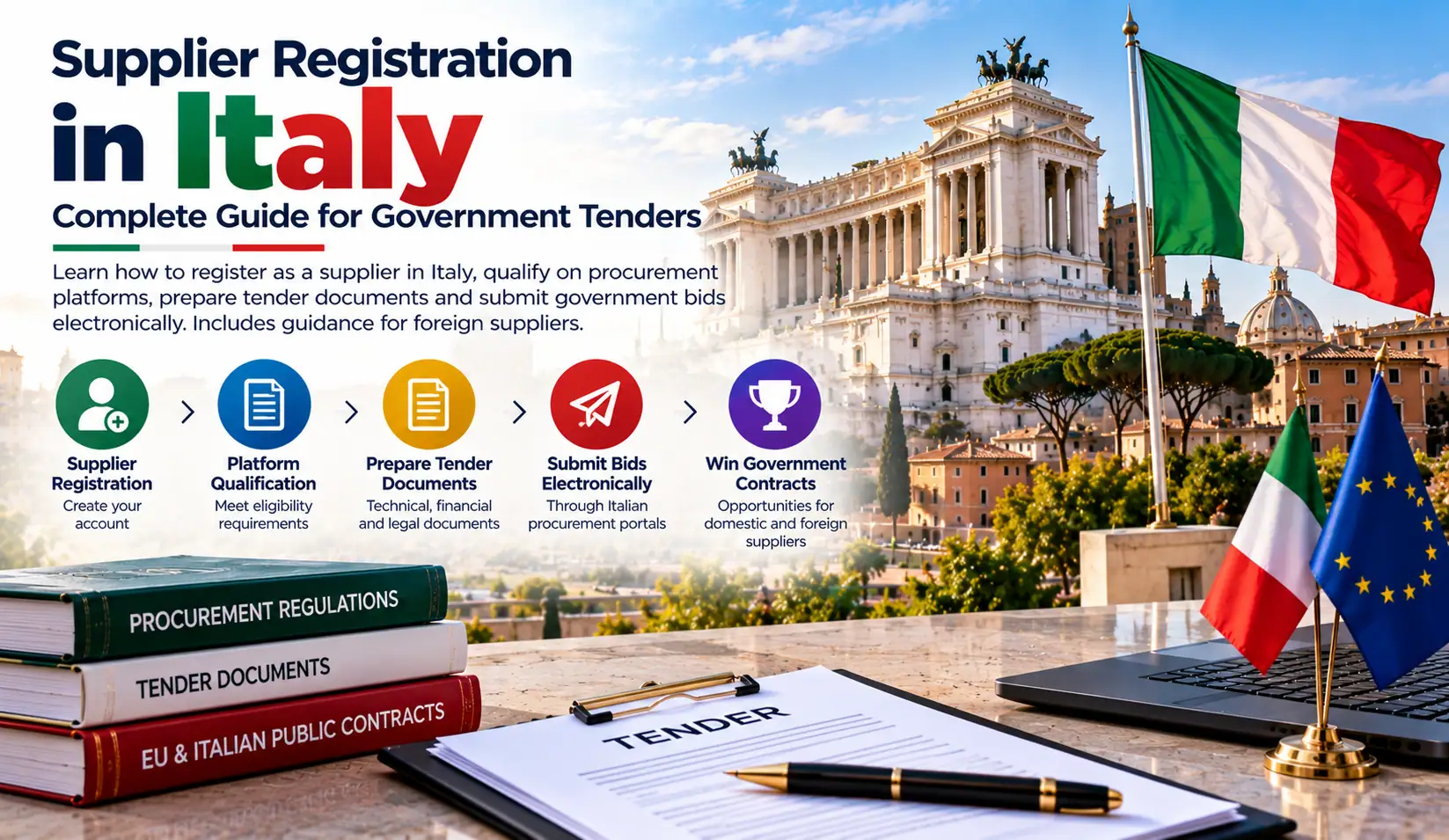
How to Register and Submit a Tender in Italy
12 Oct 2026
Introduction Registering as a supplier and submitting a public tender in Italy involves several steps, from identifying the correct procurement platform to preparing company documents, meeting participation requirements and submitting a compliant electronic bid. The exact process depends on the contracting authority, the type of contract, the procurement procedure and the digital platform specified in the tender documents. For companies searching for how to register for Italy government tenders, Italy supplier registration, how to bid for Italian public contracts or partecipare a una gara d'appalto, understanding the difference between general platform registration and qualification for a specific procurement mechanism is essential. Italy's public procurement system operates through certified digital procurement platforms connected to the national procurement infrastructure managed by ANAC. Suppliers may encounter public-authority tender portals, Consip and Acquisti in Rete PA, MEPA, SDAPA, regional platforms and European-level procurement notices published through TED. There is no single registration that automatically gives a company access to every Italian public tender. A supplier may need to register on the platform specified by the contracting authority, complete additional qualification steps and satisfy the requirements of each individual procedure. This guide explains how to prepare for the Italian procurement market, register on relevant platforms, understand supplier eligibility, prepare tender documentation, submit an electronic bid and avoid common errors. It is intended as a practical starting point; the official tender documents and applicable rules always take precedence. Table of Contents Understand Supplier Registration in Italy Choose the Correct Procurement Platform Prepare Your Company Before Registration Digital Identity and Electronic Access Register as a Supplier Complete Vendor Qualification Find a Suitable Tender Read the Tender Documents Check Eligibility and Qualification Requirements Prepare the Tender Submission Submit the Bid Electronically What Happens After Submission? Registration for Foreign Suppliers Common Registration and Bidding Errors Italy Tender Submission Checklist Use Procurement Intelligence to Find Opportunities Conclusion Understand Supplier Registration in Italy Supplier registration in Italian public procurement generally means creating and activating an account on the electronic platform required for a particular procurement activity. Depending on the platform, the supplier may also need to complete a company profile, provide business information, select procurement categories or apply for qualification. Three activities should be distinguished: User registration: establishing an account or digital identity to access a procurement platform. Supplier qualification or enablement: completing the platform-specific process required to participate in certain purchasing mechanisms or categories. Tender participation: submitting the documents and bid required for a particular procurement procedure. These steps are related, but completing one does not necessarily complete the others. For example, the official Acquisti in Rete PA guidance distinguishes user registration from vendor qualification for MEPA and SDAPA. Qualification requirements depend on the procurement instrument and the supplier's intended activity. Likewise, registration on a commercial tender-search service is not the same as registering on an official procurement platform. Tender discovery helps a company identify opportunities; the official platform specified in the tender documents is where it must follow the applicable participation and submission process. Choose the Correct Procurement Platform Before registering, identify the platform used for the tender you intend to pursue. The platform should be confirmed from the official notice, procurement documents or contracting authority's instructions. Platform or sourcePurpose for suppliers Contracting authority's e-procurement platformAccess the relevant procedure, documents, clarifications and electronic submission functions. Acquisti in Rete PAParticipate in relevant national electronic purchasing instruments and procedures. MEPAAccess applicable electronic marketplace purchasing activities after meeting the relevant requirements. SDAPAParticipate in relevant dynamic purchasing system procedures following the applicable qualification process. Regional e-procurement platformAccess procurement managed through the relevant regional or local system. TEDDiscover European-level procurement notices and follow the participation instructions for the individual procedure. Italy's digital procurement framework requires contracting authorities to use certified digital procurement platforms for the relevant procurement lifecycle activities. These platforms interoperate with ANAC's national procurement infrastructure. The specific platform used for an opportunity can therefore be different from the website where a supplier first discovered the notice. See ANAC's digitalisation guidance. Do not assume that every tender published in Italy must be submitted through MEPA, or that registering with ANAC alone enables a company to bid in every procedure. Follow the specific tender instructions. Prepare Your Company Before Registration Preparing company information before opening a supplier account can reduce delays and help avoid inconsistencies between registration records and bid documents. Depending on the company, platform and procurement procedure, information that may be requested includes: Legal company name and registered address. Company registration details and relevant tax identification information. Details of the legal representative or authorised user. Business activity, products and services offered. Contact details and the designated contact person. Banking or payment information where required for the relevant process. Evidence of professional, technical or financial capability where applicable. Relevant certifications, licences or sector-specific authorisations. Declarations concerning eligibility and exclusion grounds, as required by the procedure. This is a preparation checklist, not a universal mandatory document list. The contracting authority and platform determine which fields and documents are required. Some information may be collected electronically or verified through interoperable public systems rather than uploaded manually. Make sure the company's legal name, identification details and representative information are consistent across its registration profile, declarations and bid documents. Inconsistencies can create avoidable verification problems. Digital Identity and Electronic Access Electronic identity is an important part of Italy's digital public procurement environment. The authentication method available to a supplier depends on the platform, the user's status, the country of origin and the service being accessed. Suppliers may encounter the following identity and access methods: SPID: Italy's Public Digital Identity System. CIE: the Italian Electronic Identity Card. CNS: the National Services Card. eIDAS: recognised electronic identification for eligible cross-border users and services. Platform-specific credentials: accounts or additional authentication methods accepted by the relevant system. Not every method is available to every supplier or on every platform. Some services may require a recognised digital identity, while other platforms provide specific access procedures for foreign users. Authentication requirements can also change as digital procurement rules and platform implementations evolve. Before beginning registration, consult the official platform's current access instructions. Confirm whether the person operating the account must authenticate personally, whether the company must be associated with the user profile and whether any authorisation or representation requirements apply. Do not assume that creating a username and password alone is sufficient to submit a tender electronically. Register as a Supplier Although interfaces vary, the supplier registration process commonly follows a sequence of practical steps. Open the official platform: use the link provided by the contracting authority or the official platform website. Select the appropriate access route: choose the relevant digital identity or registration option. Create or access the user account: complete the requested personal or professional profile information. Associate the user with the company: provide the required business details and confirm the user's authority to act for the economic operator. Complete verification: follow any identity, company or authorisation checks required by the platform. Review the supplier profile: confirm that the company's details are accurate and the account is active. Proceed to any required qualification: if the procurement instrument requires a separate application, complete it before attempting the relevant activity. For suppliers using Acquisti in Rete PA, the official guidance sets out separate stages for user registration and vendor qualification where MEPA or SDAPA participation requires it. Read the current instructions before starting: Acquisti in Rete PA supplier registration guide. Keep a record of the registered account, the authorised users, relevant notifications and any qualification status. Account activation alone should not be treated as confirmation that a supplier is qualified for every category or tender. Complete Vendor Qualification Vendor qualification is the process of demonstrating that a supplier meets the requirements for a platform, purchasing instrument or procurement category. It is distinct from creating a basic user account. For MEPA or SDAPA, suppliers should consult the relevant call for qualification, category requirements and official guidance. The documents and information required depend on the instrument and the categories for which the supplier wants to qualify. Qualification may involve describing the goods or services offered, supplying business information, making required declarations and meeting category-specific conditions. The precise process must be checked against the current platform rules. Some tenders may also impose additional participation conditions even where the supplier already has a qualified account. A supplier must therefore assess both its platform status and its eligibility for the individual procedure. For public works, relevant qualification requirements may include SOA certification depending on the contract and applicable rules. Other sectors can have their own professional licences, technical standards or authorisations. For detailed platform-specific instructions, see the official Acquisti in Rete PA portal and its current supplier guidance. Find a Suitable Tender Once the company understands the registration and qualification requirements, the next step is to identify a procurement opportunity that fits its capabilities. Search for tenders using relevant product and service keywords, Italian procurement terminology, CPV codes, target regions, contracting authorities and contract values. Italian terms such as gare d'appalto, bandi di gara and appalti pubblici can be useful alongside English search terms. Review the notice to identify the procurement subject, estimated value, procedure type, participation conditions, deadline and the platform through which the bid must be submitted. Then open the full official documentation rather than relying only on the search result or summary. Businesses can start their opportunity research through Italy tender search. The objective is to identify relevant opportunities before investing time in document preparation. A tender is worth pursuing only if the company has sufficient delivery capability, can meet the relevant requirements and has enough time to prepare a complete and compliant submission. Read the Tender Documents Italian tender documentation can contain several documents with different purposes. The exact names and structure vary by procedure, but suppliers may encounter a bando di gara (tender notice), disciplinare di gara (tender rules or instructions), capitolato or technical specifications, forms, declarations, draft contracts and other attachments. Before preparing the bid, identify: The contracting authority and procurement reference. The scope of the works, supplies or services. Eligibility conditions and exclusion grounds. Technical and financial qualification requirements. The documents required from the bidder. The evaluation method and award criteria. The submission deadline and electronic submission procedure. Rules for pricing, lots, alternatives and variants, where applicable. Clarification procedures and any published amendments. Contract terms, delivery requirements and performance obligations. Do not rely solely on the notice's summary. The complete tender documents explain the requirements that govern participation and evaluation. If the documents are amended or clarifications are published, review them before final submission. Check Eligibility and Qualification Requirements Before bidding, establish whether the company meets the requirements of the particular procedure. Depending on the tender, these can include legal eligibility, professional suitability, technical capability, financial standing, previous experience, licences, certifications and other specified conditions. Some requirements relate to the supplier's general capacity, while others are specific to the contract. A company might be eligible to operate in a sector but still lack the experience, certification or financial capacity required by a particular tender. Carefully review declarations relating to exclusion grounds and any requested supporting evidence. Where the tender uses FVOE or other official verification mechanisms, follow the relevant requirements and instructions. For joint bids, consortia or subcontracting arrangements, check the applicable rules and the responsibilities of each participating party. Do not assume that one partner's qualifications automatically satisfy every requirement for the group. If the eligibility requirements are unclear, use the official clarification procedure before the stated deadline. An internal review by the company's legal, commercial and technical teams can help identify issues before the bid is submitted. Prepare the Tender Submission A tender submission should be prepared against the exact requirements of the procurement documents. Depending on the procedure, a bid may include administrative documentation, technical proposals, a financial offer and supporting evidence. Administrative submission: may include participation applications, declarations, company information, evidence of eligibility, authorisations and other requested documents. Technical submission: may describe the proposed solution, delivery approach, methodology, staffing, technical compliance, service levels or other evaluation criteria specified in the tender. Financial submission: may include prices, rates, discounts or other financial information in the format prescribed by the contracting authority. Not every tender uses the same structure. Follow the specified forms, file formats, language requirements, pricing templates and document separation rules. Before uploading, verify that all required fields are complete, documents are legible, signatures are valid where required, and the proposed offer is consistent across the administrative, technical and financial components. Pay particular attention to restrictions on the placement of financial information. If the procedure requires technical and financial files to be submitted separately, do not insert pricing information into a technical document where the rules prohibit it. Submit the Bid Electronically Electronic submission must be completed through the platform and process specified in the tender documentation. The exact screens, upload functions, signing requirements and confirmation steps vary by platform and procedure. A practical submission workflow is: Log in to the correct procurement platform using the required authentication method. Open the exact tender procedure and confirm the procurement reference. Read the current submission instructions and verify the deadline. Complete all required electronic forms. Upload administrative, technical and financial documents in the correct sections. Apply electronic signatures where required by the tender or platform. Review all uploaded files and the information entered into the system. Complete the final submission action and follow any required confirmation process. Save the submission receipt, protocol reference or other evidence provided by the platform. Uploading documents is not necessarily the same as completing submission. Some platforms require a separate final confirmation or submission command. Verify that the system records the bid as submitted rather than merely saved as a draft. Do not wait until the final minutes. Authentication problems, file-size restrictions, signature issues, browser problems or platform traffic can delay submission. Allow sufficient time to resolve issues before the deadline. What Happens After Submission? After the bid has been submitted, the supplier should retain evidence of submission and monitor the procurement platform for communications, clarification requests, procedural updates and the eventual outcome. Depending on the procedure, the contracting authority may examine administrative documentation, evaluate technical offers, assess financial offers, request permitted clarifications or conduct other steps prescribed by the applicable rules and tender documents. Suppliers should regularly check the designated platform and the official contact channels associated with the procedure. Missing a communication or failing to respond within a required period can affect participation. When an outcome is published, review the information and retain the relevant records. Award notices and contract records can also provide useful market intelligence for future bids. For historical procurement research, suppliers can explore Italy contract awards to investigate published procurement outcomes and learn more about buyer activity. Registration for Foreign Suppliers Foreign companies can explore Italian public procurement opportunities, but they must check the participation conditions applicable to the specific procedure and platform. Requirements may differ according to the supplier's country, legal status, procurement category and the contract being pursued. International suppliers should prepare accurate corporate details, evidence of legal establishment, information about the authorised representative and the documents requested by the contracting authority. Where documents originate outside Italy, the tender may specify requirements concerning translation, certification, equivalence or other formalities. Digital identity is another important consideration. Acquisti in Rete PA provides registration guidance for foreign suppliers and describes different routes depending on whether a user has a recognised digital identity such as eIDAS or requires an alternative registration process. Foreign companies should not assume that every Italian platform accepts the same credentials or documents. Check the official access instructions and allow time for account verification and qualification before a tender deadline. Also verify the tender's eligibility rules and any applicable international procurement conditions. Access to a platform does not itself establish that a company is eligible for every procurement opportunity. Common Registration and Bidding Errors Several avoidable mistakes can undermine a tender submission even when the company has a suitable product or service. Registering on the wrong platform: always confirm the submission platform in the official tender documents. Confusing registration with qualification: check whether a separate vendor qualification or category application is required. Leaving registration too late: complete access and verification steps well before the deadline. Using inconsistent company information: keep legal names, identifiers and representative details aligned. Ignoring the full tender documents: read the technical specifications, administrative requirements and award criteria. Missing amendments or clarifications: monitor the official platform for updates. Submitting the wrong file format: follow the platform's accepted formats and size limits. Missing required signatures: verify which documents require electronic signatures and which signature format is accepted. Failing to complete final submission: confirm that the bid has been formally submitted and retain the receipt. Waiting until the deadline: allow time to resolve authentication or technical problems. A structured internal review before submission can reduce these risks. Assign responsibility for administrative compliance, technical content, financial approval and final platform submission rather than leaving every task to one person at the last minute. Italy Tender Submission Checklist Use the following checklist as a practical final review. The exact requirements of the tender documents take precedence over this general list. Correct tender and contracting authority identified. Official submission platform confirmed. User account and any required supplier qualification completed. Company eligibility and participation requirements checked. All required administrative declarations prepared. Technical offer aligned with the specifications and evaluation criteria. Financial offer completed in the required format. Required certificates and supporting documents included. Electronic signatures applied where required. Clarifications and amendments reviewed. Deadline and time zone confirmed. Final submission completed successfully. Submission receipt or confirmation saved. Post-submission monitoring assigned to a responsible team member. Keep the checklist alongside the tender file so that the company can document its internal review and improve its process for future bids. Use Procurement Intelligence to Find Opportunities Registration and bid preparation are only useful when a company is targeting the right opportunities. Procurement intelligence helps suppliers find relevant tenders, understand contracting authorities and analyse previous procurement activity before committing resources to a bid. Companies can build targeted searches using product and service keywords, CPV codes, regions, contracting authorities and contract values. Historical award research can reveal which organisations purchase relevant products or services and help suppliers understand the competitive environment. ItalyTenders.com provides a starting point for this discovery process. Use Italy tender search to explore opportunities, the procurement authorities section to investigate buyers, and the contract awards section to research procurement outcomes. Businesses can access the platform through registration and login. For assistance, use the ItalyTenders contact page. Use tender intelligence for discovery and monitoring, then verify the official notice, participation requirements, platform and submission deadline before preparing the bid. This combination helps create a more disciplined tender pipeline and reduces wasted effort on unsuitable opportunities. Conclusion Registering and submitting a tender in Italy requires a structured approach. Companies must identify the correct procurement platform, prepare their business information, complete the required account and qualification steps, review tender documents, verify eligibility and submit a compliant bid electronically. The key distinction is that registration does not automatically qualify a company for every procurement instrument or make it eligible for every tender. Requirements vary by platform, contract and procedure, so suppliers must follow the current official instructions and the specific tender documentation. For Italian and foreign suppliers alike, early preparation is essential. Completing platform access in advance, organising company documents, tracking clarifications and submitting well before the deadline can reduce avoidable errors. Finally, effective tendering begins before registration. By combining targeted opportunity discovery, authority research and contract-award intelligence with careful compliance and bid preparation, businesses can build a more consistent approach to Italy's public procurement market. Official sources for publication review ANAC - Digitalisation of public contracts ANAC - Piattaforma Contratti Pubblici Acquisti in Rete PA - Foreign suppliers registration guide Acquisti in Rete PA - Official portal AgID - Technical rules for e-procurement
View Details
Sogei Turns to a Telecom-led Consortium for Its Cloud Contact Centre in a EUR 11 Million Award
12 Oct 2026
Standfirst Consip, Italy's central purchasing body, has awarded a contract for a cloud-based contact centre solution and professional services to a consortium led by Telecom Italia. The contract, worth EUR 11,049,348.73, covers the contact centre operations of Sogei, the IT company owned by Italy's Ministry of Economy and Finance, along with other clients. Sixteen tenders were received, and the contract was concluded on 22 September 2026. The award is a clear example of how Italy's public sector is moving from owned contact centre infrastructure to cloud-based, subscription-style service models. Introduction Contact centres are the operational front door of public administration. When a citizen calls a tax helpline, a pension office, a health service or a local authority, the call is answered, routed and managed by a contact centre. Those centres handle millions of interactions a year, and the technology behind them determines whether citizens get a fast, accurate answer or a frustrating wait. Sogei is the IT company owned by Italy's Ministry of Economy and Finance. It runs the digital infrastructure for the country's tax authority, customs agency, state property office, monopolies agency and other public bodies. Its contact centre operations handle a wide range of citizen and business interactions, from tax queries to customs declarations. Consip, Italy's central purchasing body, has now awarded a contract for a cloud-based contact centre solution, known in the industry as CCaaS, or Contact Centre as a Service. The contract covers Sogei's contact centre and other clients, and it includes both the software solution and professional services. It has been awarded to a consortium led by Telecom Italia and including Konecta Italia and Consorzio Activa Digital. This article explains what was procured, who was involved, how the procurement was structured and what the award signals for suppliers in Italy's public sector cloud services market. Why This Contract Matters This contract matters because it shows how Italy's central purchasing body is buying cloud services for a critical national IT provider. Sogei handles the digital infrastructure for tax, customs and finance. Its contact centres are the interface between citizens and those systems. Moving them to a cloud-based service model is a significant operational change, and it sets a template for how other public bodies may procure similar services in future. It also matters because of the consortium structure. The winning bidder is not a single company but a consortium, or RTI in Italian procurement terminology, led by Telecom Italia and including Konecta Italia and Consorzio Activa Digital. Each member has declared specific shares of the contract, and each will contribute different capabilities. Telecom Italia brings network and cloud infrastructure, Konecta brings contact centre operations, and Activa Digital brings specialist digital services. The contract also matters because of the competition. Sixteen tenders were received, which is a high level of interest for a contract of this kind. That suggests the market for cloud contact centre services in Italy's public sector is competitive, and that suppliers were willing to invest in bidding for a place on the contract. Finally, the contract matters because of the gap between the estimated value and the awarded value. The estimated value was EUR 19,805,124.24, but the awarded value was EUR 11,049,348.73, approximately 56% of the estimate. That gap is significant, and the notice does not explain it. It may be that the estimate was based on a different scope, that competition drove the price down, or that the awarded contract covers fewer services than the estimate assumed. Contract Timeline Winner selected: 21 July 2026 Contract concluded: 22 September 2026 Notice dispatched: 9 October 2026 Notice published: 12 October 2026 Contract Overview The contract covers the acquisition of a CCaaS solution and professional services for Sogei's contact centre and other clients. It is classified as a supplies contract under CPV 48211000 (platform interconnectivity software package). It is a single-lot procurement, identified as LOT-0001, with the internal identifier ID 2904 LOTTO UNICO. The place of performance is Rome, in the Roma NUTS region (ITI43), with additional information indicating that the contract applies across the whole of Italy. The estimated value excluding VAT was EUR 19,805,124.24, and the awarded value was EUR 11,049,348.73. The procurement was conducted as an open procedure under Directive 2014/24/EU and Italian Legislative Decree 36/2023. It is not a framework agreement and does not use a dynamic purchasing system. It is not financed with EU funds, and it is covered by the Government Procurement Agreement. Key Contract Details Notice ID 700877-2026 OJ S issue 197/2026 Publication date 12 October 2026 Contracting authority Consip S.p.A. Contract type Supplies Main CPV code 48211000 – Platform interconnectivity software package Procedure type Open procedure Legal basis Directive 2014/24/EU and Italian Legislative Decree 36/2023 Lot LOT-0001 Winner RTI Telecom Italia S.p.A. - Konecta Italia S.p.A. - Consorzio Activa Digital S.c.a.r.l. Winning bid EUR 11,049,348.73 Estimated value excluding VAT EUR 19,805,124.24 Number of bids 16 Award criteria Quality, with weighting not expressible by criteria according to the notice Framework agreement No Dynamic purchasing system No EU funding No GPA covered Yes Subcontracting Yes, declared by the winner; value and percentage not known Review body Tribunale Amministrativo Regionale per il Lazio – Roma Project Scope The scope is a CCaaS solution and professional services for Sogei's contact centre and other clients. CCaaS stands for Contact Centre as a Service. It is a cloud-based model in which the contact centre platform, including call routing, interactive voice response, workforce management, analytics and agent desktop tools, is delivered as a service rather than installed and owned on the buyer's own infrastructure. The notice describes the contract in Italian as "Gara a procedura aperta per l'appalto di acquisizione di una soluzione CCaaS e servizi professionali relativamente al contact center Sogei e altri clienti" — an open procedure for the acquisition of a CCaaS solution and professional services for the Sogei contact centre and other clients. The scope therefore includes both the software platform and the professional services needed to implement, configure and support it. The contract is classified under CPV 48211000, platform interconnectivity software package. That classification reflects the fact that a CCaaS solution must integrate with other systems, including Sogei's existing applications and databases. The notice does not disclose the specific functional requirements, the number of contact centre agents or sites covered, the integration requirements, or the technical architecture. The contracting authority has not disclosed this information. One notable feature of the notice is the detail on subcontracting. The winning consortium declared specific shares for each member across several CPV categories. Telecom Italia declared 50% shares for platform interconnectivity software, IT consultancy and assistance services, software development services and IT systems management services. Konecta Italia declared 20% shares for IT consultancy and assistance services, software development services and IT systems management services. Activa Digital declared 50% shares for IT consultancy and assistance services and software development services. Those declared shares do not add up to 100% in any single category, and the notice does not explain how the remaining share is allocated or what the actual role of each consortium member will be. The contracting authority has not disclosed this information. About the Contracting Authority The buyer is Consip S.p.A., Italy's central purchasing body. It is classified as a body governed by public law with general public services activity. Its registration number is 05359681003, and it is based in Rome, postcode 00198, in the Roma NUTS region (ITI43). Its email address is utg@consip.it, and its telephone number is 06854491. Consip is wholly owned by Italy's Ministry of Economy and Finance. It runs framework agreements and centralised procurement for public bodies across Italy, covering a wide range of goods and services, from IT and energy to facilities management and professional services. Its role is to aggregate demand, standardise terms and achieve better value for money across the public sector. Consip is both the buyer and the contracting authority for this procurement. It ran the open procedure, evaluated the sixteen tenders and concluded the contract with the winning consortium. Although the contract is described as being for Sogei and other clients, Consip is the legal buyer on behalf of those clients. About the Organisations Involved Consip S.p.A. Consip is the contracting authority. It is Italy's central purchasing body, owned by the Ministry of Economy and Finance. Its role in this procurement is as buyer and manager of the contract. It is registered in Rome, with registration number 05359681003. It runs centralised procurement for public bodies across Italy, and it has awarded this contract for a CCaaS solution and professional services for Sogei and other clients. RTI Telecom Italia S.p.A. - Konecta Italia S.p.A. - Consorzio Activa Digital S.c.a.r.l. The winning bidder is a temporary grouping of companies, known in Italian procurement as an RTI. It is classified as a large economic operator. Its registration number is 00488410010, and its lead company, Telecom Italia, is based at Via Gaetano Negri 1, Milan, postcode 20100, in the Milano NUTS region (ITC4C). The consortium's email address is GESTIONE.CONVENZIONI@PEC.TELECOMITALIA.IT, and its telephone number is 800333666. The consortium has three members. Telecom Italia S.p.A., known as TIM, is Italy's largest telecommunications company and the leader of the consortium. It brings network infrastructure, cloud capability and large-scale public sector delivery experience. Konecta Italia S.p.A. is the Italian arm of the Konecta group, a multinational customer experience and contact centre operator. Consorzio Activa Digital S.c.a.r.l. is a consortium of digital services companies. The consortium submitted the winning tender for LOT-0001, identified as RTI Telecom Italia S.p.A., with a value of EUR 11,049,348.73. It declared subcontracting, but the value and percentage of subcontracting are not known. The notice does, however, disclose the declared shares of each consortium member across several CPV categories, as described in the Project Scope section above. The consortium's role is as tenderer and winner of LOT-0001. It will supply the CCaaS solution and professional services to Sogei and other clients. Tribunale Amministrativo Regionale per il Lazio – Roma The Tribunale Amministrativo Regionale per il Lazio, Rome section, is listed as the review organisation. Its registration number is 80195990587, and it is based in Rome, postcode 00196. Its email address is tarrm-segrprotocolloamm@ga-cert.it, and its telephone number is 06328721. Its role is to hear appeals from suppliers who believe the procurement was conducted improperly. The notice states that appeals may be brought before the TAR Lazio within 30 days of publication in the national public contracts database. Other organisations The notice does not identify the 15 non-winning bidders by name. It records that 16 tenders were received, but only the winner is named. No other organisations are disclosed. No other organisation materially affects the understanding of this award. Procurement Analysis The procurement was conducted as an open procedure under Directive 2014/24/EU and Italian Legislative Decree 36/2023. The open procedure is the standard route for a contract of this size and allows any qualifying supplier to bid. The award criterion was quality. The notice records a single quality criterion and states that the weighting cannot be expressed by criteria, with the method description simply repeating "qualità" (quality). That is an unusual entry. In most Italian public procurement, the award criteria section sets out the specific quality and price criteria and their relative weights. Here, the notice records only quality, without a price criterion or a numerical weighting. This may mean that the contract was awarded on quality alone, or that the notice template did not capture the full evaluation model. The contracting authority has not explained this. Without the tender documents, it is not possible to determine whether price played any role in the evaluation or how the quality criteria were structured. Sixteen tenders were received. That is a high level of competition for a contract of this kind, and it suggests that the market for cloud contact centre services in Italy's public sector is active and that suppliers saw the contract as attractive. The fact that a consortium won, rather than a single company, also suggests that the scope was broad enough to require combined capabilities. The gap between the estimated value and the awarded value is notable. The estimated value was EUR 19,805,124.24, and the awarded value was EUR 11,049,348.73, approximately 56% of the estimate. That gap may reflect a number of factors. The estimate may have been based on a broader scope than the final contract. Competition may have driven the price down. The awarded value may cover only the base contract period, with options or extensions priced separately. The contracting authority has not disclosed an explanation. The contract is not a framework agreement and does not use a dynamic purchasing system. It is a direct contract with a single supplier group for a defined scope. Subcontracting is a significant feature of this award. The consortium declared specific shares for each member across several CPV categories, as described above. Those shares suggest that the work will be divided between the consortium members, with Telecom Italia taking the largest share, Konecta a smaller share and Activa Digital a share of the consultancy and software development work. The notice does not explain how the remaining shares are allocated. The contract is covered by the Government Procurement Agreement, which means it is open to suppliers from GPA member countries on the same terms as EU suppliers. It is not financed with EU funds. Additional Procurement Facts Legal basis: Directive 2014/24/EU and Italian Legislative Decree 36/2023. Procedure: Open procedure, not accelerated. Award criteria: Quality, with weighting not expressible by criteria according to the notice. No price criterion is recorded. Number of bids: 16. Estimated value: EUR 19,805,124.24 excluding VAT. Awarded value: EUR 11,049,348.73. Value gap: The awarded value is approximately 56% of the estimated value. The notice does not explain the difference. EU funding: The procurement project is not financed with EU funds. GPA: Covered by the Government Procurement Agreement. Framework agreement: None. Dynamic purchasing system: None. Subcontracting: Declared by the winner, with specific shares disclosed for each consortium member across several CPV categories. The shares do not sum to 100% in any category, and the notice does not explain the allocation of the remainder. Review body: Tribunale Amministrativo Regionale per il Lazio – Roma. Review deadline: 30 days from publication in the national public contracts database. Market and Industry Perspective The contact centre market is undergoing a structural shift from on-premises systems to cloud-based services. Traditionally, organisations bought contact centre hardware and software, installed it in their own data centres and managed it themselves. That model required significant capital investment, ongoing maintenance and specialist staff. The CCaaS model replaces it with a subscription service delivered from the cloud, where the provider manages the infrastructure, updates the software and scales capacity as needed. For public sector buyers, CCaaS offers several advantages. It converts capital expenditure into operating expenditure, which is easier to budget for. It provides access to the latest functionality without major upgrade projects. It allows capacity to be scaled up or down according to demand. And it shifts the burden of maintenance and security patching to the provider. Italy's public sector has been moving towards cloud services for several years, driven by the government's cloud-first policy and by the creation of the National Strategic Pole, a national cloud infrastructure for public administration. Consip's centralised procurement of a CCaaS solution for Sogei is part of that broader shift. By buying through Consip, Sogei and other clients benefit from aggregated demand and pre-negotiated terms. The Italian CCaaS market is served by a mix of international cloud providers, national telecommunications companies and specialist contact centre operators. The winning consortium brings together all three types of capability. Telecom Italia provides network and cloud infrastructure and has extensive public sector experience. Konecta provides contact centre operations. Activa Digital provides specialist digital services. That combination reflects the fact that a CCaaS solution is not just software — it requires infrastructure, integration, operations and ongoing support. The high number of bids received, 16 in total, suggests that the Italian market for public sector CCaaS is competitive. That is good for buyers, because competition keeps prices competitive and encourages suppliers to offer better solutions. It also means that suppliers bidding for similar contracts must be able to differentiate themselves on quality, capability and price. Economic Significance At EUR 11.05 million, this contract is a significant piece of public sector IT spending. It represents a multi-year commitment to a cloud-based contact centre service for Sogei and other clients, and it provides the winning consortium with a substantial and predictable revenue stream. The economic significance extends beyond the contract value. Sogei's contact centres handle interactions with citizens and businesses across tax, customs and finance. If those contact centres work well, citizens get faster and more accurate answers, and businesses can comply with their obligations more easily. If they work badly, the cost falls on citizens, businesses and the public administration itself. The contract also has a direct economic effect on the Italian IT and contact centre sector. The winning consortium includes Telecom Italia, Konecta Italia and Activa Digital, and it has declared subcontracting. The work will support employment and economic activity across those companies and their supply chains. The shift from owned infrastructure to cloud services has an economic dimension too. By moving to a subscription model, the buyer avoids large upfront capital costs and pays for the service as it is used. That can improve cash flow and budgeting, although it also creates a recurring operating cost that must be funded year after year. Future Procurement Opportunities The most immediate future opportunities are the professional services that accompany the CCaaS solution. The contract covers both the software platform and professional services, and those services will be delivered over the contract period. Suppliers in the consortium's supply chain may find opportunities as the work is rolled out. Beyond the current contract, Sogei and other public bodies in Italy will need to renew or replace their CCaaS arrangements when the current contract ends. That will create future procurement opportunities. The notice does not disclose the contract duration, so it is not possible to say when a renewal might be expected. More broadly, other Italian public bodies are likely to procure CCaaS and similar cloud services through Consip's framework agreements. Suppliers with a track record on this contract will be well positioned to bid for that work. Suppliers should monitor Consip's procurement activity and the Italian public procurement portal for future opportunities. There may also be opportunities in related areas, such as integration services, analytics, workforce management and security. As contact centres become more data-driven, the demand for these adjacent services is likely to grow. Opportunities for Suppliers Consortium members: The winning consortium will deliver the CCaaS solution and professional services. Its members and their supply chains will benefit from the contract. Subcontractors: The consortium declared subcontracting. Suppliers in the contact centre, cloud and digital services ecosystem may find opportunities through the consortium's supply chain. Future CCaaS procurements: Other Italian public bodies are likely to procure CCaaS and similar cloud services. Suppliers with relevant capability should monitor Consip's procurement activity. Adjacent services: Integration, analytics, workforce management and security services are increasingly part of CCaaS procurements. Suppliers with these capabilities may find opportunities. International suppliers: The contract is covered by the Government Procurement Agreement, so suppliers from GPA member countries can compete on equal terms. Monitoring the buyer: Consip's procurement portal is the best source for future opportunities. What Businesses Should Watch How the contract is delivered: The award is only the beginning. Suppliers should watch how the consortium delivers the CCaaS solution and whether it meets the client's expectations. Whether the value gap is explained: The awarded value is approximately 56% of the estimate. Suppliers should watch for any clarification of this difference. Whether the contract is extended or renewed: The notice does not disclose the contract duration. Suppliers should watch for a renewal or follow-on procurement. Whether subcontractors are disclosed: The consortium declared subcontracting and specific shares for its members, but the notice does not explain the full allocation. Suppliers should watch for further disclosure. Whether other public bodies follow suit: If this CCaaS model works well, other Italian public bodies may adopt similar arrangements. Whether competition remains strong: Sixteen tenders were received for this contract. Suppliers should watch whether future procurements attract similar levels of competition. ItalyTenders.com Procurement Intelligence This contract represents a broader procurement trend in Italy and across Europe: public bodies are moving from owned contact centre infrastructure to cloud-based CCaaS services, procured through central purchasing bodies. That shift changes the economics of contact centre provision. Instead of buying hardware and software, the buyer subscribes to a service. Instead of managing infrastructure, the buyer relies on the provider. Instead of paying a large upfront cost, the buyer pays a recurring operating cost. The model offers flexibility and access to current technology, but it also creates a long-term dependency on the provider and requires careful management of security, data protection and service levels. The award is strategically important because it secures a cloud-based contact centre service for Sogei, the IT company at the heart of Italy's tax, customs and finance administration. Sogei's contact centres are the interface between citizens and businesses and some of the most important systems in the Italian state. The contract ensures that those contact centres have a modern, cloud-based platform and the professional services needed to run them. The involvement of Consip, Italy's central purchasing body, and the participation of 16 bidders, underline the significance of the contract and the competitiveness of the market. Suppliers can learn several things from this procurement. First, consortium structures matter. The winning bidder is not a single company but a group bringing together network infrastructure, contact centre operations and digital services. Suppliers that cannot cover the full scope alone should consider partnering. Second, cloud service models are becoming the norm. Suppliers that only offer on-premises solutions will find themselves increasingly uncompetitive. Third, quality matters. The award criterion recorded in the notice is quality, and although the notice does not disclose the weighting, it is clear that technical capability was central to the evaluation. Fourth, competition is strong. Sixteen bids were received, so suppliers cannot assume they will win by default. Fifth, data quality issues must be flagged. The gap between estimated and awarded value, and the incomplete record of subcontracting shares, are both worth noting and monitoring. Suppliers should position themselves accordingly. They should build capability in cloud contact centre platforms and the professional services that surround them. They should be prepared to work in consortiums or partnerships where the scope requires combined capabilities. They should be able to demonstrate quality and technical depth, not just price competitiveness. And they should monitor Consip's procurement activity, because central purchasing bodies are increasingly the route through which Italian public bodies buy cloud services. Future contracts in this market are likely to evolve in two directions. First, more public bodies will move to CCaaS and other cloud-based service models, creating a steady pipeline of procurements. Second, the scope of those procurements will broaden to include analytics, artificial intelligence, workforce management and security, as contact centres become more data-driven and more integrated with other public services. Suppliers that can offer a broad, integrated cloud service will be well positioned. Suppliers that offer only a narrow component will find themselves squeezed out of a market that increasingly demands end-to-end capability. Supplier Takeaways Consip awarded a contract for a CCaaS solution and professional services for Sogei and other clients to a consortium led by Telecom Italia. The contract value is EUR 11,049,348.73, against an estimated value of EUR 19,805,124.24, approximately 56% of the estimate. Sixteen tenders were received, indicating strong competition. The winning consortium comprises Telecom Italia, Konecta Italia and Consorzio Activa Digital. The award criterion recorded in the notice is quality, with weighting not expressible by criteria. No price criterion is recorded. The procurement was an open procedure under Directive 2014/24/EU and Italian Legislative Decree 36/2023. The contract is not a framework agreement, not a dynamic purchasing system and not EU-funded. It is covered by the Government Procurement Agreement. The consortium declared subcontracting and specific shares for each member across several CPV categories. The shares do not sum to 100% in any category and the notice does not explain the allocation of the remainder. The contract is for a cloud-based contact centre platform and professional services for Sogei's contact centre and other clients. The review body is the Tribunale Amministrativo Regionale per il Lazio – Roma. Key Takeaways Consip S.p.A., Italy's central purchasing body, awarded a CCaaS solution and professional services contract for Sogei and other clients. The contract was awarded to an RTI comprising Telecom Italia S.p.A., Konecta Italia S.p.A. and Consorzio Activa Digital S.c.a.r.l. The awarded value is EUR 11,049,348.73, against an estimated value of EUR 19,805,124.24. Sixteen tenders were received. The award criterion is quality, with no price criterion recorded in the notice. The contract was awarded through an open procedure under Directive 2014/24/EU and Italian Legislative Decree 36/2023. The contract is not a framework agreement, not a dynamic purchasing system and not EU-funded. It is GPA-covered. The winning consortium declared subcontracting with specific shares disclosed for each member. The shares do not sum to 100% in any category. The contract covers a cloud-based contact centre platform and professional services. The review body is the Tribunale Amministrativo Regionale per il Lazio – Roma. Conclusion Italy's central purchasing body has taken another step in the public sector's shift to cloud services, awarding a CCaaS contract for Sogei and other clients to a consortium led by Telecom Italia. The contract, worth EUR 11.05 million, covers a cloud-based contact centre platform and the professional services needed to implement and run it. The winning consortium brings together network infrastructure, contact centre operations and digital services, reflecting the breadth of capability that a modern contact centre requires. The procurement attracted 16 bids, a strong level of competition that indicates a healthy market for public sector cloud contact centre services in Italy. The awarded value came in well below the estimated value, a gap the notice does not explain. The notice also records subcontracting shares for each consortium member that do not sum to 100% in any category, another data point that warrants monitoring. For suppliers, the contract reinforces the importance of cloud capability, consortium structures and quality differentiation in Italy's public sector IT market. For Sogei and its clients, the challenge will be to ensure that the new platform delivers the service quality that citizens and businesses expect. The notice leaves some questions unanswered — the contract duration, the full evaluation model, the allocation of subcontracting shares — but the core award is clear: a Telecom-led consortium will provide the cloud contact centre solution, and Italy's central purchasing body will continue to shape how public bodies buy cloud services. Source: Tenders Electronic Daily (TED), Contract Award Notice 700877-2026, Official Journal of the European Union, OJ S 197/2026, published on 12 October 2026.
View Details