
Italy Insures Its Entire School Workforce in a EUR 320 Million Deal With Three Major Insurers
02 Sep 2026
Standfirst Consip, Italy's national central purchasing body, has awarded a EUR 320 000 000 contract to provide supplementary health insurance for the country's school personnel to a coalition of three major insurers, led by UniSalute alongside Intesa Sanpaolo Protezione and Poste Assicura. The tender was deliberately kept as a single, undivided lot to ensure every teacher and school employee in Italy receives identical coverage. Introduction Teachers and school staff across Italy are about to get a significant, centrally negotiated health benefit: supplementary insurance covering healthcare expenses beyond what the national health service provides. Consip, acting on behalf of Italy's Ministry of Education and Merit, has just settled who will provide that coverage. The winning bidder is not a single company but a formal co-insurance arrangement, three of Italy's most recognisable financial and insurance brands, UniSalute, Intesa Sanpaolo Protezione and Poste Assicura, joining forces under a single contract worth EUR 320 million. Why This Contract Matters Consip's own notice explains a deliberate design choice behind this tender: it was structured as a single, undivided lot specifically to avoid inconsistencies in how individual healthcare benefits are delivered to beneficiaries, given that school personnel are treated as one unified body of workers. In other words, every teacher and school employee covered by this contract, regardless of which region or school they work in, receives exactly the same insurance terms. At EUR 320 million, this is one of the larger single insurance contracts to appear in Italian public procurement, reflecting the scale of Italy's school workforce and the government's commitment to providing a meaningful supplementary health benefit across that entire population. Contract Timeline Procedure type: Open procedure under Directive 2014/24/EU and Italy's D.Lgs. 36/2023 Winner selected: 20 May 2026 Contract concluded: 3 August 2026 Notice dispatched to the Publications Office: 1 September 2026 Published in the Official Journal, OJ S 169/2026: 2 September 2026 Contract Overview Consip S.p.A., acting as sole shareholder company on behalf of Italy's Ministry of Education and Merit, ran an open procedure for supplementary health insurance coverage for school personnel's healthcare expenses. The tender was evaluated on a best price quality ratio basis and structured as a single lot covering the entire national school workforce. Two tenders were received, and the contract was awarded to a co-insurance grouping led by UniSalute S.p.A., with Intesa Sanpaolo Protezione S.p.A. and Poste Assicura S.p.A. as co-insurers, at a value of EUR 320 000 000, matching both the notice's total awarded value and the original estimated value exactly. Key Contract Details Contracting authorityConsip S.p.A., on behalf of the Ministry of Education and Merit Contract titleSupplementary health insurance coverage for school personnel's healthcare expenses CPV code66512000, Accident and health insurance services Procedure typeOpen procedure Legal basisDirective 2014/24/EU and Italy's D.Lgs. 36/2023 Estimated and awarded valueEUR 320 000 000, excluding VAT Award criteriaBest price quality ratio, specific weighting deferred to tender specifications Tenders received2 WinnerCo-insurance grouping: UniSalute S.p.A. (lead), Intesa Sanpaolo Protezione S.p.A. and Poste Assicura S.p.A. SubcontractingNo, for the winning tender Winner selected20 May 2026 Contract signed3 August 2026 GPA coverageYes EU fundingNo Framework structureNo framework agreement, single direct contract Review bodyTribunale Amministrativo Regionale per il Lazio – Roma, 30 day review deadline Notice reference605107 2026, OJ S 169/2026, published 2 September 2026 Project Scope The contract provides supplementary health insurance covering the healthcare expenses of Italy's school personnel nationwide. Consip's own tender documentation explains that the contract was deliberately kept as a single lot rather than split geographically or by staff category, specifically to ensure consistent execution of individual healthcare benefits, given that school staff are treated as one unified body of workers rather than separate regional groups. The contract includes a renegotiation clause under Articles 9 and 120(8) of Italy's procurement code, allowing terms to be revisited during the contract's life if circumstances require, and permits subcontracting under conditions set out in the tender's governing rules, though the winning tender itself did not involve any. About the Contracting Authority Consip S.p.A. is a body governed by public law based in Rome, active in general public services. Consip is Italy's national central purchasing body, wholly owned by the Ministry of Economy and Finance, and in this instance acted specifically on behalf of the Ministry of Education and Merit to secure supplementary health insurance for the country's school workforce. About the Organisations Involved Consip S.p.A. As covered above, Consip is the buyer running this national tender on behalf of Italy's Ministry of Education and Merit. Tribunale Amministrativo Regionale per il Lazio – Roma The Lazio Regional Administrative Court in Rome is named as the review organisation for this contract, with a 30 day window to file a challenge from the date of publication in Italy's national public contracts database. UniSalute S.p.A., Intesa Sanpaolo Protezione S.p.A. and Poste Assicura S.p.A. The winning bidder is a formal co-insurance grouping led by UniSalute S.p.A., based in Bologna, alongside Intesa Sanpaolo Protezione S.p.A. and Poste Assicura S.p.A. UniSalute is a major Italian health insurance specialist operating within the Unipol Group, one of Italy's largest insurance conglomerates. Intesa Sanpaolo Protezione is the insurance arm of Intesa Sanpaolo, Italy's largest banking group. Poste Assicura is part of Poste Italiane, the Italian postal service group, which operates a substantial insurance and financial services business alongside its traditional postal operations. Together, the three represent a coalition of some of Italy's most recognisable financial services brands. Procurement Analysis Consip ran a standard open procedure evaluated on a best price quality ratio basis, though the specific numeric weighting between price and quality criteria is deferred to the underlying tender specifications rather than disclosed in this notice. Only two tenders were received, a relatively narrow field for a contract of this scale, though insurance coverage at national scale for an entire public sector workforce category realistically limits bidding to the small number of insurers with the scale and risk appetite to underwrite coverage for hundreds of thousands of beneficiaries. The decision to structure the contract as a co-insurance arrangement among three separate insurers, rather than a single underwriter, is a common risk sharing mechanism in large scale insurance procurement, spreading the financial exposure of covering a very large, diverse population across multiple carriers while presenting a single unified offer to the buyer. Additional Procurement Facts This contract is confirmed as not financed with EU funds. The contract is confirmed as covered by the Government Procurement Agreement. No framework agreement or dynamic purchasing system applies; this is a direct, standalone services contract. The entire procedure was conducted through Consip's electronic platform, acquistinretepa.it. Market and Industry Perspective This award brings together three of Italy's most established financial and insurance brands in a single co-insurance arrangement, reflecting how large scale public sector insurance contracts increasingly favour coalitions of major insurers over single carrier bids, particularly for coverage spanning an entire national workforce category. The involvement of Poste Assicura and Intesa Sanpaolo Protezione, both insurance arms of institutions better known for banking and postal services respectively, also illustrates how thoroughly Italy's largest financial groups have diversified into specialised insurance underwriting. Economic Significance At EUR 320 000 000, this is a substantial public sector insurance commitment, providing a meaningful supplementary health benefit to Italy's entire school workforce and representing significant, guaranteed revenue for the three winning insurers over the contract's term. Future Procurement Opportunities Given the scale and national significance of this benefit, a recompete is likely once the current contract term concludes, offering other major Italian and international insurers a future opportunity to compete for this business, either individually or through similar co-insurance arrangements. Opportunities for Suppliers Insurers considering large scale Italian public sector health coverage contracts should note the co-insurance model demonstrated here as an effective route to competing for contracts whose scale might otherwise exceed a single carrier's risk appetite or capacity. What Businesses Should Watch The contract's actual duration and any renegotiation activity under its built-in renegotiation clause. Future Consip tenders for supplementary insurance covering other categories of Italian public sector employees. Broader trends in co-insurance and risk sharing arrangements for large scale Italian public procurement. ItalyTenders.com Procurement Intelligence This contract is a clean example of how large scale public sector benefit programmes can be procured through coalition based insurance arrangements, spreading risk across multiple major carriers while still delivering a single, consistent benefit to beneficiaries. Consip's explicit rationale for keeping the tender as a single lot, ensuring consistent treatment across Italy's entire school workforce, is a useful principle for other public buyers designing large scale, geographically dispersed benefit contracts. For insurers, the narrow two bidder field on a contract this large suggests genuine barriers to entry, likely tied to the underwriting capacity and risk management sophistication needed to credibly cover a population this size. Firms considering entry into large scale Italian public sector insurance procurement should recognise that co-insurance partnerships, as demonstrated by the winning consortium here, may be a necessary strategy for competing at this scale. Supplier Takeaways This contract was won by a co-insurance grouping of three major insurers rather than a single carrier, a model worth considering for large scale public sector insurance bids. Only two tenders were received, suggesting significant barriers to entry for contracts of this scale and national scope. The buyer's decision to keep the tender as a single, undivided lot reflects a deliberate priority on consistent treatment across all beneficiaries. Award criteria combined price and quality, with detailed weighting deferred to tender specifications. A built-in renegotiation clause gives both parties flexibility to revisit terms during the contract's life. Key Takeaways Consip awarded a EUR 320 000 000 contract for supplementary health insurance covering Italy's entire school personnel workforce. The winning bidder is a co-insurance grouping of UniSalute, Intesa Sanpaolo Protezione and Poste Assicura. Only two tenders were received for this single, nationally undivided lot. Award criteria used a best price quality ratio basis, with specific weighting deferred to tender documents. The contract is not financed with EU funds and involves no subcontracting. The contract includes a renegotiation clause allowing terms to be revisited during its life. Conclusion Behind a routine sounding insurance procurement notice sits a significant public benefit reaching Italy's entire school workforce: teachers and staff nationwide now have supplementary health coverage backed by three of the country's most established financial institutions, secured through a single, carefully unified contract designed to treat every beneficiary the same way, regardless of where in Italy they teach. Source: Tenders Electronic Daily (TED), Contract Award Notice 605107-2026, Official Journal of the European Union, OJ S 169/2026, published on 2 September 2026.
View Details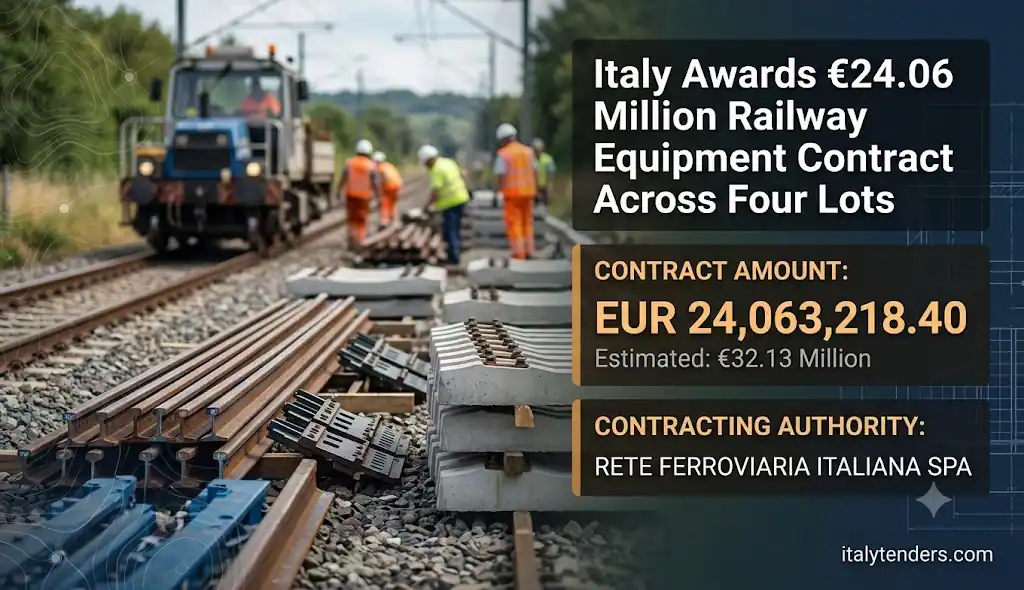
Italy Awards €24.06 Million Railway Equipment Contract Across Four Lots
01 Sep 2026
Standfirst Rail infrastructure operators depend on a steady supply of specialised equipment to keep railway assets operational and Italy's latest procurement shows how that demand is being structured across multiple suppliers. Rete Ferroviaria Italiana SpA (RFI) has awarded four lots for the supply of 60P583U-branded plate kits, with contracts worth a combined €24.06 million excluding VAT. The procurement attracted three requests to participate for each of the first three lots and seven for the fourth. The awards went to four different companies, creating a diversified supplier structure rather than concentrating the entire procurement with a single contractor. Introduction Railway infrastructure requires a continuous flow of specialised components, often with procurement decisions extending well beyond a single maintenance order. In this case, RFI divided its requirement for railway equipment into four lots, each carrying a 48-month contract period and each awarded separately. The procurement concerns Kit piastre marca 60P583U, or kits of plates of the specified 60P583U brand, under procedure DAC.0825.2025. The notice classifies the requirement under CPV 34940000 – Railway equipment. The estimated value across the procurement was €32.13 million excluding VAT, while the combined value of the awarded tenders was €24.06 million. Why This Contract Matters The significance of the award lies less in any single contract and more in the way RFI has organised procurement for a recurring railway-equipment requirement. Four separate lots allow different suppliers to compete for defined portions of demand while giving the railway operator access to several supply channels. The award also demonstrates the commercial importance of specialised railway-equipment procurement. The CPV classification places the purchase within a sector where suppliers need to understand technical specifications, qualification requirements and the purchasing practices of infrastructure operators rather than compete solely on general industrial capability. Another important signal is the price-led award structure disclosed in the notice. The stated award criterion is price, although the notice directs bidders to the tender specifications for the detailed description. The published material therefore does not establish a numerical price weighting or any separate technical weighting. Contract Timeline The procurement was conducted through an open procedure and was not accelerated. The four contracts were concluded at different points in 2026, with Lot 1 signed first and Lot 3 last. 20 May 2026: Contract concluded for Lot 1 with CINEL OFFICINE MECCANICHE SPA. 12 June 2026: Contract concluded for Lot 2 with SCHWIHAG AG. 30 June 2026: Contract concluded for Lot 4 with SO.CO.FER. SOCIETA' COSTRUZIONI. 23 July 2026: Contract concluded for Lot 3 with VOESTALPINE RAILWAY SYSTEMS BULGARIA OOD. 31 August 2026: The award notice was dispatched. 1 September 2026: The award notice was published in the Official Journal of the European Union, OJ S issue 168/2026. The notice does not provide a separate contract commencement date for each lot, so the conclusion dates should not be treated as confirmed operational start dates. Contract Overview RFI's procurement covers four lots under the same overall procedure. All four lots have the same CPV classification, a 48-month duration and no framework agreement or dynamic purchasing system. The combined estimated value was €32,125,719.60 excluding VAT. The awarded tender values total €24,063,218.40 excluding VAT, representing approximately €8.06 million less than the published estimated value. On a simple comparison with the estimate, the awarded value is about 25.1% lower. This comparison should not be interpreted as a formal procurement saving measure because the notice does not state how the estimate was constructed or identify the commercial basis for the difference. Key Contract Details CountryItaly Contracting authorityRETE FERROVIARIA ITALIANA SPA ProcedureOpen procedure Procedure identifierDAC.0825.2025 Contract natureSupplies SubjectSupply of 60P583U-branded plate kits CPV34940000 - Railway equipment Number of lots4 Estimated total value excluding VAT€32,125,719.60 Total awarded value excluding VAT€24,063,218.40 Contract duration48 months per lot Maximum renewals0 Framework agreementNo Dynamic purchasing systemNo EU fundingNo EU funds GPA coverageYes Award criterion disclosedPrice These core procurement details are stated in the award notice. Project Scope The procurement is for the supply of Kit piastre marca 60P583U, with railway equipment identified as the main CPV category. The stated place of performance is the Officina Nazionale di Pontassieve or other plants specified in individual orders communicated by RFI. The notice does not provide a detailed engineering description of the plate kits. It therefore would be inappropriate to infer their exact installation point, technical function or the specific railway assets on which they will be used. What can be established is that RFI is procuring the equipment as a supply requirement over a four-year period. Each lot contains contractual provisions allowing certain changes, including technical extension provisions, contract modifications under Italian procurement legislation and variation up to one-fifth of the contract amount. The contracts also include a renegotiation clause intended to address circumstances arising during a contract's duration. These provisions indicate that RFI has sought contractual flexibility around a supply programme that will run for 48 months. About the Contracting Authority RETE FERROVIARIA ITALIANA SPA RETE FERROVIARIA ITALIANA SPA is identified in the notice as the buyer and as the organisation responsible for providing additional information about the procurement procedure. The notice classifies it as a public undertaking whose contracting activity is associated with railway services. The organisation is based in Rome, Italy. For this procurement, its relevance is direct: it is the contracting entity responsible for purchasing the railway equipment covered by the four lots. About the Organisations Involved CINEL OFFICINE MECCANICHE SPA CINEL OFFICINE MECCANICHE SPA was the successful tenderer for Lot 1. Its tender value was €9,682,218.00. The contract was concluded on 20 May 2026. The notice identifies CINEL as a tenderer and explicitly records it as the winner of Lot 1. It also states that no subcontracting was indicated for the tender. SCHWIHAG AG SCHWIHAG AG was the successful tenderer for Lot 2. Its tender value was €7,285,718.70 and the contract was concluded on 12 June 2026. The notice identifies SCHWIHAG AG as a tenderer and winner of Lot 2. No subcontracting was indicated for its tender. The organisation is listed in Switzerland, with the notice giving its location as Konstanz 70-72, CH 8274 Tagerwilen. VOESTALPINE RAILWAY SYSTEMS BULGARIA OOD VOESTALPINE RAILWAY SYSTEMS BULGARIA OOD won Lot 3. Its tender value was €4,900,244.70 and the contract was concluded on 23 July 2026. The notice records the company as a tenderer and winner of Lot 3. It also states that no subcontracting was indicated. SO.CO.FER. SOCIETA' COSTRUZIONI SO.CO.FER. SOCIETA' COSTRUZIONI was selected for Lot 4. Its tender value was €2,195,037.00, with the contract concluded on 30 June 2026. The notice identifies the company as a tenderer and winner of Lot 4 and states that no subcontracting was indicated. TAR DEL LAZIO TAR DEL LAZIO is identified as the review organisation for the procurement. The notice states that challenges are to be brought before the competent Regional Administrative Court within the stated 30-day period in accordance with the information provided in the award notice. TAR DEL LAZIO is therefore not a supplier or participant in the contract. Its role is connected to the legal review mechanism surrounding the procurement. Procurement Analysis The procurement used an open procedure and was not accelerated. An open procedure allows eligible suppliers to compete within the conditions established by the tender documentation and is particularly significant for a procurement subject to the EU utilities procurement framework. The notice identifies Directive 2014/25/EU as the legal basis. That is consistent with the buyer's classification as a public undertaking operating in railway services. The procurement is also marked as covered by the Government Procurement Agreement. The four-lot structure is one of the strongest procurement signals. Instead of awarding the entire estimated requirement as a single package, RFI created four separately awarded opportunities. The outcome was four different winners, meaning the published award does not show supplier concentration across all four lots. Competition varied by lot. Lots 1, 2 and 3 each received three requests to participate, while Lot 4 received seven. The difference is notable because the smaller Lot 4 generated the largest number of participation requests. However, the notice does not disclose the identities or bid values of unsuccessful participants, so the reasons for the different participation levels cannot be established from the award notice alone. Price Was the Disclosed Award Criterion The notice identifies price as the award criterion for each lot. It does not publish a percentage weighting between price and technical considerations, instead referring bidders to the tender documents for the detailed description. For suppliers, this distinction matters. A procurement can list price as the criterion while the underlying tender documentation contains detailed compliance requirements that determine which bids are admissible before price is evaluated. Because the detailed tender documentation is not included in the award notice, no further conclusion should be drawn about the relative importance of technical factors. Additional Procurement Facts The procurement consists of four supply lots. All four lots use CPV 34940000, Railway equipment. Each lot has a 48-month estimated duration. None of the lots provides for contractual renewals. There is no framework agreement. There is no dynamic purchasing system. The procurement is not financed with EU funds. The procurement is covered by the Government Procurement Agreement. Subcontracting was marked as not applicable for all four winning tenders. No winning tender was identified as a variant. The notice does not disclose the unsuccessful tenderers. The absence of a framework agreement is particularly important. The four awards are individual lot contracts rather than appointments to a framework from which future call-off contracts would automatically be issued. Market & Industry Perspective The award illustrates a procurement market in which railway infrastructure buyers can create sizeable opportunities for specialised suppliers through multi-lot purchasing. The four contracts have an aggregate awarded value above €24 million, but no single winning supplier captured the entire requirement. For the railway-equipment market, the structure creates a useful competitive signal. Suppliers can target individual lots rather than necessarily competing for the full estimated requirement. That can make the procurement relevant to companies whose production or delivery capacity is suited to a particular portion of demand. The international composition of the winners is also notable. The four successful organisations listed in the notice are based in Italy, Switzerland and Bulgaria. The procurement therefore resulted in participation from suppliers operating across multiple European markets, although the notice does not provide sufficient information to assess the full geographical distribution of bidders. Economic Significance The €24.06 million awarded value represents a substantial procurement commitment for a specialised railway equipment supply programme. The contracts are structured for four years, giving the successful suppliers a defined period over which the awarded requirements are to be delivered. The difference between the €32.13 million estimated value and €24.06 million in awarded tenders is approximately €8.06 million, or 25.1% of the estimate. That gap is commercially significant, but it should not automatically be described as a saving for RFI because the award notice does not explain the assumptions behind the original estimate or the final commercial calculations. The absence of EU funding is another relevant feature. The notice explicitly states that the procurement project is not financed with EU funds, indicating that the disclosed procurement is not presented as an EU-funded project in the award documentation. Future Procurement Opportunities The four-year duration creates a relatively long procurement horizon for the specific awarded supply programme. Suppliers monitoring the Italian railway-equipment market should therefore distinguish between opportunities arising from the existing contracts and completely new procurements. The contract documents also contain provisions for certain modifications, technical extension, variation and renegotiation. These provisions create contractual flexibility, but they should not be interpreted as guaranteed additional revenue for the winners. Future opportunities may also arise from other railway-equipment requirements using similar procurement structures. However, the award notice itself does not announce a follow-on tender or a confirmed renewal, so any specific future procurement should be treated as an opportunity to monitor rather than a scheduled contract. Opportunities for Suppliers Companies supplying railway equipment can draw several practical lessons from this award. Track RFI procurement activity: The buyer's railway focus makes its future procurement notices relevant to specialist equipment manufacturers and suppliers. Analyse lot structures carefully: A large requirement may be divided into commercially accessible lots, creating several independent bidding opportunities. Compete on price where the procurement permits it: Price is the disclosed award criterion in this notice, although suppliers still need to satisfy all tender requirements. Prepare for multi-year supply commitments: The four-year duration means bidders need to assess production, delivery and commercial capacity over a long period. Monitor international opportunities: The successful supplier group demonstrates that the procurement can produce awards to companies from different European markets. Watch contractual flexibility: Variation and renegotiation provisions can affect the commercial environment during a long-running contract, although they do not guarantee additional orders. What Businesses Should Watch New RFI tenders for railway equipment under CPV 34940000 and related classifications. Future procurement notices involving specialised railway components and infrastructure supplies. Changes to procurement requirements that could alter the balance between price and technical compliance. New opportunities created when long-duration supply contracts approach their end. Contract modifications or variations disclosed through subsequent procurement notices. Competition levels in future RFI railway-equipment procurements. Whether future procurements continue to use multiple lots or move toward different purchasing structures. ItalyTenders.com Procurement Intelligence This award reflects a broader procurement trend in which major infrastructure buyers are using lot-based competition to balance supply requirements with market participation. For suppliers, the important signal is not simply the €24.06 million award value, but the distribution of that value among four different companies. The procurement also shows why businesses should analyse contract-award notices rather than looking only at new tender opportunities. The award stage reveals which companies are actually succeeding, the commercial value attached to each lot, the level of competition and the structure buyers are using to source specialised products. For railway-equipment suppliers, the lesson is to build intelligence around the buyer as well as the product. RFI's requirements, lot structure, contract duration, competition levels and award outcomes can provide indicators of where future opportunities may appear. Companies that track these patterns can identify relevant procurement activity earlier and benchmark their competitive position against awarded suppliers. The four winners also demonstrate that the market is not necessarily closed to suppliers outside the buyer's immediate domestic market. At the same time, the notice does not provide enough information to determine why each winner succeeded, so suppliers should not infer a particular technical or commercial advantage from the award alone. Looking ahead, businesses should watch for new railway-equipment procurements, especially where the contracting authority uses multi-lot structures and multi-year supply arrangements. The strongest intelligence will come from comparing future notices with this award to determine whether RFI's procurement model is being repeated, expanded or changed. Supplier Takeaways RFI awarded four separate railway-equipment lots rather than concentrating the requirement in one contract. Four different suppliers won the four lots. Three participation requests were received for Lots 1, 2 and 3, while Lot 4 received seven. Price was the disclosed award criterion, but the detailed weighting was not included in the award notice. Each contract has a 48-month duration and zero stated renewals. The procurement is not a framework agreement or dynamic purchasing system. No subcontracting was indicated for the four winning tenders. The total awarded value is approximately 25.1% below the published estimated value. Suppliers should monitor RFI and related railway procurement activity for comparable future requirements. Key Takeaways €24.06 million: Combined value of the four awarded contracts excluding VAT. €32.13 million: Combined estimated procurement value excluding VAT. Four winners: CINEL OFFICINE MECCANICHE SPA, SCHWIHAG AG, VOESTALPINE RAILWAY SYSTEMS BULGARIA OOD and SO.CO.FER. SOCIETA' COSTRUZIONI. Four lots: Each covers the same broad railway-equipment classification and has a 48-month duration. Competition: Three participation requests for each of Lots 1–3 and seven for Lot 4. Procurement model: Open procedure, with price identified as the award criterion. Funding: No EU funds are identified for the procurement. Market signal: The award shows active competition and multi-supplier sourcing for specialised railway equipment. Conclusion RFI's €24.06 million award for 60P583U-branded plate kits is a significant example of how railway infrastructure procurement can be divided into multiple long-term supply contracts. The four-lot model produced four separate winners and attracted different levels of participation, while the published award values remained below the overall estimate. For suppliers, the procurement provides a useful benchmark for understanding the scale, duration and competitive structure of railway-equipment opportunities in Italy. The most important next step is not to assume that the current award creates guaranteed future work, but to monitor how RFI structures subsequent requirements and whether similar equipment categories return to the market. Source: Tenders Electronic Daily (TED), Contract Award Notice 602199-2026, Official Journal of the European Union, published on 01/09/2026.
View Details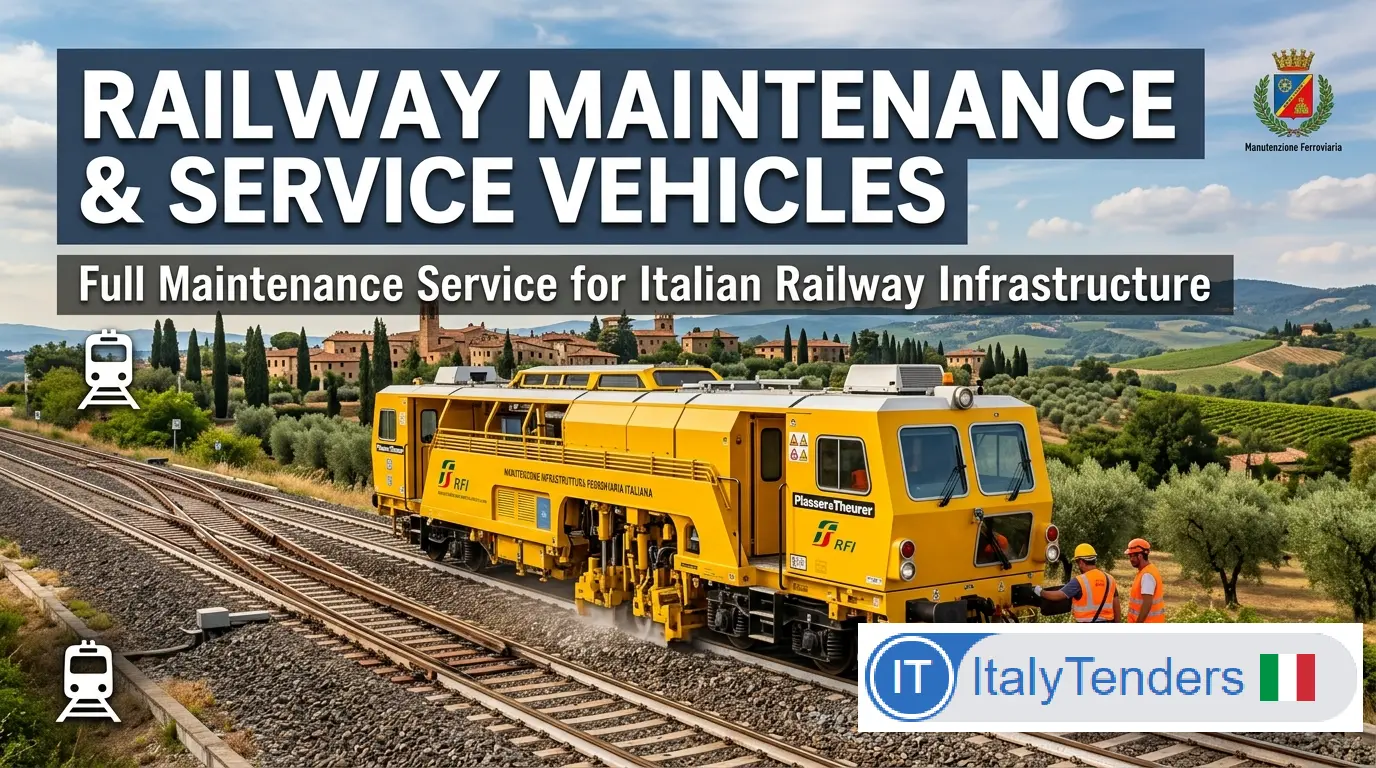
Plasser & Theurer Locks In RFI's EUR 161 Million Switch Tamping Machine Contract for Nearly a Decade
31 Aug 2026
Standfirst Rete Ferroviaria Italiana, Italy's national rail infrastructure manager, has awarded a consortium led by Austrian manufacturer Plasser & Theurer at least two of three lots in a EUR 161 476 189.33 procurement for switch tamping machines, supplied under a full maintenance service model running up to 114 months. The machines are essential to keeping the geometry of railway points and crossings safe and precise across Italy's national network. Introduction Every time a train changes track at a railway switch, it relies on precisely maintained ballast beneath the rails to keep the geometry stable under repeated mechanical stress. Specialised machines called switch tampers do that maintenance work, compacting and levelling the ballast around the complex trackwork found at points and crossings. Rete Ferroviaria Italiana has just secured a fleet of them for the better part of the next decade. The winning bidder is a joint venture led by Plasser & Theurer, the Austrian company that is effectively the global standard bearer in railway track maintenance machinery, paired with its Italian subsidiary Plasser Italiana. The contract structures the deal not as a simple equipment purchase, but as a full maintenance service arrangement, where the manufacturer keeps the machines running throughout the contract term rather than merely selling them and walking away. Why This Contract Matters Switch tampers address one of the more mechanically demanding maintenance challenges on any rail network. Railway switches, where trains move from one track to another, concentrate stress and wear far beyond what straight track experiences, and keeping their underlying ballast properly compacted and aligned is essential to safe, smooth train operation. A well maintained fleet of specialised tamping machines is a quiet but critical piece of national rail safety infrastructure. The full maintenance service structure also matters commercially. Rather than RFI owning these complex machines outright and bearing the risk and cost of their upkeep, the manufacturer remains responsible for keeping them operational throughout the contract, a model that shifts maintenance risk onto the party best equipped to manage it and gives RFI more predictable long term costs. Contract Timeline Procedure type: Open procedure under Directive 2014/25/EU Lot 2 contract concluded: 6 August 2026 Notice dispatched to the Publications Office: 28 August 2026 Published in the Official Journal, OJ S 167/2026: 31 August 2026 Contract duration: 114 months (Lots 1 and 2), 90 months (Lot 3) Contract Overview RFI ran an open procedure under the EU's Utilities Directive for supply, under a full maintenance service regime, of switch tampers to maintain the efficiency of Italy's national railway infrastructure, split into three lots with a combined estimated value of EUR 161 476 189.33. Lots 1 and 2 are identically specified, each estimated at EUR 58 249 810.07 over a 114 month term, while Lot 3 carries an estimated value of EUR 44 976 569.19 over a shorter 90 month term. A joint venture led by Plasser & Theurer, Export von Bahnbaumaschinen, Gesellschaft m.b.H., with Plasser Italiana S.r.l. as its Italian partner, won Lot 1 with a tender valued at EUR 39 457 855.82, and the same value and contract details recur for Lot 2, indicating the same consortium secured both lots. A separate tender valued at EUR 30 585 093.12 is recorded against Lot 3, though this notice does not include a full organisational profile identifying that lot's winning supplier. Key Contract Details Contracting authorityRete Ferroviaria Italiana S.p.A. (RFI) Contract titleSupply, under Full Maintenance Service, of switch tampers for Italy's National Railway Infrastructure CPV codes34621200, Railway maintenance or service vehicles, plus 50222000, Repair and maintenance services of rolling stock Procedure typeOpen procedure Legal basisDirective 2014/25/EU, the Utilities Directive Combined estimated value, all 3 lotsEUR 161 476 189.33, excluding VAT Lot 1 and Lot 2 value and termEUR 58 249 810.07 each, 114 months Lot 3 value and termEUR 44 976 569.19, 90 months Award criteriaQuality, detailed in a separate technical annex to the tender specifications Lot 1 and Lot 2 winnerJoint venture of Plasser & Theurer and Plasser Italiana S.r.l. Lot 1 and Lot 2 winning tender valueEUR 39 457 855.82 each Lot 3 winning tender valueEUR 30 585 093.12 Contract concluded (Lot 2)6 August 2026 GPA coverageYes EU fundingNo Renewal optionsNone; contract includes options for value variation up to one fifth and contractual modifications under Italian procurement law Review bodyT.A.R. Lazio Notice reference598800 2026, OJ S 167/2026, published 31 August 2026 Project Scope The contract covers switch tamping machines, specialised heavy equipment used to maintain the ballast beneath railway switches and crossings, supplied under a full maintenance service model. Under that structure, the winning consortium remains responsible for keeping the machines operational, presumably including servicing, spare parts and repairs, throughout the contract term, rather than RFI purchasing the equipment outright and managing its own maintenance regime. Each lot's terms include options allowing value variation of up to one fifth of the contract amount and contractual modifications under Article 120 of Italy's 2023 procurement code, standard flexibility mechanisms in Italian public works and supply contracts. About the Contracting Authority Rete Ferroviaria Italiana S.p.A. is Italy's national railway infrastructure manager, based in Rome, classified as a contracting entity active in railway services. RFI is part of the Ferrovie dello Stato Italiane group, Italy's state railway holding company, and is responsible for maintaining and developing the national rail network's infrastructure, including the specialised maintenance equipment fleets that keep it operational. About the Organisations Involved Rete Ferroviaria Italiana S.p.A. As covered above, RFI is the buyer for this contract and also serves as the organisation providing further procurement information and offline access to tender documents. T.A.R. Lazio The Regional Administrative Court of Lazio, based in Rome, is named as the review organisation for this contract, the standard venue for procurement disputes involving national infrastructure entities based in the capital. Plasser & Theurer and Plasser Italiana S.r.l. The winning joint venture pairs Plasser & Theurer, Export von Bahnbaumaschinen, Gesellschaft m.b.H., based in Vienna, as lead partner, with Plasser Italiana S.r.l. as its Italian member. Plasser & Theurer is widely regarded as the world's leading manufacturer of railway track maintenance machinery, including tampers, ballast regulators and related equipment, with a global customer base spanning national rail infrastructure managers across every continent. Its Italian subsidiary gives the consortium direct local presence for ongoing service and support obligations under the full maintenance service structure. Procurement Analysis RFI ran an open procedure under the Utilities Directive, evaluated on quality criteria detailed in a separate technical annex rather than disclosed numerically in the notice itself, a common approach for highly specialised technical equipment where detailed evaluation methodology sits in supporting tender documentation. Three tenders total were recorded across the visible lot results, a reasonable field for equipment this specialised, where genuinely few manufacturers worldwide can credibly supply and service switch tampers at the scale a national rail infrastructure manager requires. The identical specification and value of Lots 1 and 2, both won by the same Plasser led consortium at matching tender values, suggests these lots may represent parallel procurement tracks for the same equipment category, possibly split for administrative or geographic reasons, while Lot 3's shorter term and different winning value point to a distinct scope or machine configuration. Additional Procurement Facts This project is confirmed as not financed with EU funds. All three lots are confirmed as covered by the Government Procurement Agreement. Lot 1's base tender amount before options was EUR 39 537 505.10, with an options amount of EUR 18 712 304.97, together making up its full estimated value. No renewal options apply to any lot; the contracts run their full fixed terms without extension provisions. Market and Industry Perspective Plasser & Theurer's dominant position in this award reflects its broader standing in the global railway track maintenance machinery market, where the company has built a reputation over decades as the primary supplier of tamping and ballast maintenance equipment to major rail networks worldwide. Its win here, through a joint venture with its established Italian subsidiary, reinforces its long standing relationship with RFI and the broader Italian rail infrastructure sector. Economic Significance At a combined EUR 161 476 189.33 across three lots, with a contract term running up to nearly a decade for the largest lots, this is a substantial, long term investment in Italy's rail maintenance capability, ensuring RFI retains access to specialised switch maintenance equipment critical to safe network operation for years to come. Future Procurement Opportunities With no renewal options built into any lot, RFI will need to run a full recompete once each lot's term concludes, Lot 3 around 90 months from its award and Lots 1 and 2 around 114 months out, offering other specialised track maintenance equipment manufacturers a future opportunity to compete for this business. Opportunities for Suppliers Railway maintenance machinery manufacturers should note the full maintenance service contracting model demonstrated here as an increasingly common structure for specialised, high value rail infrastructure equipment, shifting long term maintenance responsibility onto suppliers in exchange for guaranteed, multi-year revenue. What Businesses Should Watch Confirmation of Lot 3's winning supplier, not fully detailed in the organisational section of this notice. Further RFI tenders for specialised railway maintenance equipment as its broader fleet renewal programme continues. Plasser & Theurer's continued market position across other European national rail infrastructure procurement. ItalyTenders.com Procurement Intelligence This contract illustrates how specialised rail infrastructure equipment increasingly moves toward full maintenance service contracting models, where the manufacturer's ongoing responsibility for keeping machines operational becomes as important as the initial supply itself. For national rail infrastructure managers, this structure offers more predictable long term costs and shifts technical maintenance risk to suppliers with the deepest expertise in their own equipment. Plasser & Theurer's dominant position across this and comparable European rail maintenance equipment tenders reflects how concentrated this specific manufacturing niche remains globally, a useful reminder for any supplier considering entry into railway maintenance machinery that competing against an established, technically dominant incumbent requires genuinely differentiated capability, not just competitive pricing. Supplier Takeaways This contract uses a full maintenance service model, shifting long term equipment upkeep responsibility onto the winning supplier in exchange for a multi-year, high value contract. Award criteria were quality focused, with detailed technical evaluation methodology set out in a separate annex rather than the notice itself. The winning consortium paired a dominant global manufacturer with its established Italian subsidiary, a combination that likely strengthened both technical credibility and local service capability. Contract terms run up to 114 months with no renewal options, meaning a full recompete will eventually follow for each lot. Specialised railway maintenance machinery remains a globally concentrated market with few credible alternative suppliers to established incumbents. Key Takeaways RFI awarded a joint venture led by Plasser & Theurer at least two of three lots in a EUR 161 476 189.33 procurement for switch tamping machines under a full maintenance service model. Lots 1 and 2, each worth an estimated EUR 58 249 810.07, run 114 months and were both won by the Plasser led consortium. Lot 3, worth an estimated EUR 44 976 569.19, runs 90 months, with its winning tender valued at EUR 30 585 093.12. Award criteria were quality based, detailed in a separate technical annex. The contract is not financed with EU funds and is covered by the Government Procurement Agreement. No renewal options apply to any of the three lots. Conclusion Few passengers ever think about the machines that keep railway switches safely aligned, but contracts like this one are what make that invisible reliability possible. Plasser & Theurer, already the dominant name in this specialised corner of rail engineering, has now secured close to a decade of work keeping Italy's switch infrastructure in shape, under a full maintenance service model that ties the manufacturer's fortunes directly to how well those machines keep running. Source: Tenders Electronic Daily (TED), Contract Award Notice 598800-2026, Official Journal of the European Union, OJ S 167/2026, published on 31 August 2026.
View Details