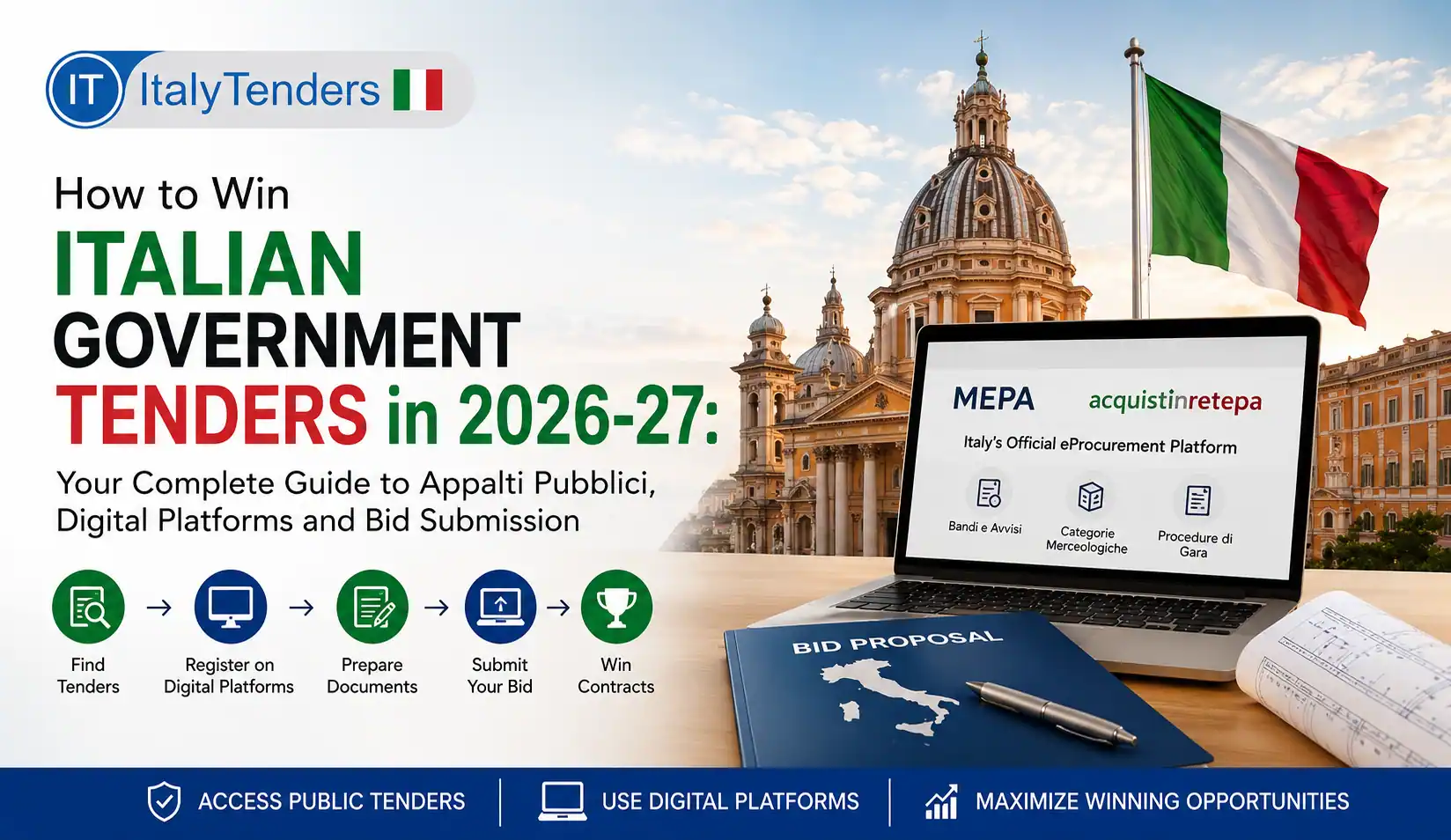
How to Win Italian Government Tenders in 2026-27: Your Complete Guide to Appalti Pubblici, Digital Platforms and Bid Submission
Published on ItalyTenders.com | Category: Italian Public Procurement
Every working day, thousands of Italian contracting authorities, ministries, municipalities, regional health services, universities and public utilities publish gare d'appalto (tender competitions) and bandi di gara (tender notices) worth hundreds of millions of euros. Most businesses, including many Italian ones, never see the majority of these opportunities because they do not know which platform to monitor, which qualification documents to maintain or how Italy's mandatory digital procurement ecosystem actually works in practice.
This guide changes that. Whether you are an Italian SME bidding on your first appalto pubblico, an EU company looking to break into the Italian market or an international contractor evaluating the opportunity, you will find here a practical, accurate and fully updated account of how Italian public procurement works in 2026, the legal framework, the platforms, the qualification requirements, the bid submission process and the rules that govern foreign participation. ItalyTenders.com monitors the full Italian procurement landscape, PCP, MePA, ANAC and major regional platforms, so you receive every relevant opportunity in one place.
→ Search Live Italian Government Tenders Now
Why Italy Is One of Europe's Most Important Procurement Markets
Italy's public procurement market is the third largest in the European Union by total annual value, reflecting the country's position as the EU's third largest economy by GDP. Italian stazioni appaltanti (contracting authorities) collectively spend tens of billions of euros every year on construction and public works, IT services and digital transformation, healthcare equipment and services, professional consultancy and facilities management. The market spans every level of Italian government, national ministries and their agencies, 20 Regioni, 107 Province, over 7,900 Comuni and a vast network of public healthcare trusts, universities and publicly controlled utilities.
Three structural features make Italy particularly attractive for suppliers willing to invest in understanding its procurement system:
- Mandatory transparency: Every gara d'appalto, direct award and contract outcome must be published digitally, Italy's procurement system generates more publicly accessible contract data than almost any comparable market in Europe.
- Recurring demand: Italian public sector needs, road maintenance, hospital supplies, school IT, waste management, facility cleaning, are continuous and recurring. Winning a framework agreement or qualifying on a supplier list generates multi-year revenue, not a single transaction.
- EU fund-driven investment: Italy is the largest single recipient of NextGenerationEU funds in the 2021–2026 cycle, with over €191 billion in PNRR (Piano Nazionale di Ripresa e Resilienza) investment generating a multi year wave of public procurement, particularly in construction, energy efficiency, digitalisation, healthcare and transport infrastructure.
The Legal Foundation: Codice dei Contratti Pubblici (D.Lgs. 36/2023)
Every Italian public procurement procedure today is governed by the Codice dei Contratti Pubblici, enacted as Decreto Legislativo 36/2023. In force since 1 July 2023 for above-threshold contracts and extended to all procedures from 1 January 2024, the Code replaced D.Lgs. 50/2016 and represents the most comprehensive restructuring of Italian procurement law since the implementation of the 2004 EU directives. It transposes EU Directives 2014/24/EU (classic public contracts), 2014/25/EU (utilities) and 2014/23/EU (concessions) into a unified Italian text.
Three principles sit at the heart of the Code and shape how every procedure must be designed and evaluated:
- Principio del risultato (principle of result): contracting authorities must achieve the award and execution of contracts with maximum speed and the best possible quality to price ratio, failure to achieve this is itself a legal failure, even if procedural steps were technically followed.
- Principio della fiducia (principle of trust): public officials are explicitly encouraged to exercise administrative discretion in the public interest without fear of automatic liability for non-criminal procedural deviations, a deliberate reversal of the culture of over cautious, box-ticking procurement that had developed under the previous code.
- Principio dell'accesso al mercato (principle of market access): every procurement must be designed to maximise participation by qualified economic operators, barriers that serve no legitimate purpose are specifically prohibited.
In December 2024, the Code was amended by the Decreto Correttivo (D.Lgs. 209/2024), which modified approximately one third of the Code's provisions. The most practically significant changes for bidders include: the standstill period between award notification and contract signature reduced from 35 to 32 days; mandatory BIM (Building Information Modelling) requirement for public works above €2 million; revised equo compenso (fair compensation) rules for architecture and engineering tenders; and a strengthened revisione prezzi (price revision) mechanism that is now effectively automatic for contracts above EU threshold rather than requiring specific contractual provision.
Italy's Digital Procurement Platforms: Where to Find and Submit Tenders
Italy's procurement system is built on a mandatory digital infrastructure. Since 1 January 2024, every procurement procedure, including direct awards below €5,000, must be conducted through an AgID-certified digital procurement platform (Piattaforma di Approvvigionamento Digitale or PAD). There is no longer any legitimate paper based procurement in Italy for regulated procedures. Understanding which platform your target buyer uses is the first practical step before searching for any opportunity.
PCP, Piattaforma Contratti Pubblici
The PCP (marches-publics.gouv.fr equivalent, pcp.mit.gov.it) is ANAC's national central publication platform, consolidating what were previously multiple separate systems into a single infrastructure. The PCP is the source of truth for:
- All above-threshold bandi di gara and avvisi di gara (tender notices and invitations).
- EU-level eForm publications automatically forwarded to TED (Tenders Electronic Daily) for above-threshold procedures.
- The DGUE (Documento di Gara Unico Europeo), Italy's implementation of the EU's standardised self-declaration form.
- The CIG (Codice Identificativo Gara), the unique identification code that must be assigned to every procurement procedure and cited on all payment flows, ensuring financial traceability.
FVOE, Fascicolo Virtuale dell'Operatore Economico
The FVOE (Fascicolo Virtuale dell'Operatore Economico) is one of the most significant practical improvements introduced under the new Code for suppliers. It is a digital repository maintained by ANAC where an economic operator's eligibility documents, legal status, contribution compliance, professional qualifications, financial capacity and technical references are uploaded once and verified centrally, then reused across all procedures rather than being re-submitted for every tender.
- For contracts below €40,000: a self declaration (dichiarazione sostitutiva) is sufficient, with buyers conducting only sample based verification through the FVOE.
- For contracts above €40,000: full FVOE based verification of the winning bidder's eligibility is mandatory, regardless of the specific procedure used.
Keeping your FVOE profile current, particularly DURC, antimafia documentation and SOA certification where applicable, is one of the highest-value compliance activities any Italian tender participant can invest time in. An outdated or incomplete FVOE profile delays award and can result in exclusion even after a technically superior bid wins the evaluation.
MePA, Mercato Elettronico della Pubblica Amministrazione
The MePA, operated by CONSIP (Italy's central purchasing body), is the electronic marketplace for sub-threshold purchases of goods, IT products and services. Suppliers register on MePA, publish their product and service catalogues and public bodies place orders directly from those catalogues or initiate richieste di offerta (RDO), competitive quotation requests among MePA-registered suppliers.
A 2025 Corte dei Conti ruling clarified that AgID-certified PADs can now substitute for MePA for purchases between €5,000 and the EU threshold for municipalities, provinces, regions and non-economic public bodies of national relevance. However, MePA remains mandatory for central state administrations, schools, universities, social security bodies (INPS/INAIL) and tax agencies (Agenzia delle Entrate). Which platform a buyer uses genuinely depends on its institutional category, always check the specific contracting authority's procurement page before deciding where to direct your registration effort.
BDNCP and ANAC: The Regulatory Backbone
Behind every platform sits the BDNCP (Banca Dati Nazionale dei Contratti Pubblici), ANAC's national contracts database that aggregates and validates procurement data from every certified digital platform. ANAC (Autorità Nazionale Anticorruzione) performs both technical oversight of the procurement ecosystem and regulatory supervision of individual contracting authorities' compliance. ANAC notices, circulars and guidelines carry interpretive weight that frequently shapes how contracting authorities apply the Code in practice, monitoring ANAC's published guidance is part of serious engagement with the Italian market.
Current EU and National Thresholds for Italian Tenders
EU thresholds are revised every two years by European Commission delegated regulation. The values in force from 1 January 2026 through 31 December 2027 are:
- Public works contracts and concessions: €5,404,000
- Supplies and services, central government authorities: €140,000
- Supplies and services, sub-central authorities (Regioni, Comuni, ASL, universities): €216,000
- Special sectors (utilities, energy, water, transport): €432,000
Below these EU thresholds, the Code's national rules under article 50 apply. The key national breakpoints are:
- Below €5,000: Even direct awards (affidamenti diretti) must now be conducted through an AgID-certified digital platform, but documentation and formality requirements are minimal.
- €5,000 to €40,000: Affidamento diretto with self-certification of eligibility, the buyer may select a supplier directly, though digital traceability via CIG is mandatory.
- €40,000 to €150,000 (works) or €40,000 to EU threshold (services/supplies): A negotiated procedure (procedura negoziata) requiring consultation of a minimum number of operators, with full FVOE verification of the winner.
- Above EU threshold: Fully formalised above-threshold procedures with mandatory EU-wide publication on both the PCP and TED.
An important practical implication: most Italian contracts by number fall below the EU threshold. Monitoring the PCP alone for above-threshold notices misses the majority of Italian procurement activity. Comprehensive coverage of the Italian market requires monitoring at both national and EU levels, which ItalyTenders.com does automatically, delivering all tier levels through a single alert service.
SOA Certification: The Entry Ticket for Public Works in Italy
If your business targets lavori pubblici (Italian public works contracts), the most important qualification requirement you will encounter is the attestazione SOA, a qualification certificate issued by an accredited private certifying body (Società Organismi di Attestazione) demonstrating your company's capacity to execute public works of a specific category and value class.
The SOA system, governed by Annex II.12 of the Code, classifies works by both type (categoria) and value (classifica). Here is what every supplier needs to know about it in practice:
- It is generally mandatory above defined value thresholds for works: A company without the correct SOA category and class typically cannot participate in public works competitions above those thresholds.
- It replaces individual proof of capacity: Once you hold the correct SOA attestation, contracting authorities cannot impose additional, duplicative financial or technical capacity requirements for that category of work, the SOA certificate is self-sufficient evidence.
- It has a validity period and must be renewed: SOA certificates are issued for five years, with a verification at the three-year mark. An expired certificate means immediate ineligibility, even mid-procedure.
- Foreign companies can obtain SOA certification: There is no nationality restriction on SOA registration, non-Italian companies with the requisite documented track record can apply to any accredited SOA body.
- Avvalimento (capacity borrowing): A company that does not hold the required SOA classification can "borrow" the capacity of another company that does, subject to specific contractual commitments, a mechanism that can make Italian works tenders accessible to otherwise sub-qualified suppliers, though courts have applied this mechanism strictly, particularly for non-EU companies.
DURC and Antimafia Documentation: What You Must Keep Current
Two compliance documents require ongoing management throughout any Italian procurement process, not just at the time of bid submission:
- DURC (Documento Unico di Regolarità Contributiva): A certificate confirming current standing on all social security, welfare and construction-sector fund contributions, INPS (National Social Security), INAIL (National Insurance for Workplace Injuries) and, for construction, the Casse Edili (construction industry welfare funds). The DURC is valid for 120 days from issuance and is checked at every stage of the procurement lifecycle, tender submission, award, contract signature and during execution. A DURC irregularity does not automatically trigger exclusion if the company can demonstrate a pending legal challenge, approved instalment plan or amnesty arrangement covering the relevant amounts.
- Antimafia documentation: For contracts above defined value thresholds, buyers must query the BDNA (Banca Dati Nazionale Unica della Documentazione Antimafia) before awarding or executing any contract. A comunicazione antimafia confirms no disqualifying convictions exist. An informazione antimafia goes further, it is a risk assessment, not just a criminal record check and an adverse assessment (interdittiva) results in immediate exclusion from procurement across all Italian public contracting. Companies receiving an interdittiva can appeal to the TAR within 60 days, request Prefettura review after the measure's 12-month validity expires or apply for controllo giudiziario volontario (voluntary judicial oversight), which suspends the interdittiva's effects during the oversight period.
- White List registration: For sectors with elevated organised-crime infiltration risk, including waste and refuse transport, mining and extraction, collective catering and security/guarding, registration on the local Prefettura's White List is a bidding precondition, not an optional enhancement. Check at the outset of market entry whether your specific service category is listed.
Step-by-Step: How to Register and Bid on Italian Tenders
- Step 1, Obtain Italian digital identity credentials: Accessing Italy's digital procurement ecosystem requires either a SPID (Sistema Pubblico di Identità Digitale) for Italian nationals and residents or a CIE (Carta d'Identità Elettronica). Foreign companies without access to SPID must obtain equivalent eIDAS-recognised credentials or work with an Italian representative who holds valid digital identity. This step is frequently underestimated, arrange it weeks before your first deadline.
- Step 2, Register your FVOE profile on ANAC's PCP: Create your economic operator profile on the PCP, upload your core eligibility documents and request verification of each document category. Your FVOE status becomes the basis on which every contracting authority verifies your eligibility, it is your procurement identity in the Italian system.
- Step 3, Register on MePA if targeting sub-threshold work: If your target buyers include central state administrations, schools, universities or social security bodies, MePA registration and catalogue publication are required separately from FVOE/PCP registration. The two registrations serve different purposes and neither substitutes for the other.
- Step 4, Obtain SOA certification if bidding on public works above threshold: Identify the correct works category and value class for your target contracts and initiate SOA certification with an accredited body. Allow a minimum of 90 days for initial certification, this is not a last-minute step.
- Step 5, Set up tender monitoring: Configure keyword, CPV code and contracting-authority alerts on the PCP for above-threshold notices and on MePA or your relevant regional platform for sub-threshold opportunities. Or use ItalyTenders.com's consolidated alert service covering all tiers and platforms in one daily notification.
- Step 6, Study the bando and capitolato before preparing your offer: The bando di gara (tender notice) and the capitolato speciale d'appalto (special contract conditions) set out the evaluation criteria, technical requirements, documentation requirements and award weighting between price and quality. Read both in full before writing a single line of your offer, the evaluation weighting determines your entire bid strategy.
- Step 7, Submit your DGUE and offer electronically through the designated PAD: Submit before the stated scadenza (deadline), Italian procurement platforms do not accept late submissions and judicial review has consistently held that technical platform issues are the bidder's risk to manage, not the contracting authority's.
- Step 8, Monitor post-award and request debrief if unsuccessful: Within the 32 day standstill period following award notification, you have the right to request information on your scoring and the winning bidder's scoring and to file for interim relief before the TAR if you believe the award decision was unlawful.
Procurement Procedures: Choosing the Right Route
- Procedura aperta (open procedure): Any eligible company submits a complete offer directly, the default above-threshold route. No shortlisting stage. Evaluation is the only filter.
- Procedura ristretta (restricted procedure): Two stages, candidates first submit a request to participate and only a shortlisted group is then invited to submit full offers. Allows contracting authorities to manage the number of full proposals to evaluate.
- Procedura competitiva con negoziazione (competitive procedure with negotiation): Negotiation is permitted with selected bidders after initial offers, available in specific legally defined circumstances including technical complexity and failed prior procedures.
- Dialogo competitivo (competitive dialogue): Structured pre-offer dialogue with multiple shortlisted operators. Reserved for projects where the contracting authority cannot pre-specify the optimal technical or legal solution before going to market.
- Partenariato per l'innovazione (innovation partnership): Combines procurement of R&D with purchase of the resulting innovative output in a single procedure, Italy's route for truly novel public sector requirements.
- Affidamento diretto (direct award below threshold): Available below the article 50 national thresholds, subject to strict CIG traceability, justified selection and digital execution through a certified PAD, even for the very smallest purchases below €5,000.
Foreign Companies Bidding on Italian Tenders: Your Rights and Practical Realities
Italy is bound by EU non-discrimination and equal-treatment principles for all economic operators from EU and EEA member states and above-threshold Italian procedures are open to bidders from WTO GPA-member and EU-trade-agreement countries on equivalent terms. In practice, what matters for any foreign company seriously targeting Italian procurement is this:
- EU law protects your right to participate, Italian contracting authorities cannot impose conditions that directly or indirectly discriminate based on nationality for EU or treaty-covered bidders. If you encounter requirements that seem designed to exclude non-Italian companies, this may itself be challengeable through the TAR.
- Language is a real barrier, not a legal one: Tender documents, the DGUE and all offer components are in Italian. This is legally required. Professional Italian-language translation and a local legal contact are practical necessities, not optional extras.
- Digital identity is the most common operational obstacle: SPID and CIE are not available to non-Italian entities in the standard way. Foreign companies typically need either to establish an Italian legal entity, appoint a local representative with valid Italian digital identity or use a recognised EU eIDAS equivalent credential where the specific PAD accepts it.
- RTI (Raggruppamento Temporaneo di Imprese): Temporary joint ventures for procurement purposes are widely used in Italy and the most practical market entry route for a foreign company partnering with an established Italian firm, each RTI member maintains its own legal independence and roles and capacity contributions are specified at the RTI formation stage.
- Avvalimento (capacity borrowing): Allows a company that lacks required SOA classification or specific technical capacity to borrow it from another company through a formal contractual commitment. Particularly useful for foreign companies whose documented track record doesn't map neatly to Italian SOA categories.
Legal Recourse: Protecting Your Rights as a Bidder
Italy's procurement challenge system is structured, court-based and relatively fast by Italian judicial standards:
- The 32 day standstill period is your primary protection window. Once the contracting authority notifies the award decision, you have this time to assess the outcome, request scoring information and, if you identify a legal basis, seek interim injunctive relief before the contract is signed.
- TAR (Tribunale Amministrativo Regionale): First-instance specialist administrative court for procurement challenges. A well-founded application for interim relief filed during the standstill can suspend contract signature and, in some cases, reverse the award decision entirely.
- Consiglio di Stato: Italy's highest administrative court, hearing appeals from TAR procurement decisions. Its interpretations of the Code and the 2024 Correttivo are shaping Italian procurement practice in real time.
- Antimafia recourse is separate: An interdittiva antimafia must be challenged within 60 days at the TAR, the standard procurement recourse timeline does not apply.
High-Opportunity Sectors for 2026 and Beyond
- PNRR-funded construction and infrastructure: Italy's €191 billion PNRR investment package is generating an exceptional pipeline of public works, school renovation, hospital construction, rail electrification, port modernisation, broadband extension and green hydrogen infrastructure. PNRR-funded tenders operate under accelerated timelines and are monitored separately on the Italia Domani transparency portal alongside the standard PCP.
- Digital transformation (gare ICT): The PNRR's digitalisation component alone allocates over €40 billion to digitising the Italian public administration, cloud infrastructure, interoperability platforms, cybersecurity and e-government services are generating sustained high-value IT tenders at national and regional level.
- Healthcare (gare appalti sanità): Italy's 21 regional health systems (SSN) are among the most active public procurement buyers in Europe, medical devices, pharmaceuticals, diagnostic equipment, health IT and outsourced clinical services are procured continuously and at significant scale.
- Energy efficiency and green building: Public building energy efficiency is a specific PNRR investment stream, generating a wave of engineering, design and installation contracts for insulation, heat pumps, solar panels and smart building controls on public buildings.
- Professional services: Engineering design, architecture, technical consultancy and legal services are consistently high frequency across all contracting authority tiers, particularly following the Correttivo's equo compenso clarifications, which now provide stronger fee protection for design professionals.
Common Mistakes That Cost Bidders Italian Contracts
- DURC lapses mid-procedure: DURC validity is 120 days. A certificate that was valid when you submitted your offer can lapse before award and an irregular DURC at the moment of award disqualifies you regardless of bid quality. Calendar your DURC renewal proactively.
- SOA certificate wrong category or class: Italian courts apply SOA category and class requirements strictly. Holding a certificate in an adjacent category does not satisfy a requirement for the specifically listed one. Verify the exact SOA requirements in the bando before submitting.
- Wrong digital platform for the buyer type: Assuming MePA covers all sub-threshold Italian procurement is incorrect. A municipality might use an AgID-certified regional PAD rather than MePA and if you're not registered there, you cannot participate. Always check the specific contracting authority's digital procurement page.
- Missing the standstill window: The 32-day period between award notification and contract signature is the window for legal intervention. Once the contract is signed, reversing it becomes substantially harder, courts are reluctant to void signed contracts even where the award process was flawed.
- White List omission in sensitive sectors: If your service falls under a White List category and you haven't registered at the local Prefettura, you are not eligible to bid, full stop. This is a precondition, not a certification you acquire during execution.
- Underestimating SPID/digital identity lead time for foreign bidders: Digital identity setup for non-Italian entities takes weeks, not hours. Starting this process after you've found a relevant opportunity is already too late.
Frequently Asked Questions
Q1: What is the Codice dei Contratti Pubblici and why does it matter for my business?
The Codice dei Contratti Pubblici (D.Lgs. 36/2023) is Italy's single legal framework governing all public procurement, from the smallest affidamento diretto below €5,000 to multi-billion-euro infrastructure concessions. Every rule governing how Italian public contracts are designed, published, evaluated and awarded derives from this Code. If you are bidding on any Italian public tender, the Code's provisions and the 2024 Correttivo amendments to it, define your rights, your obligations and the grounds on which you can challenge decisions.
Q2: What platforms do I need to be registered on to bid in Italy?
The answer depends on your target buyers. For above-threshold contracts and most significant below-threshold tenders, the PCP (ANAC's national platform) and the FVOE supplier file are the essential starting points. For contracts with central state bodies, schools, universities and social security agencies, MePA registration is also required. Some regions and large municipalities use separate AgID-certified platforms. ItalyTenders.com aggregates notices across all tiers so you can identify which specific platform each opportunity requires before committing to registration.
Q3: What are the current EU thresholds for Italian procurement?
From 1 January 2026: works and concessions €5,404,000; supplies and services for central government authorities €140,000; supplies and services for sub-central authorities €216,000; special sectors (utilities) €432,000. Below these thresholds, national rules apply, with affidamento diretto available up to €40,000 and negotiated procedures for higher values up to the EU threshold.
Q4: Do I need SOA certification to bid on Italian tenders?
Only if you are bidding on public works (lavori pubblici) contracts above defined value thresholds. For services and supplies, IT, healthcare, professional consultancy, facilities management, SOA is not required. For works, the correct SOA category and class for the specific works type and contract value is generally mandatory. Foreign companies can apply for SOA certification with any accredited Italian SOA body. Companies without the required SOA can, in some circumstances, use avvalimento to borrow the certification from a partner entity.
Q5: What is the DURC and how often do I need to renew it?
The DURC (Documento Unico di Regolarità Contributiva) is a certificate confirming that your company is current on all Italian social security, workplace injury insurance and construction welfare fund contributions. It is valid for 120 days from issue and must remain valid throughout the entire procurement process, not just at bid submission. Italian buyers check DURC status at every stage including award and contract signature. Budget for quarterly DURC renewal if you are actively bidding in Italy.
Q6: Can a foreign company bid on Italian government tenders without setting up an Italian entity?
Yes, EU and EEA companies can bid on above-threshold Italian tenders without an Italian legal entity, under the non-discrimination principle. Non-EU companies from WTO GPA or EU trade-agreement countries can also participate above threshold. The practical barriers are digital identity (SPID/CIE requirements on specific platforms), language (all documentation in Italian) and antimafia documentation (equivalence of foreign company registration documents must be established). Many foreign companies use an Italian legal representative or form an RTI with an Italian partner for their first entry.
Q7: How do I challenge an Italian tender award I believe was made incorrectly?
Within the 32-day standstill period following award notification, request scoring details from the contracting authority and assess whether the decision has legal grounds to challenge. If so, file for interim relief (sospensiva) before the competent TAR (Tribunale Amministrativo Regionale). A successful interim application suspends contract signature while the merits are heard. TAR decisions on procurement are typically issued within 30–60 days. Appeals against TAR rulings go to the Consiglio di Stato.
Q8: What is the PNRR and why is it generating so many Italian tenders right now?
The PNRR (Piano Nazionale di Ripresa e Resilienza) is Italy's national implementation of the EU's NextGenerationEU recovery fund, the single largest discretionary public investment programme in Italian history, worth over €191 billion. It finances investment in digitalisation, green energy, healthcare, education and infrastructure, all procured through Italian contracting authorities using standard procurement procedures but with accelerated timelines and specific transparency obligations. PNRR-funded tenders are distinguishable in procurement databases by their PNRR flag and are monitored on the Italia Domani portal alongside the standard PCP.
How ItalyTenders.com Helps You Win Italian Government Contracts
ItalyTenders.com is built specifically for businesses targeting the Italian public procurement market, whether you are an Italian SME tracking municipal tenders in your region or an international company entering Italy through PNRR-backed infrastructure opportunities. The platform consolidates procurement notices from the PCP, MePA and major Italian regional and sectoral platforms into a single searchable, alert-driven feed, so you receive every relevant bando di gara, avviso di gara and affidamento diretto notice that matches your profile, without manually monitoring eight different Italian platforms every morning.
- Italian tender alerts by CPV code, sector, keyword and contracting authority: Configured to your specific business profile, not generic sector categories.
- Both above-threshold and sub-threshold coverage: Most of Italy's procurement activity by contract count is below the EU threshold and does not appear on TED, ItalyTenders.com covers both tiers.
- Contract award intelligence: Track who won which Italian contracts, at what values and under which evaluation criteria, essential data for bid pricing and competitive positioning.
- PNRR tender monitoring: Dedicated tracking of Italy's PNRR-funded procurement pipeline, flagged and organised by investment mission.
Top Italy Tenders Keywords, Italian and International Search Terms
- High-volume Italian searches: appalti pubblici (public tenders), gare d'appalto (tender competitions), bandi di gara (tender notices), bando di gara (single tender notice), gare pubbliche (public bids), gare telematiche (e-tenders), come partecipare a una gara d'appalto (how to bid on a public tender)
- Platform and legal terms: Codice dei Contratti Pubblici, MePA / Mercato Elettronico della Pubblica Amministrazione, CONSIP, ANAC appalti, PCP / Piattaforma Contratti Pubblici, CIG codice gara, DGUE documento, FVOE operatore economico
- Qualification and procedure searches: attestazione SOA (SOA certificate), DURC regolarità contributiva, affidamento diretto (direct award), procedura aperta (open procedure), procedura negoziata (negotiated procedure), albo fornitori (supplier register), operatore economico (economic operator)
- Sector-specific Italian searches: appalti lavori pubblici (public works tenders), gare ICT appalti informatici (IT tenders), gare appalti sanità ASL (healthcare tenders), appalti PNRR (PNRR-funded tenders), gare pulizie servizi (cleaning service tenders)
- International English searches: Italy government tenders, Italian public procurement, Italy tender opportunities, appalti pubblici Italy, SOA certification Italy, how to bid Italian tenders, PNRR procurement Italy, EU tenders Italy, foreign company Italy tenders, Italy e-procurement
Tags: Italy Tenders, Appalti Pubblici, Gare d'Appalto, Codice dei Contratti Pubblici, MePA, CONSIP, ANAC, SOA, DURC, PNRR Tenders Italy, Italian Public Procurement
ItalyTenders.com, Italy's dedicated public procurement intelligence platform. Covering the PCP, MePA, ANAC, PNRR-funded contracts and regional procurement platforms in real time.
→ Browse All Live Italian Tenders | → Register | → Get Premium Access

Fresh and verified Tenders from Italy. Find, search and filter Tenders/Call for bids/RFIs/RFPs/RFQs/Auctions published by the government, public sector undertakings (PSUs) and private entities.
- 1,000+ Tenders
- Verified Tenders Only
- New Tenders Every Day
- Tenders Result Data
- Archive & Historical Tenders Access
- Consultants for RFI/RFP/RFQ
- Tender Notifications & Alerts
- Search, Sort, and Filter Tenders
- Bidding Assistance & Consulting
- Customer Support
- Publish your Tenders
- Export data to Excel
- API for Tender Data
- Tender Documents

Fill out the form below and you will receive a call from us within 24 hours.
Get FREE SAMPLE TENDERS from Italy in your email inbox.
Copyright © 2014-2026 ItalyTenders.com. All Rights Reserved.