Puglia Locks In the Full Spectrum of Diabetes Technology in a EUR 165 Million Framework, Led by Medtronic and Abbott
07 Sep 2026
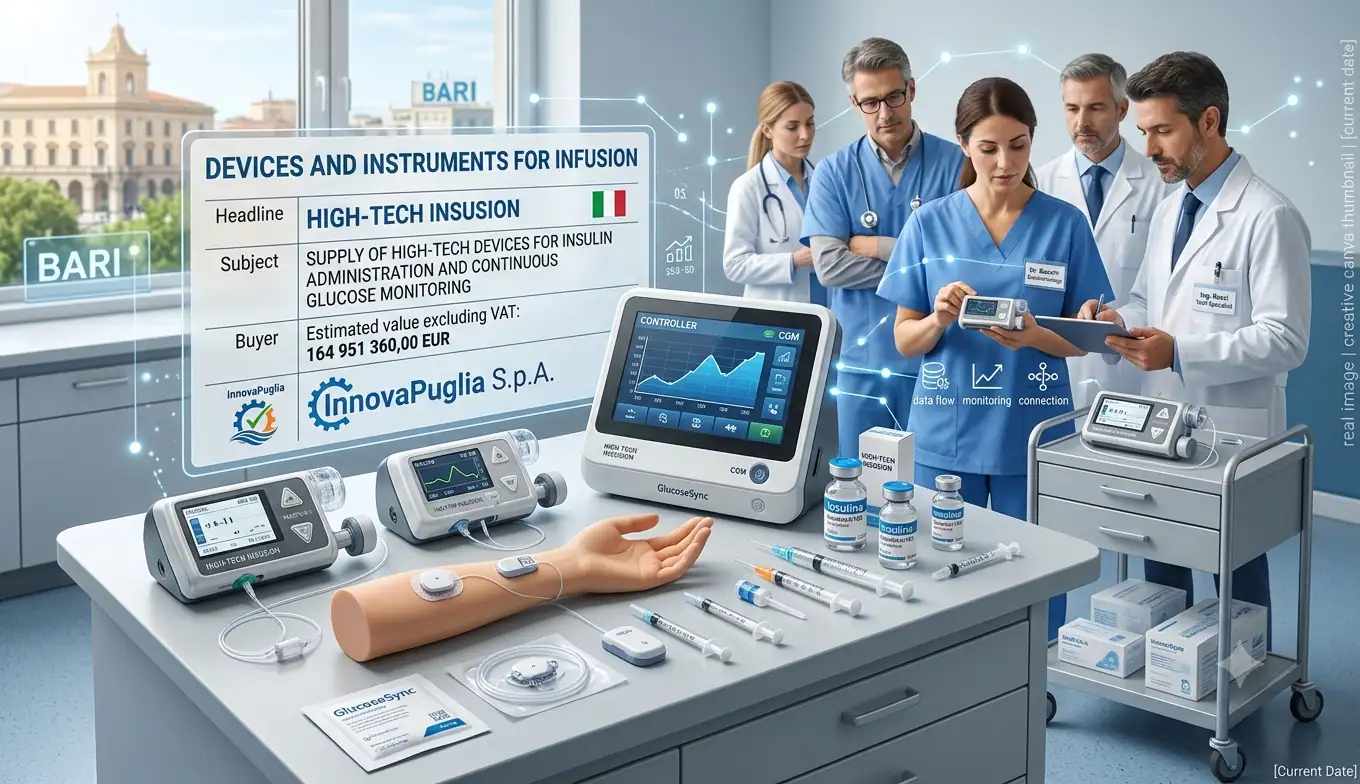
Standfirst InnovaPuglia has awarded a nine lot framework agreement worth EUR 164 951 360 covering insulin pumps, automated insulin delivery systems and continuous glucose monitors for the Puglia region's diabetes patients. Medtronic and Abbott emerged as the largest winners, each capturing multiple lots across the region's full range of modern diabetes management technology. Introduction Managing type 1 diabetes today increasingly means wearing connected technology: an insulin pump that delivers medication automatically, a sensor that tracks blood glucose continuously through the skin and software that links the two together to prevent dangerous highs and lows without constant manual intervention. Puglia's regional health system has just secured that entire technology stack for its patients in one coordinated procurement. Nine separate lots, each covering a distinct category of insulin delivery or glucose monitoring device, drew bids from essentially every major name in global diabetes technology, Medtronic, Abbott, Roche and Ascensia among them, alongside specialist Italian distributors. Why This Contract Matters The range of technology covered here maps closely onto how diabetes care has evolved in recent years: from basic catheter based insulin pumps through to fully automated insulin delivery systems that adjust dosing based on real time glucose readings and from standard continuous glucose monitors to long duration implantable style sensors and simpler flash monitoring systems. Securing all of these categories through a single coordinated regional framework gives Puglia's diabetes patients access to a genuinely comprehensive range of modern treatment options. The scale involved, close to EUR 165 million, also reflects how central this technology has become to diabetes management and how significant a share of regional healthcare technology budgets now goes toward keeping patients connected to increasingly sophisticated monitoring and delivery devices. Contract Timeline Procedure type: Open procedure Notice dispatched to the Publications Office: 3 September 2026 Published in the Official Journal, OJ S 172/2026: 7 September 2026, as notice version 05 Contract Overview InnovaPuglia ran an open procedure to conclude a framework agreement for high technology devices for insulin administration and continuous glucose monitoring, split into nine lots by device category. Every lot was evaluated on a combined quality and price basis. The combined estimated value across all nine lots is EUR 164 951 360. Key Contract Details Contracting authorityInnovaPuglia S.p.A. Contract titleFramework agreement for high technology insulin administration and continuous glucose monitoring devices Procedure typeOpen procedure Combined estimated value, 9 lotsEUR 164 951 360, excluding VAT Award criteria (all lots)Quality and price, best price quality ratio Largest winner by lot countMedtronic Italia SpA, 5 lots Largest lot by valueReal-time CGM with predictive alerts, EUR 50 971 009.19 Review bodyTAR Puglia – Bari Notice reference612988 2026, OJ S 172/2026, published 7 September 2026, version 05 Project Scope The nine lots and their winners are: Lot / device categoryEstimated valueWinner(s) Insulin micropump with catheterEUR 5 357 069.53B.C.Trade, Medtronic Italia Patch (tubeless) insulin micropumpEUR 11 383 772.75B.C.Trade, Biochemical Systems International, Roche Diabetes Care Italy, Pikdare Automated insulin delivery (AID) systemEUR 45 938 610.54Medtronic Italia, Movi, mylife Diabetes Care Italia, Biochemical Systems International Integrated insulin pump + glucose sensor with Predictive Low Glucose SuspendEUR 2 869 858.68Medtronic Italia, Biochemical Systems International Real-time CGM with transcutaneous sensor and predictive alertsEUR 50 971 009.19Abbott, Medtronic Italia, Pikdare Real-time CGM with transcutaneous sensor, no predictive alertsEUR 22 584 918.14Abbott, Roche Diabetes Care Italy, Pikdare Long duration subcutaneous CGMEUR 4 261 305.30Ascensia Diabetes Care Italy Flash glucose monitoring (FGM) with transcutaneous sensorEUR 20 402 086.23Abbott Subcutaneous cannula for multi-injection insulin therapyEUR 1 182 729.64Medtronic Italia, Theras Biocare About the Contracting Authority InnovaPuglia S.p.A. is a regional authority based in Puglia, southern Italy, acting as the region's in-house company for coordinating procurement and innovation, including large scale medical technology frameworks for the region's public health system. About the Organisations Involved InnovaPuglia S.p.A. As covered above, InnovaPuglia is the buyer running this framework on behalf of Puglia's regional health system. TAR Puglia – Bari The Regional Administrative Court of Puglia, based in Bari, is the review organisation for this contract, with ANAC, Italy's National Anti-Corruption Authority, also listed in a supporting procurement oversight role. Medtronic Italia SpA Medtronic, based in Milan, is the broadest winner across this framework, securing five lots spanning insulin micropumps, automated insulin delivery, integrated pump-sensor systems, real-time CGM and injection cannulas. Medtronic is a major global medical technology company well known internationally for its MiniMed insulin pump systems. Abbott Abbott won three lots: both real-time CGM categories and the flash glucose monitoring lot, the latter won outright without a co-winner. Abbott is globally recognised for its FreeStyle Libre continuous and flash glucose monitoring systems, one of the most widely used sensor technologies in diabetes care today. Roche Diabetes Care Italy SpA Roche Diabetes Care, based in Milan, won two lots covering the patch insulin micropump and real-time CGM without predictive alerts, reflecting its established diabetes care portfolio built around the Accu-Chek brand. Biochemical Systems International SpA Biochemical Systems International won three lots: the patch micropump, automated insulin delivery and the integrated pump-sensor category, giving it a broad presence across the insulin delivery side of this framework. Ascensia Diabetes Care Italy S.r.l. Ascensia, based in Milan and known internationally for its Contour blood glucose monitoring products, won the long duration subcutaneous CGM lot outright. B.C.Trade, Movi SpA, mylife Diabetes Care Italia, Pikdare and Theras Biocare These five companies rounded out the winning field. B.C.Trade won the insulin micropump with catheter and patch micropump lots. Movi and mylife Diabetes Care Italia, the Italian arm of Swiss diabetes technology company Ypsomed, both won places in the automated insulin delivery lot. Pikdare, based in Como, won places across three lots spanning micropumps and both real-time CGM categories. Theras Biocare, based near Parma, won the injection cannula lot alongside Medtronic. Procurement Analysis Every lot in this framework was evaluated on a combined quality and price basis, appropriate for medical devices where usability, accuracy and patient safety features matter as much as cost. The multi-winner structure across most lots, particularly the larger CGM and automated insulin delivery categories, gives prescribing clinicians and patients choice among several qualified device options rather than a single mandated product, an important consideration in diabetes technology where individual patient preference and physiology can affect which system works best. The combined lot values reconcile exactly with the procedure's overall EUR 164 951 360 estimate, a clean, internally consistent notice. Additional Procurement Facts This notice has been revised multiple times, now published as its fifth version. The framework covers nine distinct device categories spanning the full range of current insulin delivery and glucose monitoring technology. ANAC, Italy's National Anti-Corruption Authority, is listed alongside the regional administrative court in the procurement's oversight structure. Market and Industry Perspective This framework offers a comprehensive snapshot of the diabetes technology market as it currently stands, with global leaders Medtronic and Abbott each securing broad, multi-category positions, while Roche, Ascensia and Ypsomed's mylife brand each hold more targeted positions in specific device categories. The presence of several Italian specialist distributors alongside these global names reflects how device distribution in Italian regional healthcare markets often runs through established local intermediaries even for internationally manufactured technology. Economic Significance At close to EUR 165 million, this framework represents a substantial regional investment in modern diabetes care technology, giving Puglia's patient population access to automated insulin delivery and advanced continuous glucose monitoring at a scale that reflects the growing clinical importance of these technologies in diabetes management. Future Procurement Opportunities As diabetes technology continues to advance, particularly in automated and closed-loop insulin delivery, further framework recompetes are likely once current terms conclude, offering device manufacturers not yet represented here further opportunities to enter this market. Opportunities for Suppliers Diabetes technology manufacturers and distributors should note the multi-winner lot structure demonstrated here, which allows several qualified suppliers to compete within the same device category rather than a single winner taking the entire market, a pattern that leaves room for well positioned competitors even in a market with strong established global leaders. What Businesses Should Watch How patient and clinician choice distributes usage across the multiple winning suppliers within each device category. Further InnovaPuglia medical technology tenders as the region continues investing in advanced patient care technology. Broader adoption trends in automated insulin delivery and continuous glucose monitoring across other Italian regions. ItalyTenders.com Procurement Intelligence This framework is a clear illustration of how comprehensively a single coordinated regional tender can cover an entire category of modern medical technology, from basic insulin delivery through to the most advanced automated systems, while still preserving genuine supplier choice within most categories. For diabetes technology manufacturers, competing successfully in this kind of framework increasingly requires either broad category coverage, as Medtronic and Abbott demonstrated, or focused excellence in a specific niche, as Ascensia's standalone win in the long duration CGM category shows. The involvement of established Italian distributors alongside global device manufacturers also underscores how much regional Italian healthcare procurement still depends on local market knowledge and distribution relationships, even when the underlying technology itself is developed and manufactured by multinational companies. Supplier Takeaways Medtronic and Abbott each secured broad, multi-category positions across this framework, reflecting the value of comprehensive product portfolios in diabetes technology tenders. Most lots were awarded to multiple suppliers, preserving genuine choice for clinicians and patients within each device category. Standalone category wins, like Ascensia's long duration CGM lot, show that focused specialisation can still secure exclusive market access. Award criteria combined quality and price across all nine lots, rewarding device usability and safety features alongside cost. Italian specialist distributors continue to play a significant role in this market alongside global device manufacturers. Key Takeaways InnovaPuglia awarded a nine-lot diabetes technology framework worth EUR 164 951 360, covering insulin pumps, automated insulin delivery and continuous glucose monitoring. Medtronic Italia won the broadest position, securing five of the nine lots. Abbott won three lots including the flash glucose monitoring category outright. Roche Diabetes Care, Biochemical Systems International, Ascensia and several Italian distributors also secured lot wins. All lots were evaluated on a combined quality and price basis. This notice has been revised multiple times, now published as its fifth version. Conclusion From a basic insulin cannula to a fully automated closed-loop delivery system, this framework gives Puglia's diabetes patients access to the complete modern toolkit of insulin management technology, sourced from the industry's leading names. With Medtronic and Abbott anchoring the broadest categories and several specialists filling in the rest, the region has built a comprehensive, competitively sourced foundation for diabetes care that should serve its patient population for years to come. Source: Tenders Electronic Daily (TED), Contract Award Notice 612988-2026, Official Journal of the European Union, OJ S 172/2026, published on 7 September 2026.
View Details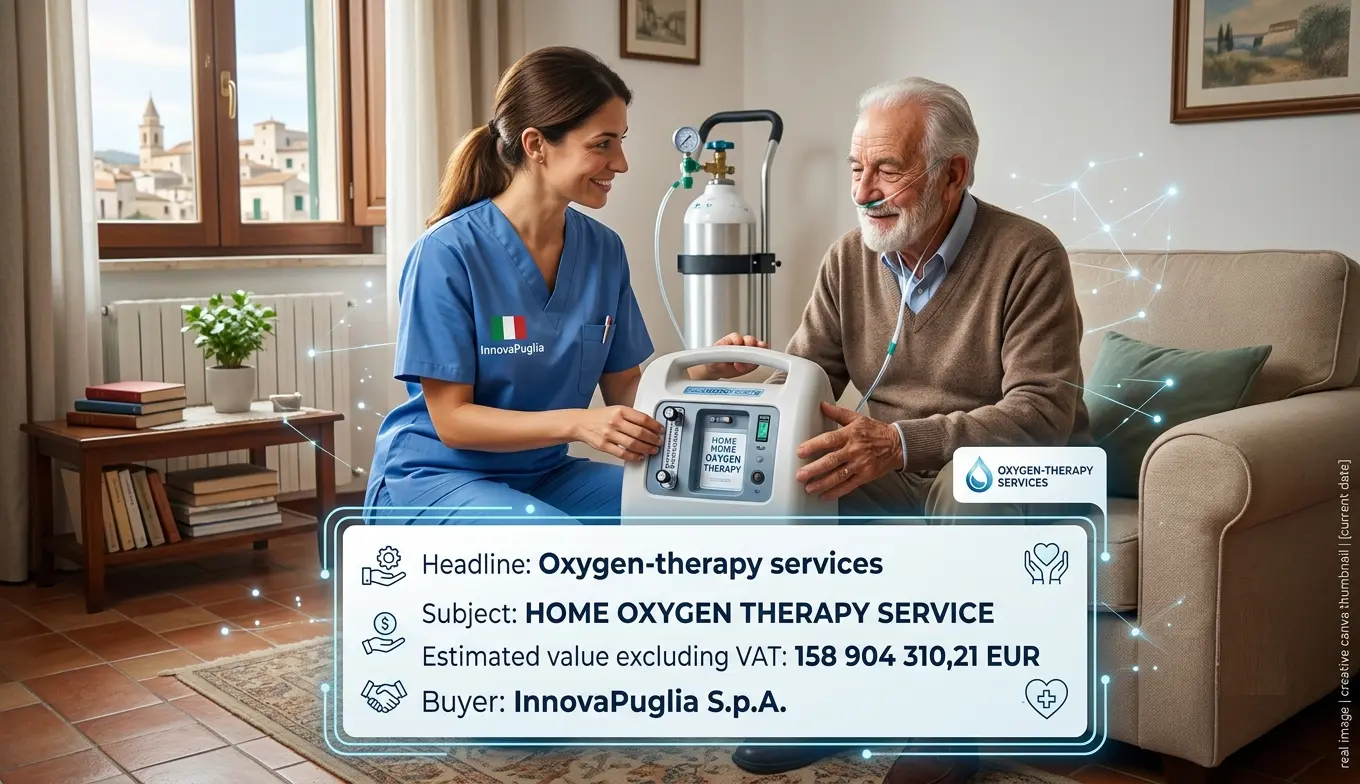
Puglia Locks In Home Oxygen Therapy for the Whole Region, at Roughly Half the Original Estimate
04 Sep 2026
Standfirst InnovaPuglia has awarded four regional contracts for home oxygen therapy services across Puglia's health authorities to Linde Medicale, SICO and Nippon Sanso Pharma, with a combined value of roughly EUR 82.9 million against an original estimate of EUR 158.9 million. Every one of the four lots was won at close to half its budgeted value, a striking and consistent pattern across the whole tender. Introduction For patients with chronic respiratory conditions who need supplemental oxygen at home rather than in hospital, home oxygen therapy is not a convenience, it is often what allows them to live outside a clinical setting at all. Puglia's regional health system has just secured that service for its entire population, splitting the work into four geographic zones covering the region's local health authorities. Three companies, all major names in industrial and medical gas supply, Linde Medicale, SICO and Nippon Sanso Pharma, will now deliver that care. What stands out beyond the winners themselves is the price: every single lot was awarded at roughly half its original estimated value, a consistency worth examining closely. Why This Contract Matters Home oxygen therapy sits at the intersection of medical equipment supply and direct patient care, requiring not just oxygen concentrators or cylinders but ongoing logistics, delivery, equipment maintenance and clinical support delivered directly into patients' homes across an entire region. Structuring this as four geographic lots, rather than one region wide contract, lets Puglia's health system match local delivery capacity to each area's specific patient population. The scale of the savings achieved here, roughly EUR 76 million below the original combined estimate across all four lots, is also worth understanding. Whether this reflects genuinely intense competition, a systematically conservative original budget, or something specific to how this therapy is priced and reimbursed, the gap between estimate and outcome is large enough to be the central story of this procurement. Contract Timeline Winners selected: 14 May 2026, all four lots Notice dispatched to the Publications Office: 2 September 2026 Published in the Official Journal, OJ S 171/2026: 4 September 2026, as notice version 08 Contract Overview InnovaPuglia S.p.A. ran an open procedure for home oxygen therapy services across Puglia, split into four lots by geographic area, each aligned to specific local health authorities. The combined estimated value across all four lots was EUR 158 904 310.21. The four winning tenders together came to approximately EUR 82 912 562.46, meaning every lot was awarded at close to half its original estimated value. Key Contract Details Contracting authorityInnovaPuglia S.p.A. Contract titleHome Oxygen Therapy service, Puglia region Procedure typeOpen procedure Combined estimated value, all 4 lotsEUR 158 904 310.21, excluding VAT Combined awarded value, all 4 lotsApproximately EUR 82 912 562.46, roughly 52 percent of the combined estimate Lot 1 (North: ASL BT, ASL FG)EUR 29 274 895.66 estimated; awarded EUR 15 449 799.54 to Linde Medicale Lot 2 (Centre 1: ASL BA)EUR 45 914 336.38 estimated; awarded EUR 24 051 310.23 to SICO Lot 3 (Centre 2: ASL BR, ASL TA)EUR 41 996 406.26 estimated; awarded EUR 21 559 138.41 to Nippon Sanso Pharma Lot 4 (South: ASL LE)EUR 41 718 671.90 estimated; awarded EUR 21 852 314.28 to SICO Winners selected14 May 2026, all lots Notice reference612151 2026, OJ S 171/2026, published 4 September 2026, version 08 Project Scope The four lots divide Puglia's home oxygen therapy service by geography: a North area covering the local health authorities of Barletta-Andria-Trani and Foggia; a Centre 1 area covering Bari; a Centre 2 area covering Brindisi and Taranto; and a South area covering Lecce. Together, the four lots span the full territorial reach of Puglia's regional health system, ensuring every part of the region has a designated home oxygen therapy provider. About the Contracting Authority InnovaPuglia S.p.A. is a regional authority based in Puglia, southern Italy, acting as the region's in-house company for coordinating procurement and innovation on behalf of Puglia's public administration, including its regional health system. About the Organisations Involved InnovaPuglia S.p.A. As covered above, InnovaPuglia is the buyer running this regional tender on behalf of Puglia's health authorities. Linde Medicale Linde Medicale, based in Arluno near Milan, won Lot 1, the North area covering Barletta-Andria-Trani and Foggia, with a winning bid of EUR 15 449 799.54. Linde Medicale operates as the medical gas division of Linde, one of the world's largest industrial gas companies, with a substantial home healthcare and medical gas supply business across Italy. SICO Società Italiana Carburo Ossigeno S.p.A. SICO, based in Milan, won two of the four lots: Lot 2, the Centre 1 area covering Bari, worth EUR 24 051 310.23 and Lot 4, the South area covering Lecce, worth EUR 21 852 314.28, making it the largest single winner in this tender by combined value, at just under EUR 46 million. Nippon Sanso Pharma S.r.l. Nippon Sanso Pharma, based in Milan, won Lot 3, the Centre 2 area covering Brindisi and Taranto, with a winning bid of EUR 21 559 138.41. The company is the Italian pharmaceutical gas arm of Nippon Sanso Holdings, a major Japanese industrial gas group with global operations. Procurement Analysis The consistency of the savings across all four lots is the defining feature of this tender. Lot 1 was awarded at roughly 53 percent of its estimate, Lot 2 at roughly 52 percent, Lot 3 at roughly 51 percent and Lot 4 at roughly 52 percent, an unusually tight clustering that suggests something systematic rather than coincidental. This could reflect a shared understanding among bidders of the service's true cost structure, a standard reimbursement or tariff based pricing model common in Italian regional healthcare service contracts where the original estimate may have been built on conservative assumptions, or simply strong, well informed competition among a small number of specialist suppliers who know this market precisely. The fact that this notice has been published as its eighth version indicates a lengthy administrative history, with multiple prior corrections or updates to the record before reaching this current, presumably final, state. Additional Procurement Facts All four lots are geographically distinct, ensuring dedicated provider coverage across every part of Puglia's regional health system. Three separate companies won across the four lots, with SICO securing two, avoiding full market concentration with a single supplier. All four winners were selected on the same date, indicating a coordinated evaluation process across the full tender. Market and Industry Perspective Home oxygen therapy and medical gas supply in Italy is dominated by a small number of large, often multinational, industrial gas companies with the logistics infrastructure needed to deliver oxygen equipment and support directly to patients' homes at regional scale. Linde, SICO and Nippon Sanso Pharma's presence here reflects that concentrated market structure, where genuine competition exists among a handful of credible national and international players rather than a broad field of smaller local providers. Economic Significance At a combined awarded value of roughly EUR 82.9 million, spread across four regional contracts, this is a substantial, recurring investment in home based respiratory care for Puglia's patient population, delivering meaningful savings against the original budget while securing dedicated provider coverage across the entire region. Future Procurement Opportunities Given the multi-year nature typical of home healthcare service contracts of this kind, further recompetes are likely once current terms conclude, offering other medical gas and home healthcare providers a future opportunity to compete for Puglia's regional oxygen therapy business. Opportunities for Suppliers Medical gas and home healthcare service providers should note the geographic lot structure demonstrated here as a common model in Italian regional healthcare procurement, allowing suppliers to focus bidding resources on specific territories matched to their existing logistics footprint rather than needing to cover an entire region. What Businesses Should Watch Whether the significant gap between estimated and awarded value across all four lots reflects a broader pattern in Italian regional healthcare service tendering. Service delivery performance across the four geographic areas as the new contracts take effect. Future InnovaPuglia tenders for related home healthcare or medical equipment services. ItalyTenders.com Procurement Intelligence The consistent, roughly 50 percent gap between estimated and awarded value across all four lots in this tender is the detail worth remembering. When every lot in a multi-lot tender lands at a similar discount to its estimate, it points toward a structural feature of the market or the pricing model, not chance and businesses tracking Italian regional healthcare procurement should watch for whether this pattern recurs in comparable future tenders, since it may indicate that original budget estimates in this specific service category are consistently set well above what genuine competition ultimately delivers. For medical gas and home healthcare suppliers, the fact that three companies split four lots, rather than one company sweeping the entire region, suggests genuine competitive dynamics persist even in a market dominated by a small number of large multinational players, offering a meaningful opening for well positioned specialists to secure regional footholds. Supplier Takeaways All four lots in this tender were awarded at close to half their original estimated values, a striking and consistent pattern worth understanding before bidding into similar future tenders. Three different suppliers won across four lots, showing genuine competitive distribution rather than single supplier dominance. Geographic lot structures matched to specific local health authorities are a common and effective way to compete for regional shares of large healthcare service contracts. This notice's eighth version status reflects a lengthy administrative correction history, a reminder to check for the most current version before relying on any single publication. Key Takeaways InnovaPuglia awarded four regional home oxygen therapy contracts worth a combined EUR 82.9 million, against an original estimate of EUR 158.9 million. Winners are Linde Medicale, SICO (two lots) and Nippon Sanso Pharma. Every lot was awarded at roughly half its estimated value, a consistent pattern across the entire tender. The four lots cover Puglia's full territory, split by local health authority groupings. All winners were selected on the same date, 14 May 2026. This notice has been revised multiple times, now published as its eighth version. Conclusion Behind the routine language of a regional healthcare services tender sits a genuinely striking pricing story: four separate contracts, four separate winners and every single one landing at almost exactly half its original budget. For patients across Puglia who depend on oxygen therapy to stay safely at home, the practical outcome is straightforward, dedicated providers now cover every corner of the region. For anyone tracking how Italian healthcare tenders are priced, the consistency of that discount is the detail worth watching closest. Source: Tenders Electronic Daily (TED), Contract Award Notice 612151-2026, Official Journal of the European Union, OJ S 171/2026, published on 4 September 2026.
View Details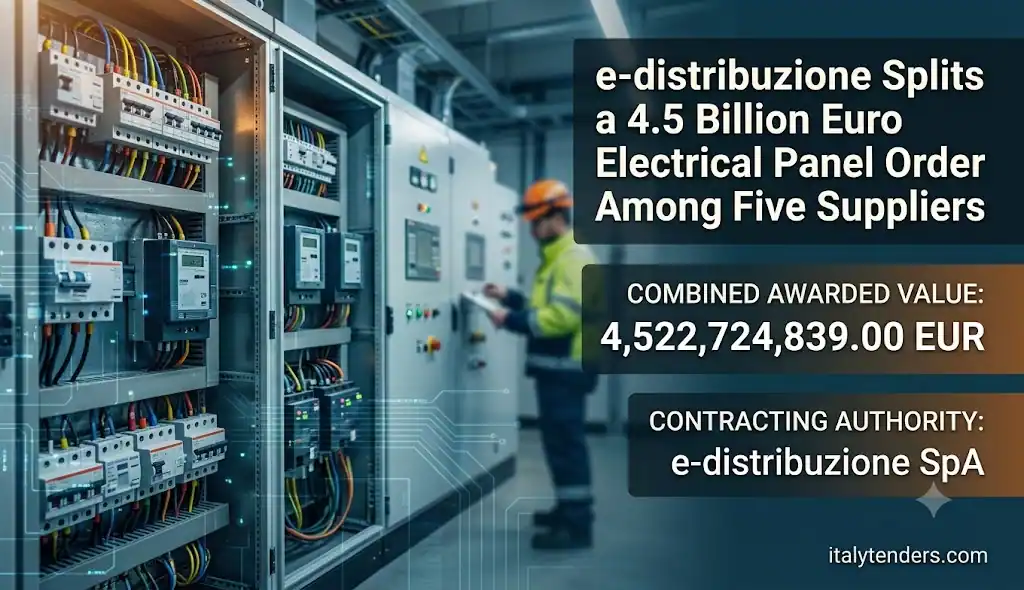
e-distribuzione Splits a 4.5 Billion Euro Electrical Panel Order Among Five Suppliers
03 Sep 2026
Standfirst e-distribuzione SpA, Italy's national electricity distribution operator, has awarded a combined 4.52 billion euros for electrical apparatus boards to five suppliers, led by Col Giovanni Paolo SpA with more than 2.1 billion euros. The award was decided through a negotiated procedure rather than open competitive bidding. Introduction Every electrical substation and distribution point across Italy's power grid depends on specialised boards and panels that house switches, protection devices and control equipment. Sourcing this equipment reliably, at the scale a national grid operator requires, means securing multiple qualified manufacturers rather than depending on a single supply line. e-distribuzione has just done exactly that, splitting a multi-billion euro order for these boards across five different Italian manufacturers. Why This Contract Matters Boards for electrical apparatus are foundational components in grid infrastructure and a supply agreement of this scale, spread across five manufacturers, reflects the volume e-distribuzione needs to keep Italy's electricity distribution network built out and maintained. Splitting the award this way also reduces the operator's dependency on any single supplier's manufacturing capacity. Contract Timeline The notice recording this award was dispatched on 2 September 2026 and published in the Official Journal of the European Union on 3 September 2026, under OJ S issue 170/2026. Contract Overview e-distribuzione SpA, an entity with special or exclusive rights operating in electricity related activities, ran this as a negotiated procedure with prior publication of a call for competition, also known as competitive with negotiation, under Directive 2014/25/EU, the EU's utilities directive. The classification is CPV code 31211100, Boards for electrical apparatus. The overall estimated value, matching the notice's confirmed value of all contracts awarded, was 4,522,724,839.00 EUR excluding VAT. Five suppliers were named as winners on the single lot covered by this notice, with individual tender values ranging from 101.16 million euros to 2.14 billion euros. Summing all five confirmed values reproduces the overall contract value exactly. Key Contract Details Contracting Authoritye-distribuzione SpA Winning BiddersCol Giovanni Paolo SpA, EA Srl, Messina Energia Srl Unipersonale, NTET SpA, Boffetti SpA Contract TitlePpr_76968, Lotto DY800/803 Procedure TypeNegotiated with prior publication of a call for competition Legal BasisDirective 2014/25/EU (utilities) CPV Code31211100 Boards for electrical apparatus Combined Awarded Value (excl VAT)4,522,724,839.00 EUR Col Giovanni Paolo SpA2,142,242,000.00 EUR EA Srl877,471,700.00 EUR Messina Energia Srl Unipersonale741,180,000.00 EUR NTET SpA660,670,280.00 EUR Boffetti SpA101,160,859.00 EUR EU FundingFully or partially financed with EU funds Covered by GPAYes Review OrganisationTAR Lazio Project Scope The contract covers the supply of boards for electrical apparatus, equipment used to house and organise electrical switching, protection and control components at substations and distribution points across e-distribuzione's national grid infrastructure. The notice does not detail further technical specifications, quantities or delivery schedules beyond this classification. About the Contracting Authority e-distribuzione SpA e-distribuzione SpA is registered as an entity with special or exclusive rights, with electricity related activities as its classified contracting entity activity. It is Italy's principal electricity distribution operator, part of the Enel group, responsible for building and maintaining the national low and medium voltage electricity distribution network. About the Organisations Involved Col Giovanni Paolo SpA Col Giovanni Paolo SpA, based in Trofarello and classified as a large enterprise, was the largest winner by value, securing 2.14 billion euros of the total contract. EA Srl EA Srl, based in Ascoli Piceno and classified as a medium sized enterprise, won 877.47 million euros of the contract. Messina Energia Srl Unipersonale Messina Energia Srl Unipersonale, based in Barletta and classified as a small enterprise, won 741.18 million euros, a notably large award for a company of this classified size. NTET SpA NTET SpA, based in Garbagnate Milanese and classified as a large enterprise, won 660.67 million euros. Boffetti SpA Boffetti SpA, based in Calusco d'Adda and classified as a large enterprise, won the smallest share among the five winners, 101.16 million euros, with subcontracting explicitly recorded as not used and its tender confirmed as not a variant. Procurement Analysis e-distribuzione used a negotiated procedure with prior publication of a call for competition rather than a standard open tender, a route that allows direct dialogue with qualified bidders on technical and commercial terms, often used for complex or high volume supply arrangements of this kind. The absence of a formal framework agreement structure, despite five parallel winners on a single lot, indicates each supplier was awarded a direct portion of the overall requirement rather than being appointed to a panel for later call-offs. The wide range in individual award values, from just over 100 million euros to more than 2.1 billion euros, suggests the five winners were allocated different volumes of the overall supply requirement, likely reflecting differences in manufacturing capacity, technical specialisation, or negotiated terms among the qualified bidders. Additional Procurement Facts The contract is confirmed as fully or partially financed with EU funds and is covered by the Government Procurement Agreement. No framework agreement or dynamic purchasing system applies. Market and Industry Perspective The five winning suppliers reflect Italy's domestic electrical equipment manufacturing base, spanning companies of varying scale from small to large enterprise classification, all contributing to supplying e-distribuzione's national grid infrastructure needs. Economic Significance At 4.52 billion euros combined, this is an exceptionally large supply contract, reflecting the scale of investment e-distribuzione is directing toward its electrical distribution infrastructure and the substantial role Italian electrical equipment manufacturers play in supporting the national grid. Future Procurement Opportunities Given the scale of this order and e-distribuzione's ongoing infrastructure investment programme, further similar procurements for grid equipment and components are likely as the operator continues expanding and maintaining its distribution network. Opportunities for Suppliers Electrical equipment manufacturers not among this round's five winners should watch for e-distribuzione's future procurement cycles for grid components, given the substantial and recurring nature of national grid infrastructure investment. What Businesses Should Watch Electrical equipment manufacturers and grid infrastructure suppliers should watch for further e-distribuzione tenders of this kind and should monitor Italy's broader electricity grid investment pipeline for related opportunities. ItalyTenders.com Procurement Intelligence This award illustrates how Italy's national grid operator secures essential electrical infrastructure components at a scale requiring multiple parallel suppliers, splitting a multi-billion euro requirement across five manufacturers rather than concentrating it with a single provider, likely to manage capacity constraints and supply risk across such a large volume order. Its strategic importance lies in the sheer scale of investment it represents in Italy's electricity distribution infrastructure and in what the widely varying award values suggest about how manufacturing capacity and specialisation are distributed among Italy's domestic electrical equipment suppliers. Supplier Takeaways Five suppliers won portions of this contract, with award values ranging from 101 million to 2.14 billion euros The award used a negotiated procedure with prior competition rather than a standard open tender No framework agreement applies, meaning each supplier received a direct allocation of the overall requirement Suppliers ranged from small to large enterprise classification, showing room for varying company sizes in this equipment category Key Takeaways e-distribuzione has awarded a combined 4,522,724,839.00 EUR contract for electrical apparatus boards to five suppliers Col Giovanni Paolo SpA was the largest winner with 2.14 billion euros The contract is EU funded and covered by the Government Procurement Agreement The award used a negotiated procedure with prior publication of a call for competition Conclusion This award secures e-distribuzione's supply of critical electrical distribution components across five domestic manufacturers, reflecting the scale of ongoing investment in Italy's national grid infrastructure. For the winning suppliers, from large national manufacturers to smaller regional firms, it represents a substantial, multi-year commercial engagement with the country's principal electricity distribution operator. Source: Tenders Electronic Daily (TED), Contract Award Notice 608630-2026, Official Journal of the European Union, OJ S issue 170/2026, published on 03/09/2026.
View Details