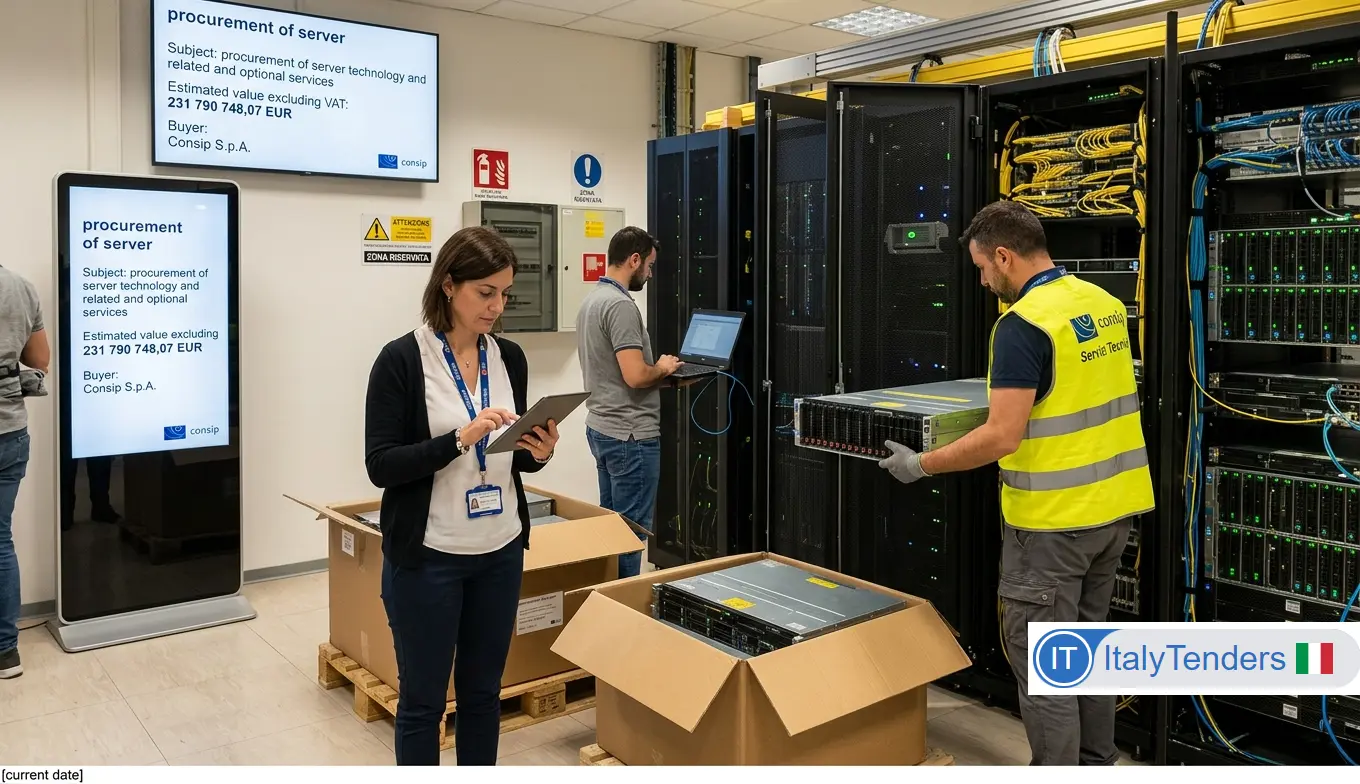
Consip Revokes Award for EUR 38 Million AI Server Lot After Winning Bidder Fails to Confirm Its Own Offer
10 Sep 2026
Standfirst Consip, Italy's national central purchasing body, has revoked its own award decision for Lot 5 of a national server technology programme after the original winner, Infordata S.p.A., failed to formally confirm its bid and did not extend its required bid guarantee. The lot, covering entry-level AI-capable rack servers worth an estimated EUR 38 194 247.43, now stands with no winner and the competition formally closed. Introduction Sometimes a procurement story isn't about who won, but about a win that quietly unravelled. Consip ran an eight-lot national tender to supply Italian public administration with server technology and one lot in particular, covering AI-capable rack servers, has ended up back at square one after the company originally selected to supply it did not follow through on basic post-award obligations. The result is a formally closed competition with no winner, a EUR 38 million gap in Italy's public sector server procurement plans and a candid explanation from Consip itself about exactly what went wrong. Why This Contract Matters This lot covers dual-processor rack servers fitted with entry-level GPUs specifically for AI workloads, a category of hardware in high demand across public and private sectors alike as government agencies begin building out their own AI processing capacity. A gap in this specific procurement channel, even temporarily, could affect how quickly Italian public administrations can access this hardware through Consip's national framework. The episode is also a useful, transparent example of how public buyers handle a winning bidder that fails to complete the formalities required after selection. Consip's own notice explains plainly what happened, rather than leaving the non-award unexplained, offering a rare, documented look at procurement going wrong after the finish line rather than before it. Contract Timeline Procedure type: Open procedure under Directive 2014/24/EU and Italy's D.Lgs. 36/2023 Award to Infordata S.p.A. formally revoked by Consip prior to this notice Notice dispatched to the Publications Office: 9 September 2026 Published in the Official Journal, OJ S 175/2026: 10 September 2026 Contract Overview Consip ran an open procedure, split into eight lots, for the supply of server technology and related optional services to Italian public administrations, under its ID 2878 programme, with a combined estimated value of EUR 231 790 748.07. This notice addresses Lot 5 specifically, covering dual-processor rack servers with entry-level AI GPUs, estimated at EUR 38 194 247.43. Only one tender was received for this lot, from Infordata S.p.A., which was initially declared the winner. Consip subsequently revoked that award as a self-correcting administrative measure, explaining in the notice that Infordata did not formally confirm its own bid and failed to deliver a required extension to the provisional guarantee it had submitted during the tender, despite being asked to do so. With no other valid tender available, the lot has been closed with no winner chosen. Key Contract Details Contracting authorityConsip S.p.A. Overall programme titleSupply of server technologies and related services for public administrations, ID 2878 Lot covered in this noticeLot 5, dual-processor rack servers with entry-level AI GPU CPV code48820000, Servers Procedure typeOpen procedure, 8 lots overall Legal basisDirective 2014/24/EU and Italy's D.Lgs. 36/2023 Overall programme estimated valueEUR 231 790 748.07, excluding VAT Lot 5 estimated valueEUR 38 194 247.43, excluding VAT Award criteriaPrice, single criterion Tenders received for Lot 51, from Infordata S.p.A. OutcomeOriginal award revoked; no winner chosen, competition closed Reason for non-awardOther, specifically the winning bidder's failure to confirm its bid and extend its guarantee EU fundingYes, fully or partially financed with EU funds GPA coverageYes Review bodyTribunale Amministrativo Regionale per il Lazio – Roma, 30 day review deadline Notice reference624282 2026, OJ S 175/2026, published 10 September 2026 Project Scope Lot 5 covers rack-mountable, dual-processor servers equipped with entry-level GPUs, specified for AI workloads, part of the broader eight-lot ID 2878 programme supplying server technology and related optional services to Italian public administration under Italy's long-standing framework agreement mechanism established under national law from 1999 and 2000. The notice does not detail the remaining seven lots' outcomes, focusing solely on Lot 5's revoked award. About the Contracting Authority Consip S.p.A. is a body governed by public law based in Rome, active in general public services. Consip is Italy's national central purchasing body, wholly owned by the Ministry of Economy and Finance, running large scale framework agreements across virtually every category of public sector procurement, including this national server technology programme. About the Organisations Involved Consip S.p.A. As covered above, Consip is the buyer running this national server technology programme and the body that made and subsequently revoked, the award decision for Lot 5. Tribunale Amministrativo Regionale per il Lazio – Roma The Lazio Regional Administrative Court in Rome is the review organisation for this contract, with a 30 day window to file a challenge from the date of publication in Italy's national public contracts database. Infordata S.p.A. Infordata S.p.A. was the sole tenderer for Lot 5 and was initially selected as the winner before Consip revoked that decision. According to Consip's own notice, Infordata did not formally confirm its bid after selection and failed to submit an extension to the provisional guarantee it had lodged during the tender process, despite being asked to do so, leading directly to the revocation. Procurement Analysis This is not a standard non-award case. Unlike a lot that simply drew no bids, Lot 5 did receive a tender and that tender was initially successful. What changed the outcome was the winning bidder's own subsequent conduct: failing to formally confirm the offer it had submitted and failing to extend the bid guarantee Consip required as a condition of moving the award forward. Consip's use of the term "autotutela," a specific Italian administrative law mechanism allowing a public body to revoke its own prior decisions when justified, confirms this was a formal, legally grounded correction rather than an informal reversal. With only one tender ever submitted for this lot, its revocation leaves Consip without any remaining valid bid to fall back on, explaining why the lot is now recorded as closed with no winner rather than simply moving to the next ranked bidder. Additional Procurement Facts This lot is confirmed as financed fully or partially with EU funds and as covered by the Government Procurement Agreement. No framework agreement structure or dynamic purchasing system applies to this specific lot's technique classification, despite the overall programme functioning as a national supply convention. Award evaluation was based on price alone, with the specific weighting method also described simply as price. Market and Industry Perspective AI-capable server hardware remains in high demand across both public and private sectors and a revoked award in this specific category leaves a gap in Italy's national public sector supply channel at a moment when demand for this kind of infrastructure is rising. The fact that only one supplier bid for this lot in the first place also suggests a relatively narrow field of vendors positioned to meet Consip's specific technical requirements for entry-level AI GPU servers within its national framework terms. Economic Significance At an estimated EUR 38.19 million, Lot 5 represents a meaningful share of the broader EUR 231.79 million programme. Its revocation and subsequent non-award leaves this portion of Italy's national server procurement plan unresolved, pending either a retender or an alternative resolution. Future Procurement Opportunities Given that only one supplier bid originally and that bid has now been revoked, Consip is likely to relaunch this lot, potentially with revised terms or clearer post-award compliance requirements, giving other server hardware suppliers a fresh opportunity to compete for this business. Opportunities for Suppliers Server hardware manufacturers and distributors with AI-capable rack server offerings should treat this notice as a clear signal of unmet demand within Consip's national programme. With the only prior bidder's award revoked, a well-prepared supplier able to meet the technical specification and follow through on post-award formalities would face a considerably more open field in any retender. What Businesses Should Watch Whether Consip relaunches Lot 5 as a standalone retender and what terms accompany a second attempt. The outcomes of the remaining seven lots within the broader ID 2878 server technology programme. Whether Infordata faces any further consequences or exclusion from future Consip tenders following this revocation. ItalyTenders.com Procurement Intelligence This notice is a useful reminder that winning a public tender is not the final step, it is the beginning of a set of formal obligations that must be completed before an award becomes final. A bidder that fails to confirm its own offer or maintain its required financial guarantees can lose a contract even after being selected and Consip's willingness to document this outcome plainly gives the market a rare, transparent look at how that process plays out in practice. For suppliers, the lesson is straightforward: post-award administrative diligence matters as much as the bid itself. A single missed deadline for a guarantee extension was enough to unwind an entire award on a contract worth close to EUR 38 million, a cautionary example worth internalising for any firm managing multiple simultaneous public sector bids and their associated compliance deadlines. Strategically, the revoked lot also represents a genuine, currently open opportunity. With the only previous bidder now out of contention, any AI server supplier able to meet Consip's specification and follow through on the formalities has a clear, largely uncontested path into this segment of Italy's public sector hardware market. Supplier Takeaways A winning bid can still be revoked if the successful bidder fails to complete required post-award steps, including confirming the offer and extending financial guarantees. This lot drew only one bid originally, suggesting limited competition for this specific AI server specification within Consip's programme. With the prior award revoked, a retender is a realistic next step, offering a fresh, largely open opportunity for qualified suppliers. Post-award administrative compliance, including guarantee extensions and formal bid confirmation, is as important as the bid itself in Italian public procurement. AI-capable server hardware remains a high demand category worth monitoring across Italian public sector procurement. Key Takeaways Consip revoked its award of Lot 5, an EUR 38 194 247.43 lot for AI-capable rack servers, after winning bidder Infordata S.p.A. failed to confirm its bid and extend its guarantee. The lot is now formally closed with no winner chosen. Only one tender was ever submitted for this lot. The lot sits within a broader eight-lot, EUR 231.79 million national server technology programme. The lot is financed with EU funds and covered by the Government Procurement Agreement. This notice does not address the outcomes of the programme's other seven lots. Conclusion A win that never became a contract leaves Italy's public sector without a secured supplier for a meaningful slice of its AI server needs and leaves Infordata with a cautionary tale about the cost of missed paperwork. For any hardware supplier watching this market, the revoked lot is now an open door, waiting for someone willing to see the process through to the end. Source: Tenders Electronic Daily (TED), Contract Award Notice 624282-2026, Official Journal of the European Union, OJ S 175/2026, published on 10 September 2026.
View Details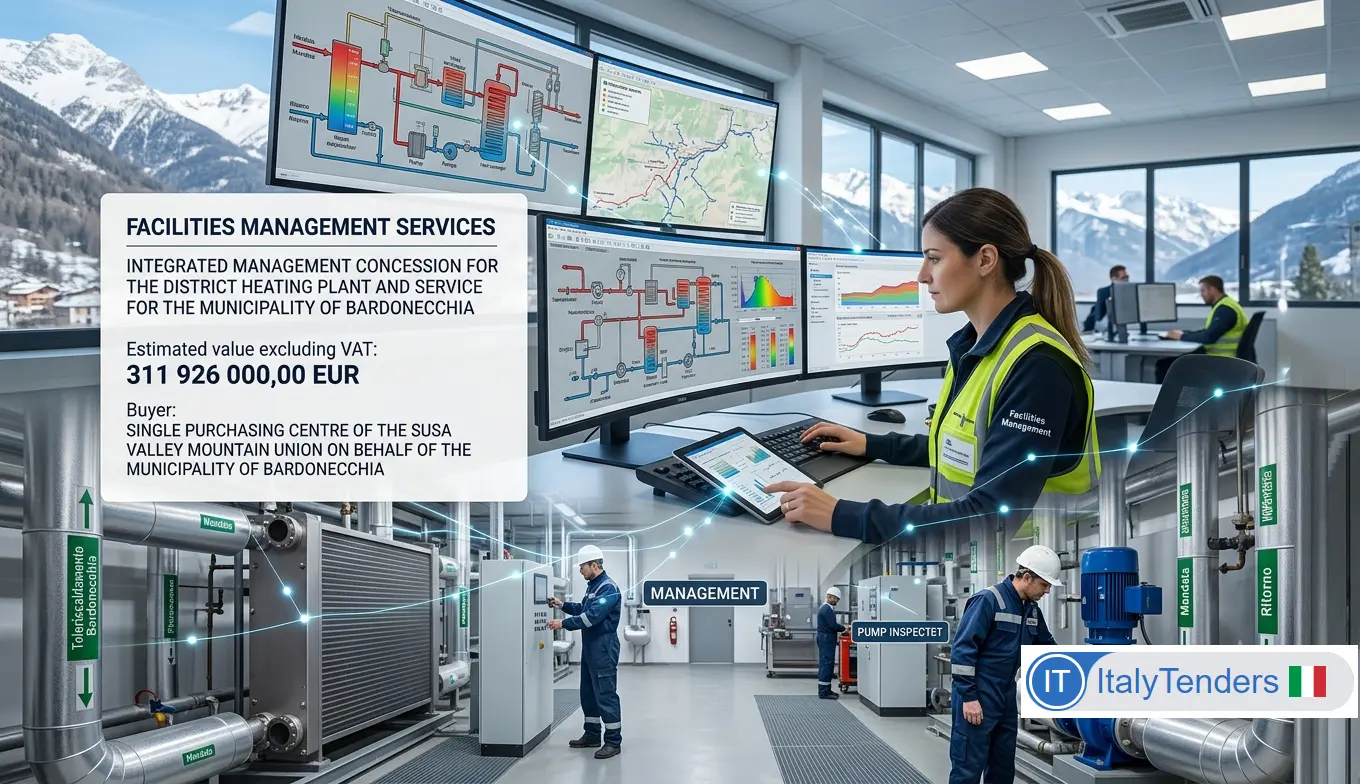
A Ski Resort's District Heating Gets a 30-Year Public Private Partnership Worth Over EUR 360 Million
09 Sep 2026
Standfirst The Municipality of Bardonecchia, the Alpine ski resort in Piedmont, has awarded a 30 year public-private partnership to revamp its district heating production plant and manage the integrated heating network and service, to a consortium of Metan Alpi Sestriere Teleriscaldamento and Ecotermica Servizi. The winning bid came in at EUR 363 460 000, notably above the original EUR 311 926 000 estimate, in a notice that also shows conflicting information about which company actually leads the winning team. Introduction Bardonecchia, a well known ski destination in Italy's western Alps near the French border, depends heavily on reliable heating through its long, cold mountain winters, both for residents and for the tourists who fill the town during ski season. The municipality has now committed to a three decade partnership to modernise the production plant behind its district heating network and hand over its ongoing management to a private consortium. Two bidders competed for the concession and the winning team, a temporary business grouping pairing Metan Alpi Sestriere Teleriscaldamento with Ecotermica Servizi, will now be responsible for both rebuilding the plant and running the entire heating service for the next 30 years. Why This Contract Matters District heating, where a central plant produces heat distributed to buildings across a town through an insulated pipe network, is a particularly important piece of infrastructure in an Alpine resort like Bardonecchia, where winter heating demand is intense and where the plant itself may already be showing its age. Structuring this as a public-private partnership, rather than a straightforward public works contract, shifts both the investment burden and the long term operational risk onto the private partner, who recoups its investment through 30 years of managing the service. The scale of the commitment, over EUR 360 million for a single Alpine municipality's heating system, reflects just how significant a revamped, modernised district heating plant and network represents for a town of Bardonecchia's size and underscores how seriously the municipality is treating the long term reliability of this essential winter service. Contract Timeline Concession start date: 1 October 2025 Winner selected: 15 May 2026 Contract concluded: 31 August 2026 Notice dispatched to the Publications Office: 7 September 2026 Published in the Official Journal, OJ S 174/2026: 9 September 2026 Concession duration: 30 years, no renewals Contract Overview The Single Purchasing Centre of the Susa Valley Mountain Union, acting on behalf of the Municipality of Bardonecchia, ran a procedure for a public private partnership covering design and construction of revamping works at the district heating production plant, alongside a concession for integrated management of the plant and heating service. Two tenders were submitted and the contract was awarded to a temporary business grouping of Metan Alpi Sestriere Teleriscaldamento and Ecotermica Servizi, with a winning bid of EUR 363 460 000, running for 30 years from an October 2025 start date. The winning tender value exceeds the procedure's original estimated value of EUR 311 926 000 by roughly EUR 51.5 million, a gap the notice does not explain, but one likely reflecting the specific scope, technical solution and investment commitments the winning consortium proposed as part of its bid, common in complex, long term PPP concessions where the final negotiated or awarded value can diverge meaningfully from an initial baseline estimate. Key Contract Details Contracting authorityCentrale Unica di Committenza dell'Unione Montana Valle Susa, for the Municipality of Bardonecchia Contract titlePublic-private partnership for revamping and concession of Bardonecchia's district heating plant and service CPV code79993100, Facilities management services, plus district-heating construction and technical services codes Legal basisOther (Italian national concession law) Estimated valueEUR 311 926 000, excluding VAT Awarded valueEUR 363 460 000, excluding VAT, roughly 16.5 percent above the estimate Concession duration30 years, starting 1 October 2025, no renewals Award criteriaTechnical offer (quality) 75 percent; economic offer (price) 25 percent Tenders received2, both electronic WinnerTemporary business grouping of Metan Alpi Sestriere Teleriscaldamento and Ecotermica Servizi SubcontractingYes, value and percentage not disclosed Winner selected15 May 2026 Contract signed31 August 2026 GPA coverageNo EU fundingNo Review bodyTribunale Amministrativo Regionale Piemonte, Torino Notice reference621704 2026, OJ S 174/2026, published 9 September 2026 Project Scope The partnership covers two linked responsibilities: designing and constructing revamping works at Bardonecchia's district heating production plant and taking on a concession for the integrated management of both the plant and the heating service itself once revamped. Additional CPV classifications attached to the contract cover district heating mains construction, district heating plant construction, warehouse construction work and general restructuring work, indicating the project spans both the central production facility and elements of the surrounding distribution and storage infrastructure. About the Contracting Authority The Centrale Unica di Committenza dell'Unione Montana Valle Susa is a local authority and contracting entity active in general public services, running this procurement on behalf of the Municipality of Bardonecchia, a mountain town in Piedmont's Turin province known internationally as an Alpine ski resort near the French border. About the Organisations Involved Centrale Unica di Committenza dell'Unione Montana Valle Susa As covered above, this joint purchasing body ran the procurement and also signed the resulting contract on behalf of Bardonecchia. Tribunale Amministrativo Regionale Piemonte, Torino The Regional Administrative Court of Piedmont, based in Turin, is named as the review organisation for this contract, the standard venue for procurement disputes involving public authorities in the region. Metan Alpi Sestriere Teleriscaldamento srl and Ecotermica Servizi Spa The winning bidder is a temporary business grouping, still in the process of formal constitution at the time of award, combining Metan Alpi Sestriere Teleriscaldamento srl and Ecotermica Servizi Spa, both based in Turin and both active in the energy sector. Notably, the notice contains conflicting information about the grouping's internal leadership: one field names Metan Alpi Sestriere Teleriscaldamento as the "mandante," or member and Ecotermica Servizi as the "mandataria," or lead agent, while a separate, structured field explicitly names Metan Alpi Sestriere Teleriscaldamento as the leader of the tendering party. The notice does not resolve this discrepancy and readers should treat the internal leadership structure of the consortium as an open question pending clarification. Metan Alpi Sestriere Teleriscaldamento's name references Sestriere, another well known Italian Alpine ski resort, suggesting the company brings direct prior experience operating district heating systems in comparable mountain resort settings. Procurement Analysis Award criteria weighted the technical offer at 75 percent against the economic offer at 25 percent, a strongly quality favoured structure appropriate for a 30 year infrastructure concession, where the technical soundness, engineering approach and long term operational reliability of a bidder's proposal matter far more than marginal differences in headline price. Only two tenders were submitted, a modest field but not unusual for a concession of this technical complexity and duration, where realistically few companies combine district heating engineering capability with the financial capacity to commit to a 30 year concession. The gap between the estimated and awarded value and the internal inconsistency over which consortium member actually leads the winning team, are both worth flagging clearly rather than resolved by assumption. Neither issue is explained within the notice itself. Additional Procurement Facts This project is confirmed as not financed with EU funds and as not covered by the Government Procurement Agreement. The winning tender involves subcontracting, though neither its value nor percentage share is disclosed. The concession's 30 year term, with zero renewal options, indicates this is intended as a single, complete concession period covering both construction and long term operation. Market and Industry Perspective District heating public-private partnerships of this scale and duration remain relatively uncommon at the individual municipal level, more typical of larger Italian cities than a mountain resort town the size of Bardonecchia. The winning consortium's apparent specialisation in Alpine resort district heating, suggested by its name referencing Sestriere, points to a genuine market niche of specialist operators serving Italy's mountain tourism regions with the specific engineering and operational expertise these high altitude, high seasonal demand heating systems require. Economic Significance At over EUR 363 million across 30 years, this is a very substantial infrastructure commitment relative to the scale of Bardonecchia as a municipality, reflecting how significant investment in essential winter infrastructure like district heating can be, even for a relatively small Alpine town, when structured as a long term concession covering both major capital works and decades of subsequent operation. Future Procurement Opportunities With no renewal options built into this 30 year concession, the next major procurement opportunity for competing district heating operators will not arise until the concession's term concludes in the mid 2050s, making this a genuinely long term, largely settled market position for the winning consortium. Opportunities for Suppliers Engineering, construction and equipment suppliers specialising in district heating plant construction and distribution infrastructure should note this contract's subcontracting component as a potential entry point, given that the winning consortium has disclosed it will subcontract part of the work, even though the specific scope and value remain undisclosed. What Businesses Should Watch Whether the notice's internal inconsistency over the winning consortium's leadership structure is clarified in a future correction. Progress on the plant revamping works as the concession's operational phase begins. Comparable district heating public-private partnerships emerging in other Italian Alpine and mountain tourism municipalities. ItalyTenders.com Procurement Intelligence This notice illustrates how long term public-private partnerships for essential local infrastructure can carry meaningful uncertainty in their public record, both in terms of final contract value relative to original estimates and in basic details like which consortium member actually leads a winning bid. For a concession this significant, running three decades and worth well over a third of a billion euro, this level of ambiguity is worth flagging clearly to anyone using this notice as a reference point. Strategically, the heavy 75 percent quality weighting in this tender's award criteria is a useful signal for engineering and infrastructure firms considering similar long term concession opportunities in Italy's Alpine tourism regions: technical credibility and demonstrated operational capability in comparable mountain settings appear to carry far more weight than competitive pricing alone, when the buyer is effectively selecting a 30 year operational partner rather than a one time contractor. Supplier Takeaways This 30 year concession was decided 75 percent on technical quality and only 25 percent on price, a structure worth replicating in bid strategy for comparable long term infrastructure concessions. The awarded value came in notably above the original estimate, a reminder that PPP concession values can diverge meaningfully from baseline estimates once final technical and financial proposals are evaluated. Only two bidders competed, suggesting a narrow field of firms with the combined technical and financial capacity for district heating concessions of this scale and duration. Subcontracting opportunities exist within the winning consortium's plan, though specific scope has not been disclosed. Specialisation in Alpine or mountain resort district heating appears to be a genuine competitive advantage in this specific market niche. Key Takeaways Bardonecchia awarded a 30 year public-private partnership for its district heating plant revamping and service management, worth EUR 363 460 000, to a consortium of Metan Alpi Sestriere Teleriscaldamento and Ecotermica Servizi. The awarded value exceeds the original EUR 311 926 000 estimate by roughly 16.5 percent. Two tenders competed, evaluated 75 percent on technical quality and 25 percent on price. The notice contains conflicting information about which consortium member leads the winning bid. The concession runs 30 years from an October 2025 start date, with no renewal options. The contract is not financed with EU funds and is not covered by the Government Procurement Agreement. Conclusion For the next three decades, an Alpine ski town's ability to keep its homes and hotels warm through the winter will rest on this single, sprawling public-private partnership, built around a technical evaluation that clearly prioritised engineering credibility over cost. With over EUR 360 million committed and a consortium whose own internal leadership the public record cannot yet confirm, this is a contract whose full story and its ultimate value to Bardonecchia, will likely take years, not months, to fully unfold. Source: Tenders Electronic Daily (TED), Contract Award Notice 621704-2026, Official Journal of the European Union, OJ S 174/2026, published on 9 September 2026.
View Details
Consip's Off-Road Vehicle Lot Draws Zero Bids in National Vehicle Purchasing Convention
08 Sep 2026
Standfirst Consip, Italy's central purchasing body, sought suppliers for 300 off-road vehicles as part of an 11-lot national vehicle purchasing framework worth up to 359 million euros. The off-road vehicle lot, estimated at 33.6 million euros, received no tenders at all and closed without an award. Introduction Italian public administrations, from local police forces to civil protection agencies, rely on Consip's national purchasing conventions to buy vehicles without running their own separate tenders. When a specific vehicle category in one of these conventions fails to attract any supplier interest, that category of vehicle simply becomes unavailable through this route. That is what has happened with the off-road vehicle lot in Consip's latest vehicle purchasing framework. Why This Contract Matters This lot was intended to supply 300 off-road vehicles to Italian public administrations under a national framework agreement. Its failure to attract even a single tender leaves a specific vehicle category unavailable through this convention, a gap that public bodies needing this kind of vehicle will need to address through other means in the meantime. Contract Timeline The notice recording this outcome was dispatched on 7 September 2026 and published in the Official Journal of the European Union on 8 September 2026, under OJ S issue 173/2026. Contract Overview Consip S.p.A. ran this as an open procedure under Directive 2014/24/EU and Italy's national procurement code, Legislative Decree 36/2023, for a framework agreement for the purchase of vehicles and connected optional services for public administrations, structured across 11 lots under internal identifier ID 2896. The classification is CPV code 34110000, Passenger cars, with a secondary classification of 50112200, Car maintenance services. The overall procedure carried an estimated value of 358,996,125.00 EUR excluding VAT, with an overall framework ceiling of 5,950 vehicles across all 11 lots. This notice covers Lot 11 specifically, titled "Fuoristrada" (off-road vehicles), covering 300 units with an estimated value of 33,628,125.00 EUR. No tenders, requests to participate or projects were received for this lot, and it was closed with no winner chosen. Key Contract Details Contracting AuthorityConsip S.p.A. OutcomeNo winner chosen; zero tenders received Lot Covered in This NoticeLot 11, off-road vehicles, 300 units Contract TitleAccordo Quadro Veicoli in acquisto ID 2896 Procedure TypeOpen procedure, not accelerated Legal BasisDirective 2014/24/EU and Italian Legislative Decree 36/2023 CPV Code34110000 Passenger cars Total Lots in Procedure11 Overall Procedure Estimated Value (excl VAT)358,996,125.00 EUR Lot 11 Estimated Value (excl VAT)33,628,125.00 EUR Award CriteriaPrice, lowest price (minor prezzo) Framework StructureFramework agreement without reopening of competition EU FundingNot financed with EU funds Covered by GPAYes Review OrganisationTribunale Amministrativo Regionale per il Lazio, Roma Project Scope The overall framework covers vehicle purchases with connected and optional services for public administrations, with predetermined quotas allocated to each winning supplier depending on the ranking position they achieve. The base auction price, which bidders cannot exceed on penalty of exclusion, was set at 239,330,750.00 EUR excluding VAT across the procedure, subject to discount, with separate base prices defined for each vehicle model, optional equipment components, and the maintenance service. Estimated lot values include the maximum allowance for the "quinto d'obbligo", a mechanism under Italian law allowing contract value to increase by up to one fifth, plus an additional permitted overrun of up to 25 percent of each lot's ceiling. About the Contracting Authority Consip S.p.A. Consip S.p.A. is a body governed by public law with general public services as its classified activity, based in Rome. It is Italy's central purchasing body, running framework conventions that public administrations across the country use instead of tendering separately for common goods and services, including vehicle fleets of this kind. About the Organisations Involved No supplier organisation is recorded as a winner in this notice, since no tenders were received for this specific lot. Tribunale Amministrativo Regionale per il Lazio, Roma This is the Regional Administrative Court for Lazio, based in Rome, named as the review organisation for this procurement. Appeals may be lodged before this court within 30 days of publication in Italy's National Public Contracts Database. Procurement Analysis This lot received zero tenders despite being part of a broader 11-lot framework covering vehicle types under CPV codes for both conventional passenger cars and electric vehicles. The complete absence of bidder interest specifically in the off-road vehicle category, while the notice does not confirm outcomes for the other 10 lots, suggests either a pricing ceiling that did not align with what off-road vehicle suppliers were prepared to offer, or limited market appetite for this specific vehicle category under the terms set. Additional Procurement Facts The lot is not financed with EU funds and is covered by the Government Procurement Agreement. Subcontracting is permitted under terms specified in the tender specifications. Bidders were required to produce provisional and definitive guarantees under Italian procurement law, along with an insurance policy, and the entire procedure was run through the national telematic platform, acquistinretepa.it. Market and Industry Perspective Off-road vehicles represent a specialised segment of the automotive market, often used by public administrations for civil protection, forestry, agricultural inspection or rural policing roles. A zero bid outcome in this specific category may reflect a narrower pool of manufacturers and dealers able to meet the technical specification and pricing ceiling set for this lot compared with the more commonly available standard passenger car categories. Economic Significance At an estimated 33.6 million euros for 300 vehicles, this represents a meaningful gap in Italy's public sector vehicle procurement pipeline for this specific vehicle category, leaving public administrations needing off-road vehicles without this particular sourcing route for now. Future Procurement Opportunities Consip will likely need to revise and relaunch this specific lot, potentially adjusting the base price or technical specifications to attract genuine supplier interest. Vehicle manufacturers and dealers specialising in off-road and 4x4 vehicles should watch for any relaunched version of this lot. Opportunities for Suppliers The complete absence of competing bids represents a genuine, currently uncontested opportunity for any qualified off-road vehicle supplier willing to engage with Consip on terms that would attract participation in a future relaunch of this specific lot. What Businesses Should Watch Vehicle manufacturers and dealers, particularly those specialising in off-road and specialist vehicles, should watch closely for any announcement relaunching this lot, and should monitor how the other 10 lots within this same framework performed for broader context on market interest in this Consip convention. ItalyTenders.com Procurement Intelligence This notice is a useful, narrower example of how even a single lot within an otherwise large and well subscribed national purchasing framework can fail to attract any market interest, leaving a specific vehicle category unavailable through this route while the rest of the framework may proceed normally. Its significance lies in what it suggests about the specific commercial terms set for off-road vehicles within this convention. A pricing ceiling or specification that works for standard passenger cars and electric vehicles elsewhere in the same framework did not translate successfully to this more specialised vehicle category, a pattern worth understanding before Consip attempts a relaunch. Supplier Takeaways This specific lot, covering 300 off-road vehicles, received zero tenders and remains unawarded Award criteria were based on lowest price, with a fixed base auction ceiling bidders could not exceed This represents a genuine, currently uncontested opportunity for off-road vehicle suppliers The broader 11-lot framework covers both conventional and electric vehicle categories, suggesting the zero bid outcome may be specific to this lot's terms rather than a framework-wide issue Key Takeaways Consip's off-road vehicle lot, part of an 11-lot national vehicle purchasing framework, received no tenders and closed without an award The lot covered 300 vehicles with an estimated value of 33,628,125.00 EUR The overall framework covers 5,950 vehicles across all lots, with a total estimated value of 358,996,125.00 EUR Award criteria were based on lowest price Consip will likely need to relaunch this specific lot to secure a supplier Conclusion This notice records a narrow but instructive procurement gap: one specific vehicle category within an otherwise substantial national purchasing framework failed to attract any supplier interest at all. For public administrations needing off-road vehicles, and for suppliers in this specialised segment, the outcome points to a clear opening once Consip determines how to relaunch this specific lot successfully. Source: Tenders Electronic Daily (TED), Contract Award Notice 618100-2026, Official Journal of the European Union, OJ S issue 173/2026, published on 08/09/2026.
View Details