Rete Ferroviaria Italiana Awards €14.9M Signalling Framework to Alstom
Winning B2B Railway Tenders, Rail Signalling Systems, Hardware & Software Integration, and Eprocurement in Italy & Europe
Standfirst
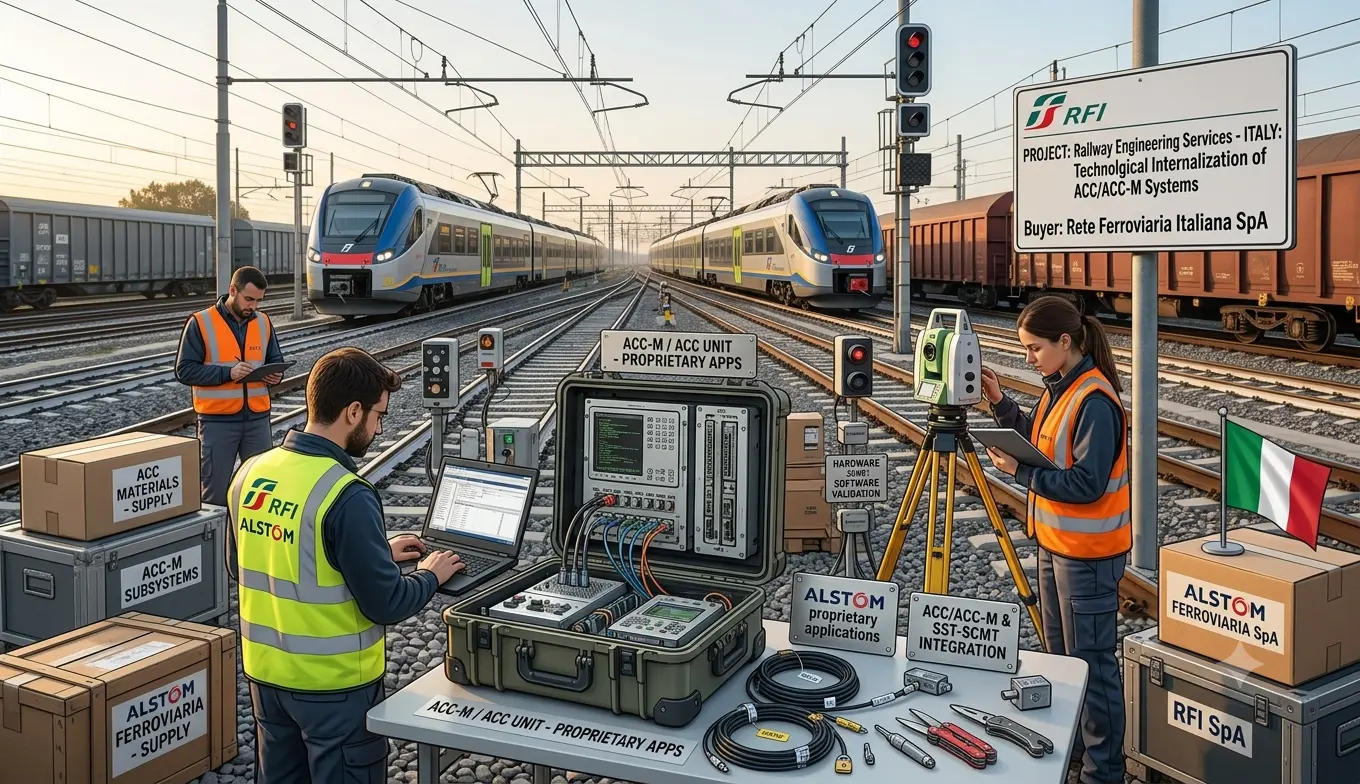
Rete Ferroviaria Italiana, the company that manages Italy's rail infrastructure, has awarded a framework agreement to Alstom Ferroviaria S.p.A. for hardware and software components used in its ACC and ACC-M signalling systems. The framework has a maximum value of EUR 14,892,265.88 and runs for 36 months from 1 October 2026. It was awarded without a call for competition, on the grounds that the technology is proprietary to Alstom, and only one tender was received.
Introduction
Railway signalling is one of the least visible and most safety-critical technologies in modern transport. It determines whether trains can move, how fast they can go, and how far apart they must be. When signalling fails, trains stop. When signalling is inadequate, capacity falls and delays multiply. When signalling is designed badly, accidents happen.
Italy's rail network is managed by Rete Ferroviaria Italiana, or RFI, a subsidiary of the state-owned Ferrovie dello Stato Italiane group. RFI owns and maintains the tracks, stations and signalling systems that carry trains operated by Trenitalia, Italo and regional operators. Its signalling systems include ACC, an Italian acronym for a computer-based centralised control system, and ACC-M, a variant used in specific contexts.
RFI has now awarded a framework agreement to Alstom Ferroviaria S.p.A., the Italian subsidiary of the French rail equipment group Alstom, for the supply of hardware and software components needed to bring the technology of its ACC and ACC-M systems in-house. The framework has a maximum value of EUR 14.9 million and runs for 36 months.
The contract was awarded without competition, on the grounds that the technology is proprietary to Alstom. Only one tender was received. The framework is the mechanism through which RFI will acquire the components it needs, and it signals a strategy of reducing dependence on the supplier for ongoing technical support.
This article explains what was procured, who was involved, how the procurement was justified and what the award signals for suppliers in the Italian and European railway signalling market.
Why This Contract Matters
This contract matters because it is about technological sovereignty over a critical national infrastructure. Signalling systems control train movements on a network that carries millions of passengers and vast volumes of freight every year. If RFI depends entirely on a single supplier for the technology that runs those systems, it has limited control over its own operations.
The contract is specifically about "internalizzazione tecnologica" — technological internalisation. In plain terms, RFI wants to bring the technology in-house, meaning it wants to acquire the hardware and software components, along with the design, verification and validation services, that will allow it to operate and maintain the ACC and ACC-M systems more independently. It is not buying a new signalling system. It is buying the components and know-how needed to take greater control of the systems it already has.
It also matters because of the direct award. Direct awards are exceptional in EU procurement, permitted only in narrowly defined circumstances. In this case, RFI has justified the award on technical grounds: the ACC and ACC-M systems use technology that is proprietary to Alstom, and the components are integrated into Alstom's own ACC applications. In practice, no other supplier can provide them.
Finally, the contract matters because of its structure. It is a framework agreement without reopening of competition, meaning RFI can place orders directly with Alstom under the framework without re-competing. That gives RFI a predictable supply route, but it also means Alstom faces no competition for the specific components covered by the framework.
Contract Timeline
- Winner selected: 11 September 2026
- Contract concluded: 1 October 2026
- Framework start date: 1 October 2026
- Notice dispatched: 7 October 2026
- Notice published: 8 October 2026
- Framework duration: 36 months
Contract Overview
The framework agreement covers the supply of ACC materials, optional basic and detailed design, verification and validation, and the hardware and software components necessary for the technological internalisation of the ACC/ACC-M systems and the related SST-SCMT integrated into Alstom's proprietary ACC applications.
It is classified as a services contract, with supplies as an additional nature. The main CPV code is 71311230 (railway engineering services), and the additional CPV code is 34632000 (railways traffic-control equipment). It is a single-lot procurement, identified as LOT-0001, with the internal identifier LOTTO 1 and the procedure reference DAC.0300.2026. The CIG code is BB6FA45858.
The place of performance is Italy, anywhere in the country. The framework starts on 1 October 2026 and runs for 36 months. The maximum value of the framework agreement is EUR 14,892,265.88, which is also the value of the winning tender.
The procurement was conducted as a negotiated procedure without prior call for competition — a direct award. The legal basis is Directive 2014/25/EU, the EU directive on procurement by entities operating in the water, energy, transport and postal services sectors, which applies to RFI as a railway infrastructure manager. The framework is covered by the Government Procurement Agreement.
The award criterion was the lowest price. The framework is a framework agreement without reopening of competition, meaning orders will be placed directly with the supplier. It does not use a dynamic purchasing system.
Key Contract Details
| Notice ID | 692947-2026 |
| OJ S issue | 195/2026 |
| Publication date | 8 October 2026 |
| Contracting authority | Rete Ferroviaria Italiana S.p.A. |
| Contract type | Services, with supplies as additional nature |
| Main CPV code | 71311230 – Railway engineering services |
| Additional CPV code | 34632000 – Railways traffic-control equipment |
| Procedure type | Negotiated without prior call for competition (direct award) |
| Legal basis | Directive 2014/25/EU |
| Lot | LOT-0001 |
| Winner | ALSTOM FERROVIARIA S.P.A. |
| Winning tender | EUR 14,892,265.88 |
| Maximum framework value | EUR 14,892,265.88 |
| Number of bids | 1 |
| Award criterion | Lowest price |
| Framework duration | 36 months from 1 October 2026 |
| Framework type | Framework agreement without reopening of competition |
| Dynamic purchasing system | No |
| GPA covered | Yes |
| Subcontracting | Yes, declared; value and percentage not known |
| Review body | Tribunale Amministrativo Regionale del Lazio |
Project Scope
The scope is the supply of ACC materials and related design, verification and validation services, together with the hardware and software components needed for the technological internalisation of the ACC/ACC-M systems and the related SST-SCMT integrated into Alstom's proprietary ACC applications.
ACC stands for "Apparato Centrale Computerizzato," a computer-based centralised control system used in Italian railway signalling. It is a type of interlocking, the system that controls signals, points and train routes to ensure safe separation of trains. ACC-M is a variant of the same technology. SST-SCMT refers to a subsystem within the signalling architecture, related to the control and management of the system.
The term "internalizzazione tecnologica" is central to understanding the scope. RFI is not simply buying spare parts. It is acquiring the components and technical services necessary to bring the technology in-house — that is, to build up its own capability to manage, maintain and potentially modify the ACC and ACC-M systems. That is a significant strategic step, because signalling systems are usually maintained by their manufacturers under long-term support contracts.
The scope includes optional basic and detailed design work, verification and validation. Design work would cover the adaptation or configuration of components for RFI's specific needs. Verification and validation are the formal processes by which signalling systems are proven to meet safety and performance requirements. These are essential in railway signalling, where safety standards are stringent and any change must be validated before it is deployed.
The notice does not disclose which specific ACC or ACC-M installations are covered, how many components will be supplied, what the delivery schedule is, or how the design and validation work will be divided between RFI and Alstom. The contracting authority has not disclosed this information.
The winning tenderer declared subcontracting, but the value and percentage of subcontracting are not known. The notice does not identify the subcontractors. The contracting authority has not disclosed this information.
About the Contracting Authority
The buyer is Rete Ferroviaria Italiana S.p.A., known as RFI. It is classified as a public undertaking with railway services as its main activity. Its registration number is 01585570581, and its address is Via dello Scalo Prenestino n. 25, Roma, postcode 00159, in the Roma NUTS region (ITI43).
RFI is the Italian railway infrastructure manager. It owns and maintains the national rail network, including tracks, stations, signalling and telecommunications systems. It is part of the Ferrovie dello Stato Italiane group, which is wholly owned by the Italian state. Its role in this procurement is as buyer, as the organisation providing additional information about the procedure and offline access to the procurement documents.
Its contact point for this procurement is Annachiara Cerabona, who is identified as the responsible officer for the award phase. Its email address is rfi-dac.asi@pec.rfi.it, and its telephone number is 0647308841. Its procurement portal is gare.rfi.it.
RFI's decision to internalise the ACC technology reflects a broader trend among infrastructure managers towards greater control over their critical systems. By acquiring the components and design capability, RFI reduces its dependence on a single supplier for the long-term maintenance and evolution of its signalling systems.
About the Organisations Involved
Rete Ferroviaria Italiana S.p.A.
RFI is the contracting authority. It is Italy's railway infrastructure manager, responsible for the national rail network. Its role in this procurement is as buyer, manager of the framework agreement and provider of information about the procedure.
It is registered in Rome, with registration number 01585570581. It operates the ACC and ACC-M signalling systems that are the subject of the framework, and it will use the framework to acquire the components and services it needs to internalise the technology.
ALSTOM FERROVIARIA S.P.A.
Alstom Ferroviaria S.p.A. is the winning supplier. It is classified as a large economic operator. Its registration number is 02791070044, and its address is Via Ottavio Moreno, 23, Savigliano (CN), postcode 12038, in the Cuneo NUTS region (ITC16). Its email address is alstomferroviaria.pec@actaliscertymail.it, and its telephone number is 0510464900.
Alstom Ferroviaria is the Italian subsidiary of Alstom, a French multinational rail equipment manufacturer. Alstom is one of the world's largest suppliers of rolling stock, signalling systems and rail infrastructure. In Italy, Alstom Ferroviaria has supplied signalling systems, including ACC technology, to RFI and other operators.
The company submitted the only tender for LOT-0001, identified as DAC.0300.2026, with a value of EUR 14,892,265.88. It declared subcontracting, but the value, percentage and identity of the subcontractors are not known. Its role is as tenderer and winner of LOT-0001. It will supply the ACC components, design, verification and validation services under the framework.
Tribunale Amministrativo Regionale del Lazio
The Tribunale Amministrativo Regionale del Lazio, the Regional Administrative Court of Lazio, is listed as the review organisation and the organisation providing more information on review procedures. It is based in Rome, postcode 00196. Its email address is urp.rm@giustizia-amministrativa.it, and its telephone number is 0632872517.
Its role is to hear appeals from suppliers who believe a procurement has been conducted improperly. In a direct award, the scope for challenge is narrower than in a competitive procedure, but suppliers can still challenge the legality of the direct award if they believe the conditions for it were not met. No complaints were recorded in this procurement.
Other organisations
The notice does not list any other tenderers, consortium members, framework participants or subcontractors. Only one tender was received, from Alstom Ferroviaria. No other organisation materially affects the understanding of this award.
Procurement Analysis
The procurement was conducted as a negotiated procedure without prior call for competition, which is a direct award. This is an exceptional procedure under EU procurement rules, permitted only when specific conditions are met.
RFI justified the direct award on technical grounds: the contract can be provided only by a particular economic operator because of an absence of competition for technical reasons. The notice adds a brief further justification: "Tecnologia proprietaria" — proprietary technology.
The reasoning is straightforward. The ACC and ACC-M systems are built around technology that is proprietary to Alstom. The hardware and software components covered by the framework are integrated into Alstom's own ACC applications. No other supplier can provide components that are compatible with those systems, because no other supplier has access to the design, the source code or the technical data. In practice, therefore, only Alstom can supply the components and services that RFI needs.
This is a common pattern in railway signalling procurement. Signalling systems are highly integrated, safety-critical and long-lived. They are built by a small number of manufacturers, and once installed, they are maintained and updated by their original suppliers. That creates a natural sole-source relationship, which is recognised in EU procurement law through the technical grounds for direct awards.
Only one tender was received, from Alstom Ferroviaria, which is consistent with a direct award. No complaints were recorded. That suggests that no other supplier believed it could have supplied the components, or that any challenge would have been unsuccessful.
The award criterion was the lowest price. In a direct award with a single bidder, the price criterion serves mainly to document the basis on which the contract was concluded rather than to compare competing offers. The winning tender was valued at EUR 14,892,265.88, which is also the maximum value of the framework agreement. That means the framework covers the full amount of the winning tender, and the value of individual call-offs will be drawn from that total.
The framework is a framework agreement without reopening of competition. That means RFI can place orders directly with Alstom under the framework without re-competing. That gives RFI a predictable supply route and avoids the administrative burden of running mini-competitions for each order. But it also means Alstom faces no competition for the specific components covered by the framework.
The framework runs for 36 months from 1 October 2026. That is a relatively short term for a signalling framework, but it is long enough to cover the initial phase of the internalisation programme.
The contract is covered by the Government Procurement Agreement, which means it is open to suppliers from GPA member countries on the same terms as EU suppliers. In practice, however, the proprietary nature of the technology means that only Alstom can supply the components.
The winning tenderer declared subcontracting, but neither the value nor the percentage is known, and the subcontractors are not identified. That means part of the work will be delivered by other companies, but the notice does not say who or what they will do. The contracting authority has not disclosed this information.
Additional Procurement Facts
- Legal basis: Directive 2014/25/EU (procurement in the water, energy, transport and postal services sectors).
- Procedure: Negotiated without prior call for competition (direct award).
- Justification: Technical reasons — the ACC and ACC-M technology is proprietary to Alstom, and only Alstom can supply compatible components.
- Award criterion: Lowest price.
- Number of tenders: 1.
- Maximum framework value: EUR 14,892,265.88.
- Winning tender value: EUR 14,892,265.88.
- Framework duration: 36 months from 1 October 2026.
- Framework type: Framework agreement without reopening of competition.
- GPA: Covered by the Government Procurement Agreement.
- Dynamic purchasing system: None.
- Subcontracting: Declared by the winner; value, percentage and subcontractor identity not known.
- Review body: Tribunale Amministrativo Regionale del Lazio.
- Complaints: None recorded.
Market & Industry Perspective
The European railway signalling market is dominated by a small number of suppliers. Alstom, Siemens Mobility, Hitachi Rail and CAF are the main players, alongside a handful of national specialists. These companies supply interlockings, train control systems, level crossing equipment and signalling components to infrastructure managers across Europe and beyond.
Signalling systems are highly integrated and safety-critical. They are built around proprietary hardware, software and communication protocols, and they must comply with stringent European standards for railway safety, including the Common Safety Method for risk evaluation and assessment. Once a system is installed, it is typically maintained and updated by its original supplier, because only that supplier holds the design authority, the software source code and the technical data.
That creates a long-term sole-source relationship between infrastructure managers and signalling suppliers. It also creates a strategic dependency. If the infrastructure manager wants to modify the system, add capacity or extend its life, it must work with the original supplier, often on the supplier's terms.
RFI's decision to internalise the ACC technology is a response to that dependency. By acquiring the components and the design, verification and validation capability, RFI is building its own ability to manage and evolve the system. That does not mean it will stop working with Alstom — the framework is awarded to Alstom, after all. But it does mean that RFI will have greater control over its own signalling technology, and less reliance on the supplier for every change.
This approach is becoming more common among infrastructure managers. In the UK, Network Rail has developed in-house signalling capability. In France, SNCF Réseau has invested in its own engineering resources. The logic is the same: signalling is too important to be left entirely to external suppliers.
The use of the utilities directive, rather than the general public sector directive, is also significant. Directive 2014/25/EU applies to procurement by entities operating in the water, energy, transport and postal services sectors, and it gives them more flexibility than the general directive, including broader scope for negotiated procedures and direct awards. RFI, as a railway infrastructure manager, falls within its scope.
Economic Significance
At EUR 14.9 million over 36 months, this framework is a significant contract in the Italian railway signalling market. It represents a substantial commitment to the internalisation of ACC technology and provides Alstom with a predictable revenue stream over the framework period.
The economic significance extends beyond the framework value itself. If RFI succeeds in internalising the ACC technology, it will reduce its long-term dependence on Alstom for routine maintenance and modifications. That could reduce costs over the life of the systems, and it could improve RFI's ability to respond quickly to operational needs.
The framework also has an economic effect on the wider supply chain. Alstom declared subcontracting, which means part of the work will be delivered by other companies. The notice does not identify them or quantify their share, but the subcontracting will spread some of the economic benefit beyond Alstom itself.
For the Italian rail network, the framework supports the continued operation and evolution of the ACC and ACC-M systems. Those systems are essential to the safe and efficient movement of trains on the national network. Any improvement in RFI's ability to manage them contributes to the reliability and capacity of the railway, which has economic value across the transport sector.
Future Procurement Opportunities
The most immediate future opportunities are the individual call-offs under the framework. RFI will place orders with Alstom for ACC materials, design work, verification and validation services as its internalisation programme progresses. The value and timing of those call-offs will depend on RFI's programme schedule.
There may also be opportunities for subcontractors. Alstom declared subcontracting, which suggests that part of the scope will be delivered by other companies. Suppliers with capability in railway signalling components, design, verification or validation may find opportunities through Alstom's supply chain.
Beyond this framework, RFI is likely to need further support as it internalises the ACC technology. If the initial framework is successful, RFI may extend it or procure additional services. It may also need training, technical documentation, software tools and other resources to build its in-house capability.
More broadly, other railway infrastructure managers in Europe face similar challenges with their own signalling systems. Suppliers with capability in signalling technology and technology transfer may find opportunities across the European market.
Opportunities for Suppliers
- Alstom's supply chain: Alstom declared subcontracting. Suppliers with capability in railway signalling components, design or validation may find opportunities through its supply chain.
- Signalling component suppliers: The framework covers hardware and software components. Suppliers of compatible components may find opportunities, though the proprietary nature of the technology limits the field.
- Design and validation specialists: The framework includes optional basic and detailed design, verification and validation. Suppliers with these capabilities may find opportunities through Alstom.
- Training and technical documentation: As RFI builds its in-house capability, it may need training, documentation and technical support. Suppliers with these capabilities may find opportunities.
- Other infrastructure managers: Other European railway infrastructure managers face similar dependency challenges. Suppliers with technology transfer experience may find opportunities across Europe.
- Monitoring RFI: RFI publishes its procurement notices through its portal at gare.rfi.it and through TED. Suppliers should monitor them for future opportunities.
What Businesses Should Watch
- How the framework is used: The value and timing of call-offs will indicate how quickly RFI is progressing with its internalisation programme.
- Whether the framework is extended: The framework runs for 36 months. Suppliers should watch for any extension or follow-on procurement.
- Whether subcontractors are disclosed: Alstom declared subcontracting but did not identify the subcontractors. Suppliers should watch for further disclosure.
- Whether the internalisation succeeds: If RFI succeeds in building its in-house capability, it may reduce its future reliance on Alstom, which could affect future procurement patterns.
- Whether other signalling systems are included: The framework covers ACC and ACC-M. If RFI decides to internalise other signalling technologies, that could create further opportunities.
- Whether other infrastructure managers follow suit: If RFI's internalisation approach works well, other European infrastructure managers may adopt similar strategies.
ItalyTenders.com Procurement Intelligence
This framework represents a broader trend in European railway procurement: infrastructure managers are seeking to reduce their dependence on signalling suppliers by internalising critical technology. Signalling systems are highly integrated, proprietary and safety-critical, and once installed, they are typically maintained by their original manufacturers. That creates a long-term sole-source relationship that gives the supplier significant leverage. RFI's decision to acquire the components, design, verification and validation capability for its ACC and ACC-M systems is an attempt to rebalance that relationship and to build its own capability to manage and evolve the technology.
The award is strategically important because it combines two objectives. First, it ensures continuity of supply: RFI needs the components and services covered by the framework to keep its ACC and ACC-M systems running. Second, it enables technological internalisation: by acquiring the components and the design and validation capability, RFI is building its own ability to manage the systems in the future. The framework is therefore both an operational necessity and a strategic investment.
Suppliers can learn several things from this procurement. First, in railway signalling, proprietary technology creates durable sole-source relationships. Suppliers that own the technology have a strong position; suppliers that do not are largely excluded from the market. Second, direct awards are a legitimate route in this sector where technical grounds justify them, and the utilities directive gives infrastructure managers more flexibility than the general public sector directive. Third, technology transfer is a growing market. Infrastructure managers that want to internalise critical technology need support from the original supplier, and that support can be procured under frameworks like this one. Fourth, subcontracting opportunities exist even in sole-source contracts, as Alstom's declared subcontracting shows. Fifth, framework agreements without reopening of competition give the supplier predictable volume but also limit the buyer's flexibility to re-compete.
Suppliers should position themselves accordingly. Companies that own signalling technology should recognise that their position is strong but that buyers are increasingly seeking to reduce their dependence, and they should be prepared to support technology transfer as a commercial service. Companies that supply components or services to signalling manufacturers should build relationships with the primes, because that is where the work flows. And companies that operate in adjacent areas, such as training, documentation or validation, should look for opportunities created by internalisation programmes.
Future contracts in this market are likely to evolve in two directions. First, more infrastructure managers will seek to internalise critical signalling technology, creating a steady pipeline of technology transfer and component supply contracts. Second, signalling suppliers will need to adapt their business models to support that trend, offering not just products but also the design, validation and training services that buyers need to build their own capability. Suppliers that can combine proprietary technology with technology transfer services will be well positioned. Suppliers that cannot will find themselves increasingly constrained by buyers who want more control over their own infrastructure.
Supplier Takeaways
- RFI awarded a framework agreement to Alstom Ferroviaria for ACC and ACC-M hardware and software components and related design, verification and validation services.
- The framework has a maximum value of EUR 14,892,265.88 and runs for 36 months from 1 October 2026.
- The contract was awarded without a call for competition, on the grounds that the technology is proprietary to Alstom.
- Only one tender was received, and no complaints were recorded.
- The framework is a framework agreement without reopening of competition, so orders will be placed directly with Alstom.
- The award criterion was the lowest price.
- The legal basis is Directive 2014/25/EU, the utilities directive, not the general public sector directive.
- The winning tenderer declared subcontracting, but the value, percentage and subcontractor identity are not known.
- The framework supports RFI's strategy of technological internalisation — building its own capability to manage and evolve the ACC and ACC-M systems.
- The review body is the Tribunale Amministrativo Regionale del Lazio.
Key Takeaways
- Rete Ferroviaria Italiana awarded a 36-month framework agreement to Alstom Ferroviaria S.p.A. for ACC and ACC-M signalling components and related services.
- The framework has a maximum value of EUR 14,892,265.88.
- The contract was awarded without competition on technical grounds: the technology is proprietary to Alstom.
- Only one tender was received, and no complaints were recorded.
- The framework covers the supply of ACC materials, optional design, verification and validation, and hardware and software components for technological internalisation.
- The framework is a framework agreement without reopening of competition, meaning direct orders will be placed with Alstom.
- The award criterion was the lowest price.
- The framework is governed by Directive 2014/25/EU and is covered by the Government Procurement Agreement.
- The winning tenderer declared subcontracting, with value and percentage not known.
- The review body is the Tribunale Amministrativo Regionale del Lazio.
Conclusion
Rete Ferroviaria Italiana has taken a significant step towards reducing its dependence on Alstom for the technology that runs its ACC and ACC-M signalling systems. The framework agreement, worth up to EUR 14.9 million over 36 months, gives RFI a route to acquire the hardware, software, design, verification and validation services it needs to internalise the technology. It was awarded without competition, on the grounds that the technology is proprietary to Alstom and no other supplier can provide compatible components.
The framework is both an operational necessity and a strategic investment. Operationally, it ensures that RFI can continue to supply and maintain its ACC and ACC-M systems. Strategically, it allows RFI to build its own capability to manage and evolve those systems, reducing its long-term reliance on a single supplier. That is a goal shared by many infrastructure managers across Europe, who are increasingly seeking to internalise critical technologies.
For suppliers, the contract reinforces the importance of proprietary technology in railway signalling and the growing market for technology transfer services. For RFI, the challenge will be to use the framework effectively to build genuine in-house capability, rather than simply buying components. For Alstom, the framework provides a predictable revenue stream and an opportunity to support its customer's strategic objectives. The notice leaves some questions unanswered — the specific components, the delivery schedule, the subcontractors — but the core award is clear: Alstom will supply the technology, and RFI will use it to take greater control of its own signalling systems.
Source: Tenders Electronic Daily (TED), Contract Award Notice 692947-2026, Official Journal of the European Union, OJ S 195/2026, published on 8 October 2026.
Frequently Asked Questions (FAQs)

Fresh and verified Tenders from Italy. Find, search and filter Tenders/Call for bids/RFIs/RFPs/RFQs/Auctions published by the government, public sector undertakings (PSUs) and private entities.
- 1,000+ Tenders
- Verified Tenders Only
- New Tenders Every Day
- Tenders Result Data
- Archive & Historical Tenders Access
- Consultants for RFI/RFP/RFQ
- Tender Notifications & Alerts
- Search, Sort, and Filter Tenders
- Bidding Assistance & Consulting
- Customer Support
- Publish your Tenders
- Export data to Excel
- API for Tender Data
- Tender Documents

Fill out the form below and you will receive a call from us within 24 hours.
Get FREE SAMPLE TENDERS from Italy in your email inbox.
Copyright © 2014-2026 ItalyTenders.com. All Rights Reserved.