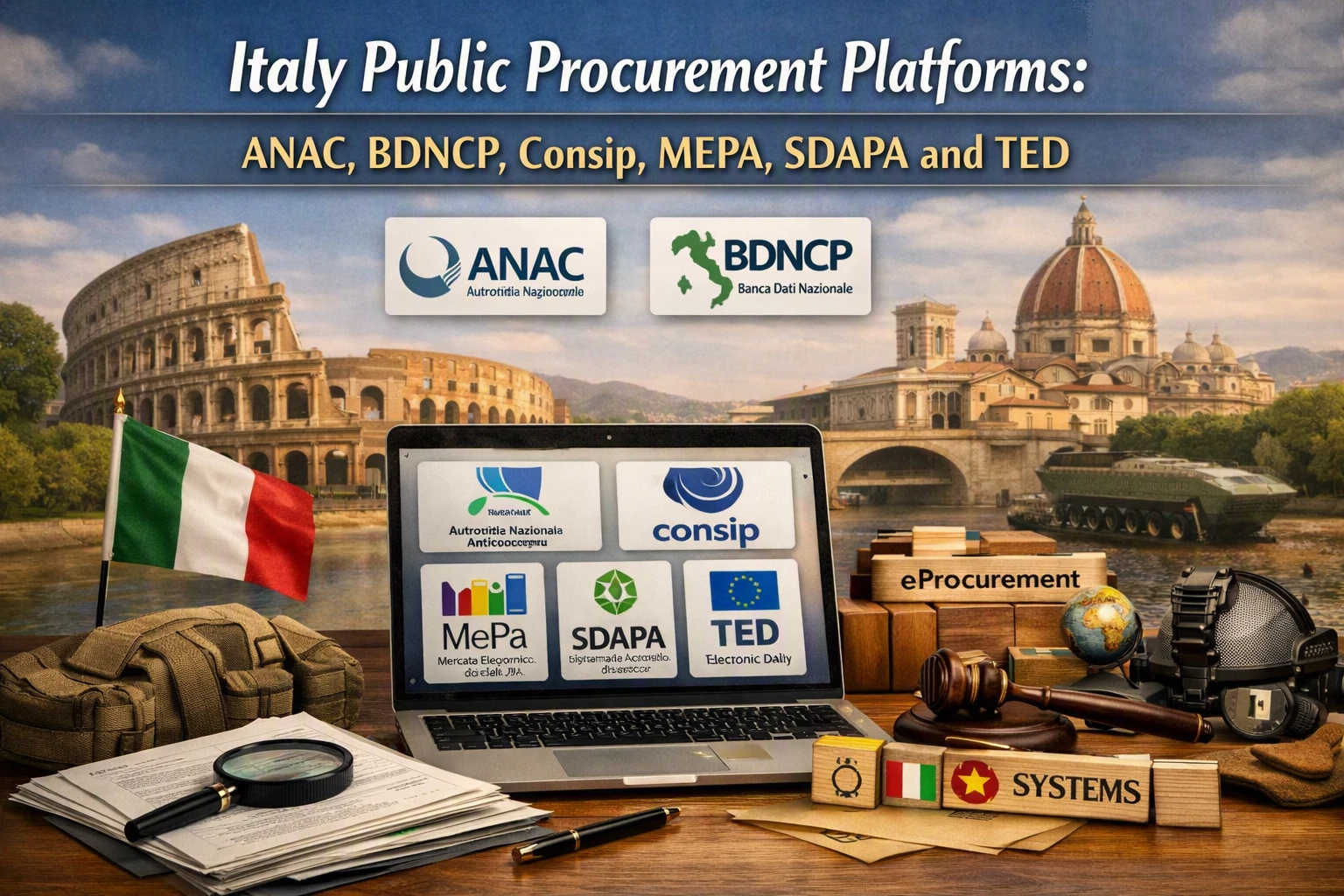
Italy Public Procurement Platforms: ANAC, BDNCP, Consip, MEPA, SDAPA & TED Portals
Introduction
Italy's public procurement system includes several platforms and institutions that suppliers need to understand before searching for government contracts. ANAC, BDNCP, Consip, MEPA, SDAPA and TED all play important roles, but each serves a different purpose. Knowing which service to use can help businesses discover procurement opportunities, verify official information, understand digital purchasing procedures and identify the correct route for participating in a tender.
For companies entering the Italian public procurement market, the terminology can be confusing. ANAC is Italy's National Anti-Corruption Authority, while BDNCP is the National Public Contracts Database managed by ANAC. Consip supports public purchasing through centralised procurement arrangements and digital purchasing tools. MEPA is the Electronic Marketplace for Public Administration, and SDAPA is the Dynamic Purchasing System. TED is the European Union's Tenders Electronic Daily portal for procurement notices published at European level.
These services are part of a wider procurement ecosystem. Since the digitalisation provisions of Italy's Public Contracts Code came into operation on 1 January 2024, digital procurement platforms have played a central role in managing procurement procedures and exchanging information with national systems. The exact route a supplier uses depends on the contracting authority, the procurement procedure and the platform identified in the official notice.
This guide explains how ANAC, BDNCP, Consip, MEPA, SDAPA and TED work, how they differ, when suppliers may need each service, and how businesses can use them together to identify and pursue Italian public procurement opportunities.
Table of Contents
- Understanding Italy's Public Procurement Ecosystem
- What Is ANAC?
- What Is BDNCP?
- What Is Consip?
- What Is MEPA?
- What Is SDAPA?
- What Is TED?
- ANAC vs BDNCP vs Consip vs MEPA vs SDAPA vs TED
- How Suppliers Should Use These Platforms
- Registration and Supplier Qualification
- Guidance for Foreign Suppliers
- Common Mistakes to Avoid
- How to Verify a Procurement Opportunity
- How ItalyTenders Helps Suppliers Find Opportunities
- Conclusion
Understanding Italy's Public Procurement Ecosystem
Italy's procurement system combines legal oversight, public procurement data, purchasing arrangements, electronic marketplaces and national and European publication services. These functions complement one another, but suppliers should not assume that every tender appears in the same place or that registering with one service automatically provides access to all the others.
The six key names can be understood through their principal functions:
- ANAC: The National Anti-Corruption Authority, responsible for important public procurement oversight, regulatory and digital infrastructure functions.
- BDNCP: The national database that supports the collection and availability of public contract information throughout the procurement lifecycle.
- Consip: The public company that carries out purchasing and e-procurement activities on behalf of the Ministry of Economy and Finance and supports public administrations in procurement.
- MEPA: A digital marketplace where eligible public administrations can purchase goods, services and works and conduct relevant electronic negotiations with enabled suppliers.
- SDAPA: A dynamic purchasing system that allows participating public administrations to conduct procurement within established categories and rules, with suppliers admitted under the relevant system.
- TED: The EU's Tenders Electronic Daily service, which publishes European-level public procurement notices.
Italy's digital procurement architecture connects certified digital procurement platforms with national infrastructure, including ANAC's BDNCP. This supports the electronic management of procurement information and procedures. Depending on the procedure, suppliers may use a particular platform to submit their offer while information about the procurement is also available through an official publication or data service.
For suppliers, the practical lesson is straightforward: use discovery services to identify opportunities, official sources to verify the details, and the specific platform named in the procurement documents to complete the participation process.
What Is ANAC?
ANAC stands for Autorità Nazionale Anticorruzione, or the Italian National Anti-Corruption Authority. It has important responsibilities concerning public procurement oversight, transparency and the digital procurement framework.
ANAC is particularly relevant to suppliers because its services provide access to procurement information and support the digital infrastructure used by contracting authorities and procurement platforms.
What does ANAC do in public procurement?
- Manages the BDNCP national public contracts database.
- Provides services supporting the digitalisation of public procurement.
- Operates procurement-related services, including the Piattaforma Contratti Pubblici.
- Provides legal-publicity search services for procurement notices and related information.
- Supports transparency and the availability of information about public contracts.
ANAC's role is not the same as that of a supplier marketplace. Businesses generally do not use ANAC simply to list products and receive orders in the way they might use an electronic marketplace. Instead, suppliers may use its public services to search, verify or consult procurement information and understand the official framework.
Useful ANAC resources for suppliers
- Official ANAC website
- General search for legal-publicity notices
- Advanced procurement notice search
- BDNCP data and procurement information
The advanced search service offers fields that can help users find notices using information such as publication dates, contracting-authority details and CPV classifications. Available fields and results depend on the search service and the information recorded for the notice.
Suppliers should use the official notice and the contracting authority's designated procurement platform to confirm the current requirements, deadline and submission process.
What Is BDNCP?
BDNCP stands for Banca Dati Nazionale dei Contratti Pubblici, Italy's National Public Contracts Database. It is managed by ANAC and forms a central part of the country's public procurement information infrastructure.
BDNCP supports the collection and availability of data relating to public contracts. Its role is particularly important in the digital procurement environment established under Legislative Decree 36/2023, Italy's Public Contracts Code.
Since the digitalisation framework took effect on 1 January 2024, certified digital procurement platforms have been used to manage relevant procurement procedures and exchange data with national infrastructure. BDNCP supports the availability of information concerning different stages of the procurement lifecycle.
Why BDNCP matters to suppliers
- Procurement verification: It can help suppliers consult information associated with public procurement records.
- Contract research: Information may be used to investigate procurement procedures and contract-related records.
- Transparency: It supports access to public procurement information.
- Identifier-based searches: The ANAC portal provides a BDNCP data service that supports consultation by CIG, the Italian procurement identification code.
- Digital procurement: It forms part of the national architecture through which digital procurement platforms exchange information.
Suppliers should understand the difference between searching a database and submitting a bid. BDNCP is an information and infrastructure resource; it is not automatically the platform on which a supplier must upload its technical and financial offer.
For example, a business may discover a notice through a legal-publicity search and use the associated procurement reference to research the record. To participate, it must still follow the notice's instructions and use the designated electronic procurement platform.
Official resource: ANAC BDNCP data.
What Is Consip?
Consip is the public company that carries out procurement and e-procurement activities for Italy's Ministry of Economy and Finance. It supports public administrations through purchasing arrangements and digital tools designed to help them procure goods, services and works.
Consip's role differs from ANAC's. ANAC is associated with oversight and national procurement data infrastructure, while Consip supports purchasing arrangements and the operation of specific e-procurement instruments.
The public purchasing programme supported by Consip includes different ways for administrations to obtain goods, services and works.
Examples of Consip procurement instruments include:
- Convenzioni: Framework purchasing arrangements under which administrations can place orders according to the applicable terms.
- Accordi quadro: Framework agreements that establish terms for subsequent contracts or orders under the applicable arrangement.
- MEPA: The Electronic Marketplace for Public Administration.
- SDAPA: The Dynamic Purchasing System.
- Gare in ASP: Electronic tendering conducted using an Application Service Provider platform.
These instruments are not interchangeable. Their availability and use depend on the purchasing requirements, the applicable rules and the specific arrangement.
For suppliers, Consip is relevant in two main ways. First, businesses can investigate procurement opportunities directly tendered by Consip. Second, eligible businesses can seek admission to relevant digital marketplaces and purchasing systems to offer products or services to public administrations.
Consip's official business guidance explains that MEPA and SDAPA use a supplier-enablement process through which businesses select relevant product or service categories. The admission arrangements and commercial opportunities depend on the particular instrument and its rules.
Official resources:
- Consip official website
- Public administration purchasing programme
- Supplier guidance on digital marketplaces
What Is MEPA?
MEPA stands for Mercato Elettronico della Pubblica Amministrazione, or the Electronic Marketplace for Public Administration. It is a digital marketplace operated through the Acquisti in Rete PA portal, managed by Consip on behalf of the Ministry of Economy and Finance.
MEPA enables eligible public administrations to purchase goods, services and works through the electronic marketplace under the applicable rules. It also allows enabled suppliers to make their offers available and respond to relevant procurement requests.
MEPA is particularly relevant to businesses seeking to supply public administrations through electronic purchasing procedures. The categories, qualification requirements and opportunities available to a supplier depend on the relevant marketplace arrangements.
How MEPA works
The typical supplier process involves registering on the portal, completing the required enablement process, selecting the relevant product or service categories and managing the catalogue or other information required by the marketplace. Depending on the procedure, a supplier may receive or identify a request and submit a response through the platform.
Public administrations may use marketplace functionality to identify suppliers and conduct relevant electronic purchasing activities. These can include direct purchasing where permitted and electronic negotiations such as a request for offers.
What suppliers should know about MEPA
- Registration alone does not necessarily mean a business is enabled for every category.
- Suppliers should select categories that match their actual products, services or works.
- Marketplace enablement does not guarantee invitations, orders or contract awards.
- Suppliers must follow the specific instructions, deadlines and technical requirements of each procedure.
- The applicable rules and purchasing arrangements determine how the marketplace can be used.
MEPA is commonly associated with purchasing below the relevant EU procurement thresholds, subject to the applicable legal framework and the specific purchasing instrument. Suppliers should not treat it as a universal limit that overrides the rules of a particular procedure.
Official portal: Acquisti in Rete PA.
Businesses interested in this marketplace should also consult the dedicated ItalyTenders guide to finding Italian tender opportunities and review the official MEPA instructions before registering or preparing a response.
What Is SDAPA?
SDAPA stands for Sistema Dinamico di Acquisizione della Pubblica Amministrazione, or the Dynamic Purchasing System for Public Administration. It is a digital procurement instrument available through the Consip purchasing programme.
SDAPA is designed to enable public administrations to conduct purchases through a dynamic system established for specified product or service categories. Suppliers apply for admission under the relevant system's rules, and participating administrations can conduct procurement procedures within that framework.
Unlike a single tender notice for a one-off contract, a dynamic purchasing system provides a framework for multiple purchasing procedures during its period of operation. The specific conditions, categories and participation arrangements are set out in the relevant admission documents and system rules.
How SDAPA works for suppliers
- Find a relevant system: Identify the SDAPA category or admission notice that matches the company's offering.
- Review the admission requirements: Check the eligibility, qualification and documentation requirements.
- Apply for admission: Complete the process specified by Consip and the relevant system documents.
- Monitor specific procurement procedures: Review invitations or opportunities issued within the system.
- Submit responses: Prepare and submit offers in accordance with each procedure's instructions.
Admission to SDAPA should not be confused with winning a contract. Admission makes the supplier eligible to participate in relevant purchasing procedures under the system's rules; each procurement still has its own requirements, deadlines and evaluation process.
Consip describes SDAPA as a digital purchasing instrument that can support the acquisition of goods and services, including opportunities that may be above the relevant EU threshold. The precise scope and applicable rules depend on the particular system and procedure.
MEPA and SDAPA: the main distinction
MEPA operates as an electronic marketplace, while SDAPA is a dynamic purchasing system with its own admission and procurement procedures. Both can provide routes for enabled suppliers to access public purchasing opportunities, but they have different structures and should not be treated as the same tool.
Suppliers should check the official admission notice and procedure documents to determine which system is relevant to their products or services.
Official guidance: Consip digital marketplaces for businesses.
What Is TED?
TED stands for Tenders Electronic Daily. It is the European Union's online service for publishing public procurement notices at European level. TED is the online supplement to the Official Journal of the European Union for procurement notices.
TED is important for companies seeking Italian public contracts because notices relating to Italian procurement may be published there when the applicable publication rules require or provide for publication at EU level.
It also allows businesses to investigate procurement opportunities in other European countries, making it relevant to companies pursuing cross-border growth.
What can suppliers find on TED?
- Contract notices and calls for competition.
- Information about contracting authorities and buyers.
- Descriptions of the contract subject and scope.
- CPV classifications and procurement categories.
- Information about contract locations, lots and estimated values where provided.
- Procedure details and submission deadlines.
- Contract award notices and other procurement-related publications.
The information available depends on the notice type and the fields completed for that publication. Suppliers should open the full notice rather than relying only on a search-result summary.
TED offers search tools that support discovery by factors such as subject, CPV classification and place of performance. Users can examine the notice details and identify the official procurement platform or contact information specified for the procedure.
Important distinction: TED is a publication and discovery service, not a universal submission portal for every Italian tender. If the notice directs suppliers to a separate electronic procurement platform, the submission must follow that platform's instructions.
Official portal: Tenders Electronic Daily (TED).
ANAC vs BDNCP vs Consip vs MEPA vs SDAPA vs TED
The following table summarises the main differences and the practical purpose of each service.
| Service | Main role | How suppliers may use it | Does it automatically accept every tender submission? |
| ANAC | Public procurement authority and digital procurement services | Search and verify procurement information; consult relevant official services | No. Follow the platform named in the procedure. |
| BDNCP | National public contracts database | Consult procurement records and related information | No. It is a database and part of the national infrastructure. |
| Consip | Public purchasing arrangements and e-procurement instruments | Explore Consip tenders and supplier participation routes | Only for procedures and instruments using the relevant platform or arrangements. |
| MEPA | Electronic marketplace | Enable the business in relevant categories and respond to applicable purchasing procedures | For relevant procedures conducted through the marketplace. |
| SDAPA | Dynamic purchasing system | Apply for admission and participate in relevant procurement procedures | For procedures conducted under the relevant system. |
| TED | European-level procurement notice publication | Discover and review procurement notices across Europe | No. Submission follows the procedure's designated platform. |
These services complement each other. For example, a procurement notice may be discoverable through TED or an official national search service, contain information associated with BDNCP and direct suppliers to a certified electronic procurement platform for participation.
Similarly, a supplier may become enabled on MEPA or admitted to an SDAPA system but still need to respond separately to each relevant purchasing procedure.
The correct workflow depends on the actual notice. Suppliers should never assume that a registration or qualification completed on one platform replaces the requirements of another.
How Suppliers Should Use These Platforms
Businesses can combine the services to create a practical process for identifying, verifying and pursuing Italian public procurement opportunities.
Step 1: Discover relevant opportunities
Use suitable discovery sources, including TED, ANAC's legal-publicity search and relevant procurement information services, to identify notices that match the company's products, services or works.
Step 2: Review the notice
Check the contracting authority, contract subject, CPV code, estimated value, lot structure, procedure type and deadline. Determine whether the notice represents an active opportunity or another stage of the procurement process.
Step 3: Open the official documents
Read the bando, disciplinare, capitolato, DGUE instructions and other documents required by the contracting authority. These materials provide the detailed conditions for participation.
Step 4: Identify the required participation platform
Confirm whether the procurement is conducted through Acquisti in Rete PA, a Consip instrument, another certified procurement platform or another system identified in the official notice.
Step 5: Complete registration or admission
If the procedure requires supplier registration, marketplace enablement or admission to a dynamic purchasing system, complete the relevant process and ensure that the business is authorised for the required category.
Step 6: Prepare the offer
Check the technical, administrative and financial requirements. Prepare the required declarations, supporting evidence and offer documents using the formats and signing methods specified in the procurement documents.
Step 7: Submit and retain confirmation
Follow the platform's instructions, submit before the deadline and retain the confirmation or receipt generated by the system. Monitor official communications and subsequent updates.
Step 8: Monitor the procurement outcome
Review published information about the outcome where available. Award notices and procurement records may help businesses understand buyer activity and identify future opportunities.
Registration and Supplier Qualification
Supplier registration is an important practical issue, but there is no single registration that automatically qualifies a company for every Italian public procurement procedure.
The requirements depend on the route through which the supplier intends to participate.
For general procurement procedures
Suppliers should follow the instructions in the official notice and register with the designated electronic procurement platform where required. They should confirm access permissions, electronic-signature requirements and any supporting documentation needed to participate.
For MEPA
Businesses should complete the relevant registration and enablement process, choose suitable product or service categories and maintain the information required by the marketplace. The business must follow the official instructions and the requirements applicable to the chosen categories.
For SDAPA
Businesses should identify the relevant dynamic purchasing system and review its admission documents. Admission requirements may include declarations, qualification information and other evidence specified in the system rules.
For Consip tenders
Suppliers should follow the participation instructions for the particular Consip tender. A business should not assume that MEPA enablement automatically qualifies it for every separate Consip competition.
For TED notices
TED is primarily a publication and discovery service. Registration or use of TED does not itself replace any qualification or registration requirement imposed by the electronic procurement platform conducting the procedure.
Before starting registration, businesses should identify the actual opportunity or instrument they intend to use. This helps them focus on the relevant requirements rather than completing unnecessary processes.
Guidance for Foreign Suppliers
Foreign companies interested in Italian public contracts should first identify the type of opportunity they wish to pursue and the platform designated by the contracting authority.
Some businesses may pursue an individual tender published at European level, while others may investigate MEPA or SDAPA as a route to supplying Italian public administrations. Each route has its own participation arrangements.
Foreign suppliers should check the following:
- Whether the company meets the legal and technical requirements for the procedure.
- Whether the tender requires registration on a particular electronic procurement platform.
- Whether the company must complete supplier enablement or admission for a specific category.
- Which company declarations and supporting evidence are required.
- Whether documents from the country of establishment need translation or other formal treatment.
- Whether electronic signatures and identity credentials are accepted by the relevant platform.
- Whether the company can meet the delivery, service and contractual obligations in Italy.
Foreign suppliers should not assume that access to TED alone allows them to submit a bid. TED helps identify notices; the official procedure determines the submission route and the conditions for participation.
Likewise, admission to MEPA or SDAPA should not be treated as a guarantee of business. Suppliers must remain attentive to relevant categories, invitations, individual deadlines and the rules of each procurement.
When a requirement is unclear, the supplier should consult the official documentation or use the clarification process provided for that procedure.
Common Mistakes to Avoid
Confusing ANAC with Consip
ANAC's public procurement oversight and data functions differ from Consip's purchasing and e-procurement activities. Suppliers should use each service according to its purpose.
Treating BDNCP as the submission platform
BDNCP supports national procurement information and data exchange. The official notice determines which platform a supplier must use to submit its offer.
Assuming MEPA and SDAPA are identical
MEPA is an electronic marketplace, while SDAPA is a dynamic purchasing system. Their admission arrangements and purchasing procedures differ.
Assuming every Italian tender appears on TED
TED publishes procurement notices at European level. Not every procurement opportunity will necessarily be published there. Suppliers should also consult the relevant national and contracting-authority sources.
Confusing supplier registration with eligibility
Creating an account or enabling a supplier profile does not guarantee that the company meets the requirements for a particular tender or will be awarded a contract.
Relying only on search-result summaries
Summaries are useful for discovery, but suppliers should verify the notice and complete documentation before making a bid decision.
Ignoring updates and deadlines
Corrections, clarifications and extensions may change the procedure. Suppliers should monitor the official platform and retain evidence of their submission.
How to Verify a Procurement Opportunity
Before acting on a procurement listing, suppliers should verify that the opportunity is genuine, current and suitable for participation.
Use this verification checklist:
- Confirm the contracting authority's identity.
- Locate the official notice or procurement page.
- Check the publication date and the current submission deadline.
- Confirm the procurement reference, CIG where applicable and other identifiers.
- Review the contract subject, CPV classification, estimated value and lot structure.
- Read the participation conditions and required documentation.
- Identify the designated electronic procurement platform.
- Check whether clarifications, corrections or deadline extensions have been published.
- Confirm whether registration, enablement or system admission is required.
- Retain the official documents and submission confirmation.
ANAC's legal-publicity search and BDNCP-related services can help suppliers consult official procurement information. TED can help with European-level notice discovery. Consip and Acquisti in Rete PA are relevant where the procurement uses the purchasing instruments or platform they provide.
Using the right source for each task reduces confusion and helps suppliers follow the procedure specified by the contracting authority.
How ItalyTenders Helps Suppliers Find Opportunities
Public procurement information is spread across multiple official sources, and suppliers may need to monitor different authorities, sectors, procurement categories and platforms. Tender-information services can help businesses discover opportunities and organise their research.
ItalyTenders tender listings can help businesses explore Italian procurement opportunities. Once a potentially relevant notice is identified, suppliers should verify the official details and follow the submission route stated in the procurement documents.
Businesses researching previous procurement outcomes can also review ItalyTenders contract awards to investigate published award information and procurement activity.
Suppliers can create an account through ItalyTenders registration and access the platform using the ItalyTenders login page.
For information about public buyers, businesses can explore the ItalyTenders authority directory. Companies requiring further information can use the ItalyTenders contact page.
ItalyTenders can support opportunity discovery, but the official notice, procurement documents and designated electronic platform remain essential for confirming requirements and completing a valid submission.
Conclusion
ANAC, BDNCP, Consip, MEPA, SDAPA and TED are important parts of Italy's public procurement ecosystem, but they serve different purposes. ANAC supports procurement oversight and digital services, while BDNCP provides national public contract information. Consip supports public purchasing through centralised arrangements and digital tools, including MEPA and SDAPA. TED provides European-level procurement notice publication.
Suppliers can use these services together to discover opportunities, verify official information and understand the procurement route. The right workflow depends on the notice, the purchasing instrument and the platform designated for the procedure.
Businesses should therefore confirm the official notice, review the complete tender documents, check the qualification requirements and use the correct electronic procurement platform. Understanding the roles of these services makes it easier to navigate Italian public procurement and build a more organised tender-search strategy.
Sources: ANAC official website and BDNCP services; Consip purchasing programme and supplier guidance; Acquisti in Rete PA; TED, the European Union's Tenders Electronic Daily portal; Italy's Public Contracts Code, Legislative Decree 36/2023.

Fresh and verified Tenders from Italy. Find, search and filter Tenders/Call for bids/RFIs/RFPs/RFQs/Auctions published by the government, public sector undertakings (PSUs) and private entities.
- 1,000+ Tenders
- Verified Tenders Only
- New Tenders Every Day
- Tenders Result Data
- Archive & Historical Tenders Access
- Consultants for RFI/RFP/RFQ
- Tender Notifications & Alerts
- Search, Sort, and Filter Tenders
- Bidding Assistance & Consulting
- Customer Support
- Publish your Tenders
- Export data to Excel
- API for Tender Data
- Tender Documents

Fill out the form below and you will receive a call from us within 24 hours.
Get FREE SAMPLE TENDERS from Italy in your email inbox.
Copyright © 2014-2026 ItalyTenders.com. All Rights Reserved.