Italy Public Procurement: Guide to Tenders and Government Contracts
Find, Understand and Compete for Public Procurement Opportunities in Italy
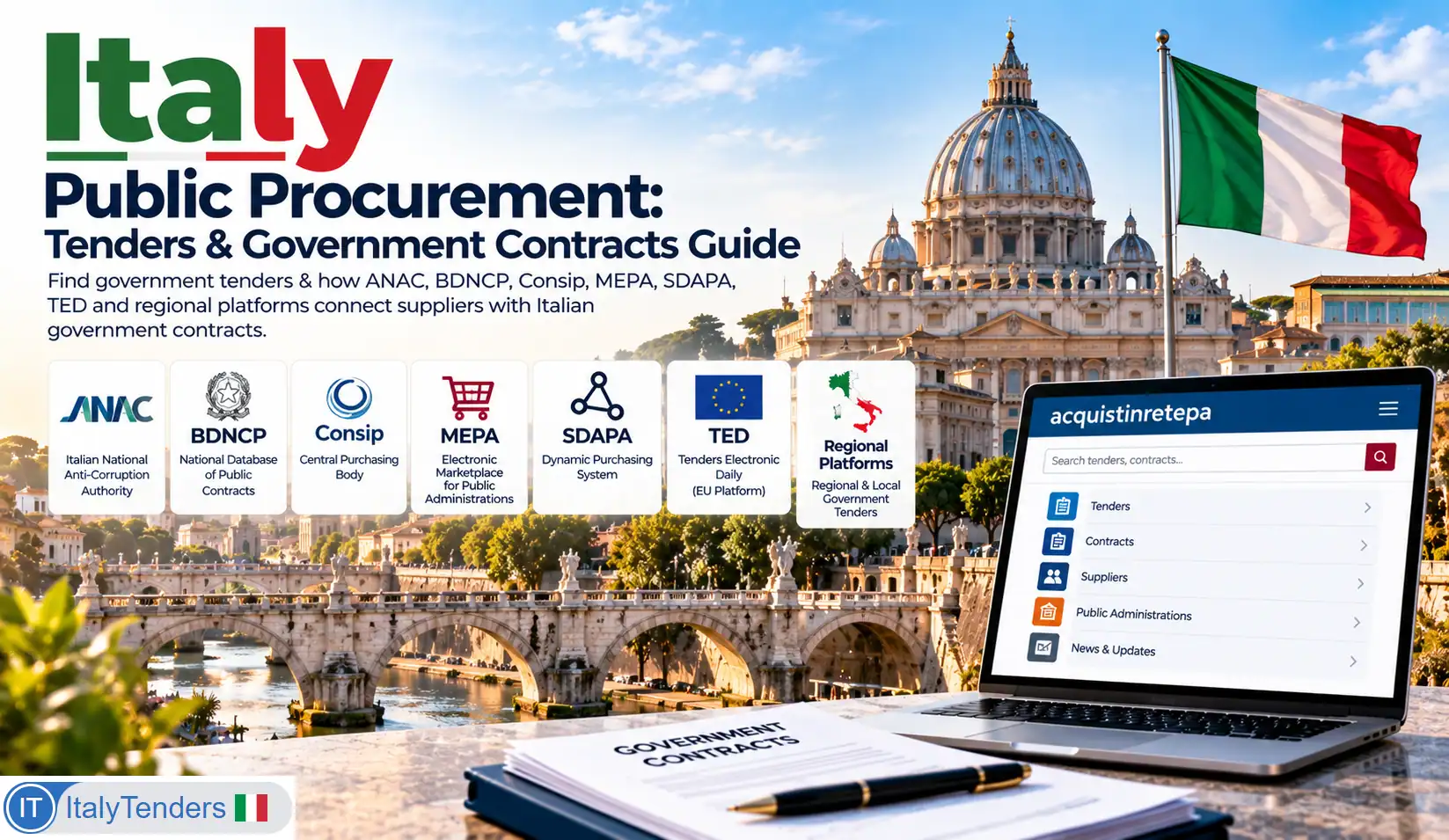
Published on Italytenders.com | Category: Italy Public Procurement | Reading Time: 10-12 min
Introduction
Italy has one of Europe's largest and most diverse public procurement markets, covering government departments, municipalities, regions, public healthcare organisations, universities, transport authorities, utilities, infrastructure bodies and other public-sector organisations. For businesses, this market creates opportunities across construction, engineering, information technology, healthcare, professional services, energy, transport, facilities management, manufacturing, consulting, security, environmental services and thousands of other procurement categories.
However, finding and winning public contracts in Italy requires more than searching for the phrase “Italy tenders.” The Italian procurement environment uses a combination of national databases, digital procurement platforms, European tender publication systems, Consip purchasing tools and regional or sector-specific platforms. Italian procurement terminology also differs from the terminology commonly used by international suppliers. A company searching only for “government tenders in Italy” can therefore miss opportunities described as appalti pubblici, gare d'appalto, bandi di gara, gare telematiche or other Italian procurement terms.
This guide explains how the Italian public procurement market works, where tenders are published, how companies can identify relevant opportunities, what major procurement platforms mean, what terminology suppliers need to understand and how procurement intelligence can improve tender discovery and bid planning.
The legal foundation is the Italian Public Contracts Code, Decreto Legislativo 31 March 2023, n. 36, which governs the public procurement framework and has been updated over time. The current official text includes provisions covering principles, digitalisation, procurement planning, contracting authorities, tender procedures, bidder documentation, participation requirements, award and contract execution.
Table of Contents
- What Is Public Procurement in Italy?
- Why the Italian Procurement Market Matters
- How the Italian Public Procurement Ecosystem Works
- Where to Find Government Tenders in Italy
- ANAC, BDNCP and the National Procurement Data Infrastructure
- Consip and Acquisti in Rete
- MEPA and SDAPA
- TED and European Public Procurement Opportunities
- Regional and Local Procurement Platforms
- Italian Tender Terminology Every Supplier Should Know
- How Companies Can Find the Right Italy Tenders
- How to Prepare for the Italian Procurement Market
- Using Procurement Intelligence to Find Better Opportunities
- Can Foreign Companies Bid for Italian Government Contracts?
- Finding and Monitoring Italy Tender Opportunities
- Conclusion
What Is Public Procurement in Italy?
Public procurement in Italy refers to the process through which public authorities and other eligible contracting entities purchase works, goods and services from economic operators. In Italian procurement language, some of the most important terms are appalti pubblici, meaning public contracts, and gare d'appalto, commonly used for competitive tender procedures.
Procurement can involve a relatively small supply requirement for a municipality or public institution, a technology service for a government department, a healthcare supply contract, a regional framework agreement or a major infrastructure project. The opportunity may be published through a national, regional, sector-specific or European procurement system depending on the contracting authority, procurement method and applicable rules.
The Italian system is increasingly digital. The Public Contracts Code introduced a digital approach to the complete contract lifecycle, while ANAC's infrastructure connects procurement platforms with national procurement data and services. This means that modern Italian tendering should be understood as a digital procurement ecosystem rather than a traditional paper-based tender process.
Why the Italian Procurement Market Matters
Italy represents a major commercial market for companies seeking public-sector customers. ANAC's analysis of 2025 procurement recorded 287,421 public procurement procedures with a total value of approximately €309.7 billion for procedures of €40,000 or more. Around €20.8 billion was associated with procurement financed by PNRR resources. The number of procedures increased by 7.6% compared with 2024, while their total value increased by 13.9%.
The market is also diverse. In 2025, ANAC recorded more than 100,000 supply procedures, more than 123,000 service procedures and more than 64,000 works procedures within the analysed €40,000-plus market. By value, supplies represented the largest share of the market, followed by services and works.
For suppliers, this means that Italy should not be treated as a single-sector tender market. A software company may find opportunities in digital transformation and public administration. An engineering company may target infrastructure and public works. A healthcare supplier may monitor hospitals and regional healthcare organisations. Professional service firms may identify consultancy, legal, financial, training and technical-service contracts.
There is also a strong geographical dimension. ANAC's 2025 data shows significant procurement activity across regions, with Lazio, Lombardia and Veneto among the regions with the highest numbers of procedures.
How the Italian Public Procurement Ecosystem Works
One of the biggest mistakes international suppliers make is assuming that Italy has one website containing every public tender. In reality, procurement information is distributed across interconnected systems.
ANAC and BDNCP provide the national procurement-data and transparency infrastructure. The Piattaforma Contratti Pubblici supports digital contract lifecycle services and connects with the Banca Dati Nazionale dei Contratti Pubblici. ANAC's infrastructure also supports functions relating to the virtual economic operator file and legal publication of procurement acts.
Consip and Acquisti in Rete operate an important national e-procurement environment for public administrations and businesses. Through the system, public administrations can use tools such as conventions, framework agreements, MEPA, SDAPA and other electronic procurement mechanisms.
TED provides the European-level publication and search environment for public procurement notices subject to European publication requirements. It allows businesses to search by country, region, sector, CPV and other criteria.
Regional and local platforms are another important layer. Depending on the region, contracting authority and procurement arrangement, businesses may encounter dedicated electronic procurement platforms and regional purchasing systems.
The practical lesson is simple: successful Italy tender research requires multi-source procurement discovery, not dependence on one portal.
Where to Find Government Tenders in Italy
Companies searching for Italian government contracts should build their search strategy around several source categories.
- National procurement and transparency infrastructure: ANAC, BDNCP and related public procurement services.
- National e-procurement: Consip and the Acquisti in Rete PA ecosystem.
- MEPA and SDAPA: digital procurement markets and dynamic purchasing mechanisms operated through Acquisti in Rete.
- European procurement: TED for European-level procurement notices.
- Regional procurement: regional e-procurement platforms and purchasing agencies.
- Municipal and institutional sources: cities, provinces, universities, hospitals, public utilities and individual contracting authorities.
- Procurement intelligence platforms: commercial databases that aggregate, classify, search and monitor tender and award information.
Official sources are particularly important for verifying tender details, deadlines, documents and procurement status. However, a commercial intelligence platform can add value by bringing fragmented information into a searchable workflow and allowing suppliers to filter opportunities according to their business needs.
ANAC, BDNCP and the National Procurement Data Infrastructure
ANAC, the Autorità Nazionale Anticorruzione, is a central institution in the Italian public procurement ecosystem. The BDNCP, or Banca Dati Nazionale dei Contratti Pubblici, is the national contracts database through which procurement lifecycle information is collected and made available through the relevant services.
The Piattaforma Contratti Pubblici managed by ANAC enables digital procurement lifecycle services and supports access to BDNCP, FVOE and legal-publication functions. ANAC documentation explains that procurement information is collected from contracting authorities and economic operators and made available through data interfaces, open data and APIs.
This is important for procurement intelligence because tender discovery is only one part of the opportunity. Historical procurement data can help businesses understand which authorities buy particular products or services, how frequently they procure, the procurement category involved and how a market develops over time.
ANAC's current advanced search environment also provides procurement-oriented filtering such as contracting authority and CPV, illustrating how procurement data can be analysed beyond simple keyword searches.
Consip and Acquisti in Rete
Consip plays a major role in Italy's public purchasing system. The Ministry of Economy and Finance's procurement rationalisation programme, implemented through Consip, provides public administrations with tools for purchasing goods, services and works.
The Acquisti in Rete portal is the operational environment through which activities such as tendering, business enablement, catalogue publication and public-sector purchasing are carried out. Its procurement instruments include ready-to-use contracts such as conventions and framework agreements as well as negotiation tools including MEPA, SDAPA and electronic tendering mechanisms.
The scale of the ecosystem demonstrates why suppliers should understand it. Acquisti in Rete reports hundreds of thousands of enabled users and hundreds of thousands of contracts across its procurement instruments, while Consip reported €25.8 billion in public purchases through the programme as of November 2025.
For companies entering Italy's government procurement market, Consip and Acquisti in Rete should therefore be treated as core components of the opportunity landscape rather than optional procurement resources.
MEPA and SDAPA
MEPA, the Mercato Elettronico della Pubblica Amministrazione, is a digital marketplace used for public-sector purchasing. It allows enabled suppliers to offer goods, services and works to public administrations through catalogue and negotiation mechanisms.
SDAPA, the Sistema Dinamico di Acquisizione della Pubblica Amministrazione, is a dynamic purchasing system through which economic operators can qualify for relevant categories and participate in specific competitions.
Consip states that companies can enable themselves for MEPA and SDAPA and participate in procurement activities conducted by public administrations. Its current information indicates that more than 200,000 companies are already enabled for these digital markets.
These platforms deserve dedicated analysis because supplier registration, catalogue management, qualification, negotiation and bidding can involve specific requirements. Later guides in this Italy procurement series will examine MEPA, SDAPA and supplier registration in much greater detail.
TED and European Public Procurement Opportunities
TED, Tenders Electronic Daily, is the online version of the Supplement to the Official Journal of the European Union dedicated to European public procurement. It provides free access to procurement opportunities and allows users to search notices by country, region, business sector and other criteria.
TED is particularly important for companies targeting larger European procurement opportunities. Its search system supports CPV-based sector searches, geographical searches and advanced queries. The platform also provides access to historical procurement notices and allows users to create personalised search profiles and alerts.
For Italy-focused tender research, TED should be used as a complementary source rather than assumed to represent the entire Italian market. National, regional and local procurement activity can exist outside the scope of European-level publication requirements.
Regional and Local Procurement Platforms
Italy's procurement market has a strong regional and local dimension. Businesses may need to monitor regional purchasing systems, municipalities, provinces, public healthcare organisations, universities, transport bodies and other contracting authorities.
This creates an important SEO and procurement-intelligence opportunity because suppliers often search for tenders using a combination of country + region + sector rather than country alone. Examples include Lombardia tenders, Lazio tenders, Milan public tenders, Rome government contracts, Veneto procurement, Emilia-Romagna tenders and Toscana public procurement.
Regional procurement research can also reveal local buying patterns that are difficult to identify from a national-level keyword search. A supplier targeting healthcare, construction, IT or environmental services may achieve better results by identifying the authorities and procurement platforms most relevant to its geographic strategy.
Italian Tender Terminology Every Supplier Should Know
Understanding Italian procurement vocabulary is essential for both search visibility and tender discovery. International suppliers should not rely exclusively on English terminology.
- Appalti pubblici: public procurement or public contracts.
- Gara d'appalto: competitive tender or procurement procedure.
- Bando di gara: tender notice or procurement notice.
- Stazione appaltante: contracting authority.
- Operatore economico: economic operator or supplier.
- Gare telematiche: electronic or online tender procedures.
- Affidamento diretto: direct award mechanism under applicable rules.
- Procedura aperta: open procedure.
- Procedura ristretta: restricted procedure.
- Procedura negoziata: negotiated procedure.
- Esito di gara: tender outcome or result.
- Aggiudicazione: award or contract award decision.
- CPV: Common Procurement Vocabulary classification used to identify procurement subject matter.
- CIG: Codice Identificativo Gara, the procurement identification code used within the Italian procurement framework.
These terms are not merely language translations. They are useful search signals. A supplier that understands both “Italy government tenders” and “gare d'appalto” can construct a much broader procurement-search strategy.
How Companies Can Find the Right Italy Tenders
The best tender search strategy begins with the company's commercial capability rather than a generic search for every available tender.
Start by defining the products or services you can deliver. Then identify relevant procurement sectors, CPV categories, Italian terminology, target regions, buyer types and contract sizes. This creates a structured search profile.
A practical Italy tender search workflow can include:
- Define core products and services.
- Identify relevant CPV codes and Italian procurement terminology.
- Choose target regions and cities.
- Identify relevant public authorities and buyer categories.
- Monitor national, regional and European procurement sources.
- Track active tenders, upcoming procurement and pre-information notices where available.
- Review tender documents before deciding whether to bid.
- Monitor amendments, clarifications and deadline changes.
- Analyse previous awards and competitors before investing significant bid resources.
This approach is more effective than simply searching for “Italy tenders” because it transforms a large procurement market into a manageable opportunity pipeline.
How to Prepare for the Italian Procurement Market
Before bidding, suppliers should assess whether they meet the applicable legal, technical, financial and administrative requirements. Depending on the type and value of procurement, requirements may involve professional qualifications, previous experience, financial capacity, technical capability, certifications, declarations, guarantees or other evidence.
Construction companies may encounter qualification requirements such as SOA certification for relevant public works. Other suppliers may need to complete platform-specific registration or qualification processes.
Digital readiness is equally important. Italy's procurement framework has moved strongly toward digital procurement. From 1 January 2024, the digitalisation provisions of the Public Contracts Code became effective, with procurement lifecycle activities conducted through certified digital procurement platforms and interoperable services.
For foreign suppliers, the preparation stage should also include understanding electronic submission requirements, company documentation, applicable declarations, language requirements, digital identity or signature requirements where relevant and the specific platform used by the contracting authority.
Using Procurement Intelligence to Find Better Opportunities
Tender searching tells a company what is being advertised. Procurement intelligence attempts to answer the more valuable questions: who is buying, what are they buying, how often do they buy, who has won before, what is the competitive environment and where is future demand likely to emerge?
For example, a company selling cybersecurity services could search only for active IT tenders. A stronger procurement-intelligence approach would identify public authorities repeatedly purchasing cybersecurity services, analyse their previous tenders, review awarded suppliers, monitor upcoming procurement planning and track related CPV categories.
Historical award intelligence is particularly valuable. A tender result can reveal the winning company, procurement authority, contract subject, award information and other data that may help a supplier understand the competitive landscape.
This is where Italy's growing digital procurement data infrastructure becomes commercially important. ANAC's BDNCP ecosystem provides procurement data and supports open data and API access, while commercial intelligence platforms can aggregate and organise information for business users.
Italian procurement competitors are already positioning around this intelligence layer. For example, Telemat combines tender discovery with business intelligence and AI-assisted document analysis, demonstrating that the Italian market is moving beyond basic tender listings toward data-supported bid decisions.
Can Foreign Companies Bid for Italian Government Contracts?
International companies can consider the Italian public procurement market, but participation should be approached as a compliance and market-entry project rather than simply translating an offer into Italian.
Foreign suppliers should identify the applicable procurement procedure, understand the contracting authority's requirements, verify eligibility and qualification conditions, prepare the required corporate and technical documentation and determine which digital procurement platform must be used.
European companies may already operate within EU procurement frameworks, while suppliers from outside the EU should pay particular attention to applicable rules concerning eligibility, international procurement access, documentation, establishment, equivalence of qualifications and other tender-specific requirements.
For international businesses, the biggest opportunity is often not trying to monitor every Italian tender. A better strategy is to identify a limited number of sectors, authorities, regions and procurement categories where the company's capabilities provide a realistic competitive advantage.
Finding and Monitoring Italy Tender Opportunities
A dedicated tender intelligence platform can make the discovery process easier by bringing relevant procurement opportunities, contract awards and buyer information into a single research workflow.
For businesses looking for Italy tenders, government contracts, public procurement opportunities, tender results and procurement intelligence, ItalyTenders.com can be used as a dedicated source for exploring and monitoring the Italian tender market.
Search Italy Tenders can be used to explore available tender opportunities, while Italy Contract Awards can support research into procurement outcomes and awarded contracts.
Businesses that want access to the platform can use ItalyTenders Registration or ItalyTenders Login. Companies requiring assistance can use Contact ItalyTenders.
Procurement professionals can also explore the Italy Procurement Authority section to support authority-focused tender research.
The strongest workflow combines platform-based discovery with official-source verification. Official ANAC, Consip, Acquisti in Rete and TED resources remain essential for checking procurement information, while structured tender intelligence can help suppliers reduce search time and identify patterns across the market.
Conclusion
Italy's public procurement market is large, digital and highly distributed. Companies seeking government contracts need to understand more than individual tender notices. They need to understand the ecosystem connecting ANAC, BDNCP, digital procurement platforms, Consip, Acquisti in Rete, MEPA, SDAPA, TED and regional procurement systems.
The opportunity is substantial: ANAC's latest market analysis recorded €309.7 billion in public procurement procedures of €40,000 or more during 2025, with significant activity across supplies, services and works.
For suppliers, the winning approach is therefore a combination of accurate tender discovery, Italian procurement terminology, CPV-based searching, authority intelligence, regional monitoring, qualification readiness and contract-award analysis.
This guide provides the foundation. The next steps are to understand exactly where Italian tenders are published, how ANAC and BDNCP work, how suppliers use Consip and Acquisti in Rete, how MEPA and SDAPA operate, how Italian tender procedures differ and how companies can search, qualify and submit bids efficiently.
Frequently Asked Questions (FAQs)

Fresh and verified Tenders from Italy. Find, search and filter Tenders/Call for bids/RFIs/RFPs/RFQs/Auctions published by the government, public sector undertakings (PSUs) and private entities.
- 1,000+ Tenders
- Verified Tenders Only
- New Tenders Every Day
- Tenders Result Data
- Archive & Historical Tenders Access
- Consultants for RFI/RFP/RFQ
- Tender Notifications & Alerts
- Search, Sort, and Filter Tenders
- Bidding Assistance & Consulting
- Customer Support
- Publish your Tenders
- Export data to Excel
- API for Tender Data
- Tender Documents

Fill out the form below and you will receive a call from us within 24 hours.
Get FREE SAMPLE TENDERS from Italy in your email inbox.
Copyright © 2014-2026 ItalyTenders.com. All Rights Reserved.