How to Read an Italian Tender Notice: Complete Guide
Understand Tender Requirements, Contract Values, Eligibility Criteria and Deadlines Before You Bid
Introduction
Finding an Italian public procurement opportunity is only the first step towards submitting a successful bid. Suppliers must also understand the tender notice, identify the contracting authority, evaluate the contract scope, check participation requirements and confirm whether they can meet the submission deadline.
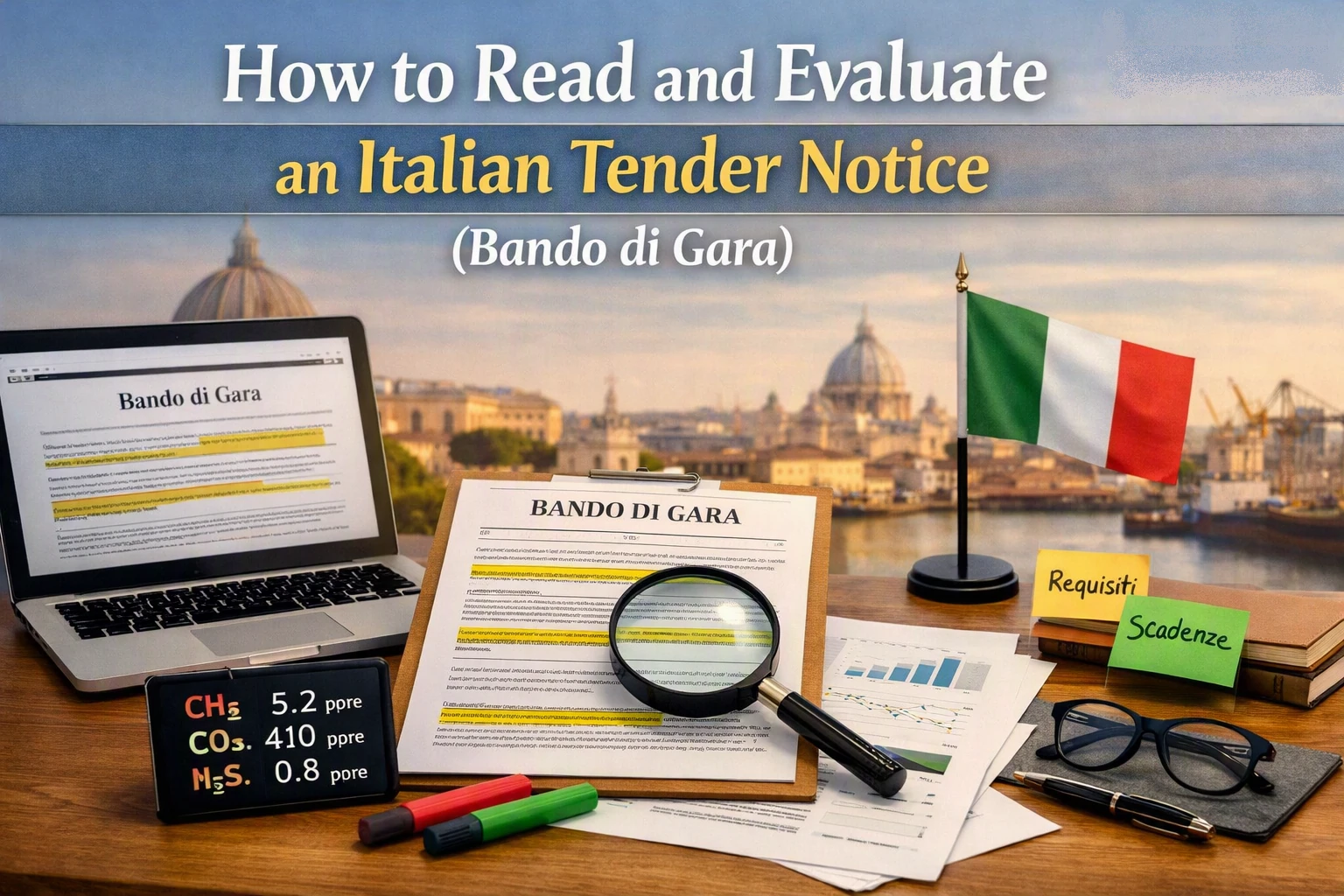
An Italian tender notice, commonly called a bando di gara, provides essential information about a public procurement procedure. It may describe the goods, works or services required, the estimated contract value, the procurement procedure, the relevant dates and the location where the contract will be performed. It also directs interested businesses to the detailed tender documentation and official submission arrangements.
However, a tender notice is not always a complete description of every obligation. Detailed technical specifications, qualification requirements, evaluation rules and contractual conditions may appear in the disciplinare di gara, capitolato tecnico, draft contract and other attachments. Suppliers should therefore use the notice to understand and assess the opportunity before examining the complete documentation package.
This guide explains how to read an Italian tender notice step by step, interpret its main fields, identify important deadlines, assess eligibility and recognise warning signs before investing time and resources in a bid.
Table of Contents
- What Is an Italian Tender Notice?
- Types of Italian Procurement Notices
- Identify the Contracting Authority
- Understand the Object of the Contract
- Understand CPV Codes, CIG and Other Identifiers
- Check the Contract Value and Lots
- Understand the Procurement Procedure
- Review Eligibility and Selection Requirements
- Understand the Award Criteria
- Check Deadlines and Submission Instructions
- Review Contract Location and Duration
- Locate the Supporting Tender Documents
- Check Clarifications and Amendments
- How to Decide Whether to Bid
- Common Mistakes When Reading Italian Tender Notices
- Where to Find and Verify Italian Tender Notices
- How ItalyTenders Helps Suppliers Discover Opportunities
- Conclusion
What Is an Italian Tender Notice?
A tender notice is an official announcement concerning a procurement opportunity or another stage of a public procurement procedure. In Italy, the term bando di gara is commonly associated with a call for competition, although the exact form and terminology depend on the procedure.
The notice helps potential suppliers understand what the contracting authority intends to purchase and how interested economic operators can obtain further information or participate.
Under Article 82 of Italy's Legislative Decree 36/2023, the procurement documents include, in particular, the tender notice or invitation, the disciplinare di gara, the special specifications and the proposed contractual conditions. The documents should be read together, with attention to the rules applicable to the specific procedure.
For suppliers, the notice serves three principal purposes:
- Opportunity identification: It helps determine whether the procurement subject matches the company's products, services or works.
- Initial qualification: It highlights the procedure and important participation information that must be checked in the complete documentation.
- Bid planning: It provides information needed to investigate the contract, locate the supporting documents and organise the submission process.
A supplier should not decide to bid solely because the notice title looks relevant. The full contract scope, eligibility requirements, deadlines and technical conditions must be assessed before proceeding.
Types of Italian Procurement Notices
Public procurement information is published at different stages of the procurement process. Understanding the type of notice helps suppliers distinguish between an active opportunity, a preliminary announcement and information about a completed procedure.
| Notice type | Italian or commonly used term | What suppliers should understand |
| Competition or tender notice | Bando di gara or bando | Announces a procurement procedure and provides information about participation. |
| Prior information notice | Avviso di preinformazione | Provides advance information about planned procurement; it does not automatically mean that a current bid can be submitted. |
| Invitation to participate or tender | Lettera d'invito or invito | Communicates participation or submission instructions in procedures where an invitation is used. |
| Correction notice | Rettifica or avviso di rettifica | Corrects or amends previously published information. |
| Deadline extension | Proroga | Communicates an extension of a deadline or period. |
| Contract award notice | Avviso di aggiudicazione | Provides information about the outcome of a procurement procedure. |
| Contract modification notice | Avviso di modifica del contratto | Reports information about a contract modification where a notice is required or published. |
European procurement notices published through Tenders Electronic Daily (TED) also use standardised notice types and subtypes. The notice type affects which fields are displayed and what information is expected to be available.
Before spending time preparing a bid, confirm that the notice actually represents an opportunity for which submissions or requests to participate are being accepted. A prior information notice or an award notice serves a different purpose from an open call for tenders.
Identify the Contracting Authority
The contracting authority is the public body or other eligible entity conducting the procurement. Identifying the buyer is an important first step because it helps suppliers understand the organisation's responsibilities, location, procurement activity and potential relevance to their business.
The notice may contain the authority's official name, address, identification details, contact information and information about where procurement documents can be accessed.
Check the following details:
- Official name: Confirm the legal name of the contracting authority rather than relying solely on an abbreviated name.
- Identification information: Check any national identification number or tax-code information supplied in the notice.
- Address: Identify the authority's location and distinguish it from the place where the contract will be performed.
- Contact point: Identify the official channel for questions, clarifications or access to documents.
- Buyer profile or platform: Locate the official procurement page and associated documentation.
The contracting authority's identity can help suppliers research previous procurement activity and understand whether the organisation regularly purchases similar goods, services or works.
However, suppliers should distinguish the contracting authority's address from the contract's place of performance. A public body based in Rome, for example, may procure services or works to be delivered elsewhere in Italy.
Understand the Object of the Contract
The object of the contract describes what the contracting authority intends to purchase. It may involve supplies, services, public works or a combination of activities.
Start by reading the notice title and short description. Then review the detailed scope and the associated technical documentation to determine precisely what the supplier will be expected to provide.
For example, a notice referring to information technology could concern computer equipment, software development, system maintenance, cloud services or technical consultancy. These activities may require different capabilities, resources and commercial arrangements.
Questions to ask when reviewing the contract object:
- What products, services or works are required?
- Does the contract cover one activity or several distinct requirements?
- Are quantities, technical characteristics or service levels specified?
- Does the procurement include delivery, installation, maintenance or ongoing support?
- Are there separate lots with different scopes?
- Does the requirement match the company's actual capabilities?
Do not rely on the title alone. A short title may not describe all the activities included in a contract, and a broad title may cover several specialised requirements.
For a more detailed technical assessment, consult the capitolato tecnico and the other documents listed in the notice. These explain the procurement scope in greater depth than the announcement itself.
Understand CPV Codes, CIG and Other Identifiers
Italian procurement notices can contain several identifiers. Understanding their different purposes helps suppliers search for opportunities, locate records and verify that they are reviewing the correct procedure.
CPV: Common Procurement Vocabulary
The Common Procurement Vocabulary classifies the subject of a public procurement contract. It helps describe the goods, works or services involved using standardised codes.
Suppliers can use CPV classifications to discover notices related to their business activities, but they should also review the description and technical requirements. A code is a useful classification tool, not proof that a contract matches the supplier's capabilities.
Official reference: TED Common Procurement Vocabulary.
CIG: Contract identification code
CIG is the Italian procurement identification code associated with a procurement procedure or contract-related record. Where provided, it can help suppliers locate or cross-check information about the specific procurement.
Do not confuse the CIG with the CPV. The CPV describes what is being purchased; the CIG identifies the relevant procurement record or procedure.
CUP: Project identification code
CUP is the Italian code used to identify a public investment project. It may appear in procurement information associated with projects that require this identifier.
Notice and procedure reference numbers
A procurement notice may also display an internal reference, publication number, lot number or platform identifier. Record the relevant identifiers so that documents, clarifications and amendments can be matched to the correct opportunity.
When reviewing a notice, verify the identifiers against the official publication or procurement platform. Similar titles alone are not sufficient to establish that two records concern the same procedure.
Check the Contract Value and Lots
The contract value is an important factor in deciding whether an opportunity is commercially viable. A notice may state an estimated value, a value for a particular lot or other financial information relevant to the procurement.
Suppliers should read the financial information carefully and confirm what the stated amount represents. Depending on the procurement, the total may relate to the entire contract, a particular lot or a wider arrangement that includes options or other specified elements.
Review these points:
- Estimated value: Identify the value stated in the notice and the scope to which it applies.
- Currency: Confirm the currency used in the notice.
- Lots: Determine whether the procurement is divided into separate lots and whether each has its own value.
- Options and extensions: Check whether the documentation identifies additional quantities, extensions or options.
- Commercial feasibility: Assess whether the likely contract revenue justifies the cost of preparing and delivering the offer.
- Financial requirements: Check whether participation depends on turnover, financial standing, guarantees or other financial conditions.
A large estimated value does not necessarily mean that the entire amount will be paid to one supplier. The contract may be divided into lots, involve multiple suppliers or specify quantities and payment arrangements in the supporting documents.
Similarly, the estimated value should not be confused with the final awarded contract value. The actual financial outcome depends on the procurement procedure and the contract ultimately awarded.
Understand the Procurement Procedure
The notice may identify the procurement procedure being used by the contracting authority. The procedure determines how the competition is organised and how economic operators can participate.
Common procedure types include:
- Open procedure: Eligible interested economic operators may submit tenders under the published rules.
- Restricted procedure: Economic operators first request participation, and those selected are invited to submit tenders according to the procedure.
- Competitive procedure with negotiation: Selected or participating economic operators may negotiate under the conditions established by the applicable rules.
- Competitive dialogue: The contracting authority conducts a dialogue with selected participants to develop suitable solutions before final tenders are submitted.
- Innovation partnership: A procedure intended for developing and subsequently purchasing innovative solutions under the relevant legal conditions.
- Negotiated procedure without prior publication: A procedure that may be used only where the applicable legal conditions permit it.
The exact process, conditions and terminology depend on the procedure and applicable law. Suppliers should read the notice and disciplinare di gara to understand how participation works in the specific case.
For an open procedure, a supplier may be able to submit a tender directly if it meets the stated requirements. In a restricted procedure, submitting a request to participate may be an earlier stage, with a later invitation required before a tender can be submitted.
Do not assume that every notice allows every interested business to submit a full offer immediately. Check the procedure type and the required stage of participation.
Review Eligibility and Selection Requirements
A procurement opportunity may match a supplier's products or services but still be unsuitable if the company cannot meet the participation requirements.
The notice may provide a summary of the qualification conditions, while the disciplinare and other procurement documents explain the requirements in greater detail.
Common areas to check include:
- Professional suitability or registration requirements.
- Economic and financial standing.
- Technical and professional capability.
- Relevant experience or similar contracts, where required.
- Professional qualifications or authorisations.
- Requirements applying to consortia or temporary groupings.
- Rules concerning subcontracting or reliance on another entity's capabilities, where applicable.
- Exclusion grounds and the declarations required from the economic operator.
Suppliers should compare each requirement with their own records and available evidence. If a tender requires specific experience, qualifications or financial capacity, the company should establish whether it can demonstrate compliance in the manner specified by the contracting authority.
Foreign suppliers should also check the instructions concerning equivalent evidence and documents issued in their country of establishment. They should not assume that a document used in another jurisdiction automatically satisfies the Italian procurement requirement.
Where the notice refers to the DGUE, the supplier should read the related instructions and determine which declarations and supporting evidence are required at each stage of the procedure.
Understand the Award Criteria
The award criteria explain how the contracting authority will compare and evaluate tenders. The notice may summarise the award method, while the disciplinare provides more detailed information about the evaluation process.
Depending on the procedure and applicable rules, the award method may involve the lowest price or the most economically advantageous tender assessed using the stated criteria.
Where a quality-and-price approach is used, the procurement documents may assign weightings to technical quality, price, methodology, service organisation or other relevant factors.
Suppliers should check:
- The stated award method.
- The evaluation criteria and any subcriteria.
- The weighting or points assigned to each criterion.
- The technical documents or evidence required for evaluation.
- The rules for submitting the financial offer.
- Any minimum quality thresholds or other evaluation conditions stated in the documents.
Understanding the evaluation method helps suppliers decide how to allocate resources when preparing an offer. If technical quality forms a significant part of the evaluation, the response should address the relevant criteria clearly and provide the evidence requested.
Suppliers should never assume that the lowest price automatically wins every Italian public tender. The award method specified for the individual procedure must guide the bid strategy.
Check Deadlines and Submission Instructions
Deadlines are among the most important details in a tender notice. Missing a submission deadline can prevent a supplier from participating, even when its offer otherwise meets the requirements.
Read the notice and supporting documents for all relevant dates, including the deadline for submitting a tender or request to participate and any deadline for asking questions or requesting clarification.
Build a deadline checklist:
- Submission deadline: Record the final date and time for submitting the required response.
- Clarification deadline: Identify the last date for submitting questions, if specified.
- Site visit or meeting: Check whether a visit, meeting or other activity is required or scheduled.
- Platform access: Allow time for registration, access permissions and electronic submission preparation.
- Internal review: Set earlier deadlines for technical, financial and legal review.
- Final confirmation: Verify that the platform confirms submission in the required manner.
Suppliers should pay attention to the time zone and the exact time stated in the official notice. They should also check for published corrections or extensions before relying on an earlier deadline.
Electronic submission may require file preparation, electronic signatures, uploads and confirmation steps. Waiting until the final minutes increases the risk of technical or administrative problems.
Review Contract Location and Duration
The place of performance and contract duration can materially affect a supplier's decision to bid.
The notice may specify the location where the goods must be delivered, works carried out or services provided. For contracts involving several locations or lots, the supplier should identify the full geographical scope rather than relying on the contracting authority's address.
Location-related questions include:
- Where must the goods, works or services be delivered or performed?
- Does the contract cover one municipality, a region or several locations?
- Are site visits, local personnel or particular operational arrangements needed?
- Will travel, logistics or delivery costs affect the commercial offer?
The contract duration should also be checked. A notice may identify an initial term, a planned start date or options for extensions. The supporting documents should explain the applicable conditions and how the duration is calculated.
Suppliers should evaluate whether they can provide the required service throughout the contract period and whether the proposed schedule is compatible with their available staff, equipment and resources.
Locate the Supporting Tender Documents
After reviewing the notice, suppliers should locate the complete documentation package. The announcement may provide a link to the procurement platform or identify where the tender documents can be downloaded.
Common supporting documents include:
- Disciplinare di gara: Detailed participation, administrative and submission rules.
- Capitolato tecnico: Technical specifications and performance requirements.
- DGUE: Standardised self-declaration concerning exclusion grounds and selection requirements.
- Domanda di partecipazione: Application or participation form, where required.
- Schema di contratto: Proposed contractual conditions.
- Financial offer forms: Templates or instructions for submitting the commercial offer.
- Technical annexes: Additional requirements, schedules, drawings or specifications.
- Clarifications and amendments: Additional information or changes published during the procedure.
Suppliers should download and review the documents before deciding to prepare a bid. They should record the document names, publication dates and any version information, especially if the contracting authority later publishes revisions.
For a more detailed explanation of these documents, consult the ItalyTenders guide to Italian tender opportunities and documentation and review the official documentation linked to the individual procurement.
Check Clarifications and Amendments
A tender notice may be followed by clarifications, corrections or other updates. These can affect the interpretation of requirements, the documents to be submitted or the deadline.
Suppliers should revisit the official procurement page during the preparation period rather than relying only on the files downloaded at the beginning.
Check for the following:
- Answers to questions raised by potential participants.
- Corrected or replacement versions of tender documents.
- Changes to the submission deadline.
- Changes to the contract scope or lot information.
- Additional instructions or attachments.
- Notices explaining procedural changes.
When an update is published, determine which part of the bid it affects and update the internal checklist accordingly. A correction to a technical specification may require a revised solution, while a change to a deadline may require an adjustment to the submission plan.
On TED, notice versions and change notices may provide information about changes to a published notice. Suppliers should review the current official notice and the relevant procurement platform for the procedure's latest information.
How to Decide Whether to Bid
Reading a tender notice should lead to a practical decision: proceed with the opportunity, investigate further or decline to bid.
A structured bid/no-bid review helps suppliers avoid spending substantial resources on opportunities they cannot realistically fulfil.
Assess the opportunity against these questions:
- Scope fit: Does the contract match the company's actual products, services or works?
- Eligibility: Can the company demonstrate the required qualifications, experience and financial capacity?
- Commercial viability: Is the likely contract value sufficient to justify the cost and risk of delivery?
- Delivery capacity: Can the company meet the technical, geographic and scheduling requirements?
- Competition: Does the company have a credible offer against the published award criteria?
- Documentation: Can the company obtain and prepare all mandatory documents before the deadline?
- Risk: Are the contractual obligations and performance expectations acceptable?
Suppliers can use a simple internal assessment with three possible outcomes:
- Proceed: The scope is relevant, eligibility appears achievable and the opportunity is commercially credible.
- Investigate: Important details remain unclear and need to be checked in the full documents or through the official clarification process.
- Decline: The company cannot meet a material requirement, the deadline is impractical or the commercial and delivery risks are unacceptable.
This assessment should be based on the full tender documentation, not the notice title alone. It is an internal decision-making tool and does not replace any formal eligibility determination made by the contracting authority.
Common Mistakes When Reading Italian Tender Notices
Relying only on the title
A title may be broad or abbreviated. Always review the detailed description and technical specifications to confirm the real contract scope.
Confusing the authority's address with the performance location
The buyer may be based in one city while the contract is performed elsewhere. Check the place of performance and delivery requirements.
Ignoring lot information
A procurement may be divided into several lots with different scopes, values or requirements. Check which lot or lots the company can realistically supply.
Assuming that the estimated value is the amount payable to one supplier
Review the financial information and lot structure. The stated value may refer to a broader procurement arrangement or include options described in the documentation.
Misunderstanding the procedure type
Not every notice allows immediate submission of a complete tender. Confirm whether the procedure requires a request to participate, a subsequent invitation or another step.
Overlooking qualification requirements
A relevant product or service does not guarantee eligibility. Review professional, financial and technical requirements before committing to bid preparation.
Missing updates
Clarifications and corrections may change the requirements or deadline. Check the official platform before finalising the submission.
Using only a third-party summary
Tender-information services can help with discovery, but the official notice and associated procurement documents should be used to verify requirements and deadlines.
Where to Find and Verify Italian Tender Notices
Suppliers can use official Italian and European procurement sources to locate notices and confirm the information published by contracting authorities.
ANAC legal-publicity platform
The Italian National Anti-Corruption Authority (ANAC) operates the Piattaforma di Pubblicità a Valore Legale. Its general search supports searches by notice type, publication date, lot amount and terms or identifiers such as CIG, CUP and contracting authority. Its advanced search includes publication dates, contracting-authority tax-code information and CPV codes.
Tenders Electronic Daily (TED)
TED provides access to procurement notices published at European level. Its search and notice-view features allow users to examine buyer details, procedure information, contract scope, dates and other available fields. The information displayed depends on the notice type.
Visit TED to search notices and inspect the official publication details.
Acquisti in Rete PA
Acquisti in Rete PA provides access to procurement opportunities and electronic purchasing procedures associated with Consip. Suppliers should consult the platform where the notice or procedure directs them to obtain documentation or participate.
View Acquisti in Rete PA tender listings.
When verifying a notice, confirm the official title, authority, publication details, procedure reference, relevant deadlines and the location of the complete documents. If a third-party listing differs from the official source, investigate the discrepancy before acting.
How ItalyTenders Helps Suppliers Discover Opportunities
Businesses often need to review opportunities across multiple procurement categories and contracting authorities. Tender-information services can help suppliers identify relevant notices before they undertake the detailed review required for a bid.
ItalyTenders tender listings can help businesses explore Italian procurement opportunities. After identifying a potentially suitable tender, suppliers should consult the official notice and supporting documentation to verify its scope, deadlines and participation requirements.
Companies researching procurement outcomes can also review ItalyTenders contract awards to examine published award information and procurement activity.
Suppliers can create an account through ItalyTenders registration and access the platform through the ItalyTenders login page.
For information about contracting authorities, businesses can explore the ItalyTenders authority directory. Companies seeking additional information can use the ItalyTenders contact page.
Regardless of the discovery method, the official procurement documents remain essential for confirming the conditions that apply to a specific tender and preparing a compliant submission.
Conclusion
Reading an Italian tender notice correctly helps suppliers determine whether a procurement opportunity is relevant, commercially viable and achievable within the required timeframe.
Suppliers should identify the contracting authority, understand the contract scope, check CPV and other identifiers, review the value and lot structure, confirm the procurement procedure and assess eligibility requirements. They should also record the submission deadline, locate the complete tender documents and monitor official clarifications or amendments.
The notice provides the starting point, but the full documentation package determines the detailed requirements for participation and performance. Businesses that follow a structured review process can make better-informed bid/no-bid decisions and reduce the risk of overlooking important procurement conditions.
Sources: ANAC Piattaforma di Pubblicità a Valore Legale; TED notice guidance and search help; Italian Public Contracts Code, Legislative Decree 36/2023.
Frequently Asked Questions (FAQs)

Fresh and verified Tenders from Italy. Find, search and filter Tenders/Call for bids/RFIs/RFPs/RFQs/Auctions published by the government, public sector undertakings (PSUs) and private entities.
- 1,000+ Tenders
- Verified Tenders Only
- New Tenders Every Day
- Tenders Result Data
- Archive & Historical Tenders Access
- Consultants for RFI/RFP/RFQ
- Tender Notifications & Alerts
- Search, Sort, and Filter Tenders
- Bidding Assistance & Consulting
- Customer Support
- Publish your Tenders
- Export data to Excel
- API for Tender Data
- Tender Documents

Fill out the form below and you will receive a call from us within 24 hours.
Get FREE SAMPLE TENDERS from Italy in your email inbox.
Copyright © 2014-2026 ItalyTenders.com. All Rights Reserved.