Cagliari University Awards SaaS Library System Contract
B2B Global Tender Bidding & eProcurement Services Support
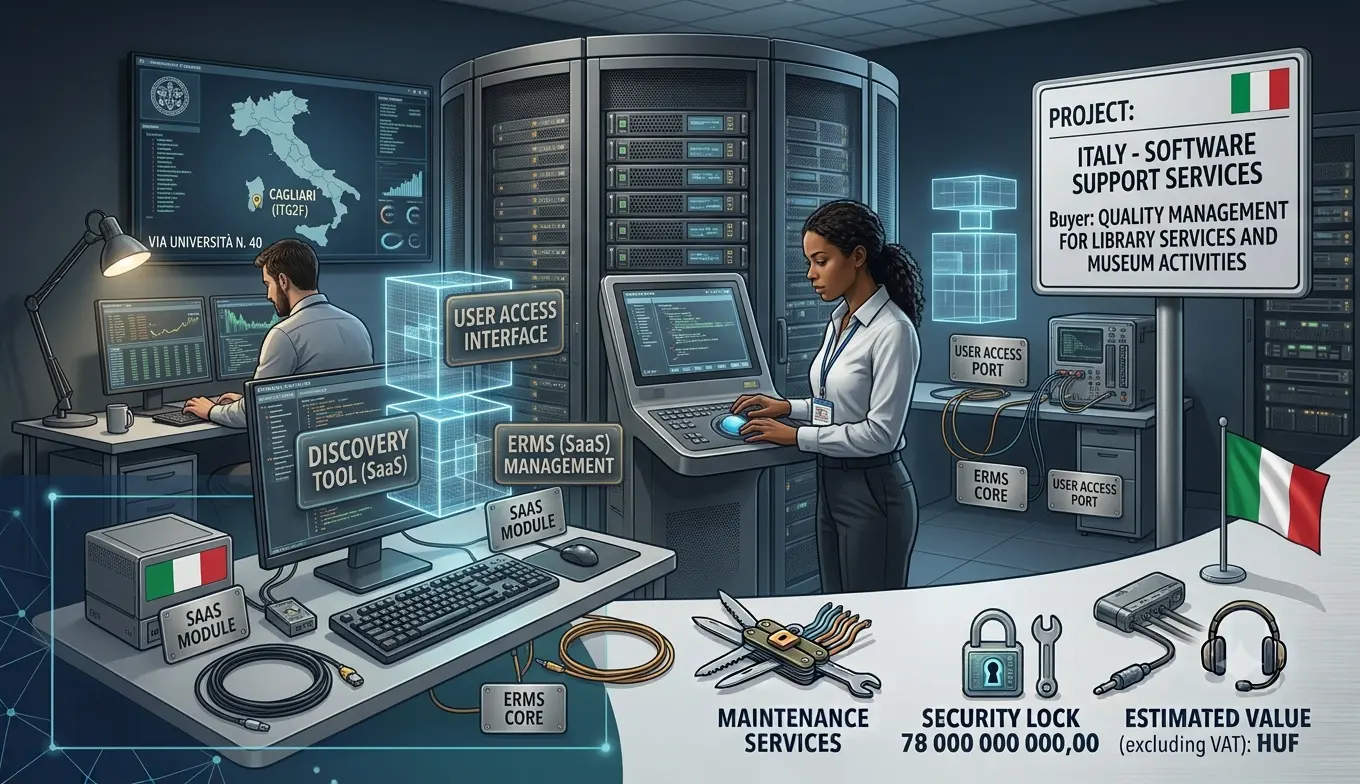
Standfirst
The University of Cagliari has awarded a 36-month contract for a Discovery Tool and Electronic Resource Management System in Software as a Service mode to OCLC B.V., a Netherlands-based library technology company. The contract, worth EUR 260,452.50, covers implementation of up to six months followed by three years of operation, with an option to extend by a further 36 months. Two tenders were received and the award was decided on the most economically advantageous offer, with price not the only criterion.
Introduction
Academic libraries have changed beyond recognition over the past two decades. Where a library once managed physical collections, it now manages access to thousands of electronic journals, databases, e-books and streaming services, each with its own licensing terms, authentication requirements and usage rules. Students and researchers expect to find what they need in a single search, whether it is a printed book on a shelf or an article in a journal the library subscribes to but does not own.
Managing that environment requires specialised software. A Discovery Tool gives users a single search interface across all of a library's collections, physical and electronic. An Electronic Resource Management System, known as an ERMS, handles the behind-the-scenes work: tracking subscriptions, managing licences, maintaining access links, producing usage statistics and ensuring that the library knows what it has paid for and what it can access.
The Università degli Studi di Cagliari, the University of Cagliari in Sardinia, has awarded a contract for both capabilities, delivered as a Software as a Service solution. The contract went to OCLC B.V., one of the world's largest library technology organisations, and covers implementation of up to six months followed by 36 months of operation. Two tenders were received, and the award was decided on the most economically advantageous offer.
This article explains what was procured, who was involved, how the procurement was structured and what the award signals for suppliers in the European library technology market.
Why This Contract Matters
This contract matters because it shows how a mid-sized European university is modernising the digital infrastructure that underpins its research and teaching. The University of Cagliari is not a large institution by European standards, but it provides access to a substantial electronic collection for its students and researchers. Managing that collection effectively is essential to the university's academic mission.
It also matters because of the delivery model. The university has chosen Software as a Service rather than an on-premises installation. That means the system is hosted and maintained by the supplier, and the university pays a subscription rather than buying a perpetual licence. SaaS has become the default model for library management and discovery systems, because it reduces the university's IT burden and ensures that the software is always up to date.
The procurement also matters because of its structure. The contract is divided into an implementation phase of up to six months and an operational phase of 36 months, with an option to extend by a further 36 months. That structure recognises that implementing a discovery and ERMS system takes time and that the university wants to see the system working before committing to a long-term arrangement.
Finally, the contract matters because of the competition. Two tenders were received, which is a modest level of competition for a specialist procurement of this kind. The library technology market is concentrated, with a small number of international suppliers dominating, and the fact that two suppliers bid suggests that the university's requirements were accessible to more than one provider.
Contract Timeline
- Winner selected: 3 August 2026
- Contract concluded: 5 October 2026
- Notice dispatched: 8 October 2026
- Notice published: 9 October 2026
- Implementation period: Up to 6 months
- Operational period: 36 months
- Extension option: Further 36 months
Contract Overview
The contract covers the supply of a Discovery Tool and an Electronic Resource Management System, delivered in Software as a Service mode, for the University of Cagliari. It is classified as a services contract under CPV 72261000 (software support services), with an additional classification under CPV 48160000 (library software packages).
It is a single-lot procurement, identified as LOT-0001, with the procedure reference C1-26. The place of performance is the university's library directorate at Via Università n. 40, Cagliari, in the Cagliari NUTS region (ITG2F).
The total contract value at tender was EUR 338,250 excluding VAT and charges. Of that, EUR 180,250 covered the implementation and operational start-up plus 36 months of operation, and EUR 158,000 covered the option to extend by a further 36 months. The awarded value was EUR 260,452.50, which is below the tendered value. The contracting authority has not explained the difference.
The procurement was conducted as an open procedure under Article 71 of Italian Legislative Decree No. 36/2023, which is Italy's public contracts code. The legal basis is Directive 2014/24/EU. The contract is not financed with EU funds and is not covered by the Government Procurement Agreement. It is not a framework agreement and does not use a dynamic purchasing system.
The award criterion was the most economically advantageous offer, based on the best price-quality ratio. Price was not the only criterion. The notice states that all criteria are set out in the procurement documents, but it does not disclose them in the notice itself.
Key Contract Details
| Notice ID | 697221-2026 |
| OJ S issue | 196/2026 |
| Publication date | 9 October 2026 |
| Contracting authority | DIREZIONE QUALITA SERVIZI BIBLIOTECARI E ATTIVITA MUSEALI, Università degli Studi di Cagliari |
| Contract type | Services |
| Main CPV code | 72261000 – Software support services |
| Additional CPV code | 48160000 – Library software packages |
| Procedure type | Open procedure |
| Legal basis | Directive 2014/24/EU; Italian Legislative Decree No. 36/2023, Article 71 |
| Lot | LOT-0001 |
| Winner | OCLC B.V. |
| Winning bid | EUR 260,452.50 |
| Tendered value | EUR 338,250.00 excluding VAT |
| Number of bids | 2 |
| Award criteria | Most economically advantageous offer, based on best price-quality ratio; criteria detailed in the procurement documents |
| Contract duration | Up to 6 months implementation plus 36 months operation |
| Maximum renewals | 1 extension of 36 months |
| Framework agreement | No |
| Dynamic purchasing system | No |
| EU funding | No |
| GPA covered | No |
| Subcontracting | No |
| Review body | Tribunale Amministrativo Regionale per la Sardegna |
Project Scope
The scope is the provision of a Discovery Tool and an Electronic Resource Management System in Software as a Service mode for the University of Cagliari. The notice describes the contract in Italian as the awarding of the service of Discovery Tool and management of electronic resources in SaaS mode.
A Discovery Tool provides a single search interface that allows users to search across the library's physical and electronic collections at once. It aggregates metadata from the library catalogue, journal databases, e-book platforms and other sources, and presents results in a unified way. For students and researchers, it replaces the need to search multiple systems separately.
An Electronic Resource Management System handles the administration of electronic resources. It tracks what the library subscribes to, manages licence terms and access rights, maintains links to content, produces usage statistics and supports renewal decisions. For library staff, it replaces spreadsheets and manual records with a structured management system.
Delivering both capabilities as a Software as a Service solution means that OCLC hosts the system and the university accesses it over the internet. The university does not need to install or maintain the software on its own servers. Instead, it pays a subscription that covers hosting, maintenance, updates and support.
The contract includes an implementation phase of up to six months and an operational phase of 36 months. The implementation phase covers configuration, data migration and testing. The operational phase covers live service delivery. The university has the option to extend by a further 36 months.
The notice does not disclose the specific functional requirements, the number of users, the volume of electronic resources to be managed, or the technical integration requirements with the university's existing systems. The contracting authority has not disclosed this information.
About the Contracting Authority
The buyer is the DIREZIONE QUALITA SERVIZI BIBLIOTECARI E ATTIVITA MUSEALI, the Directorate for Library Services Quality and Museum Activities of the Università degli Studi di Cagliari. It is classified as a body governed by public law with education as its main activity. Its registration number is 80019600925, and its address is Via Università n. 40, Cagliari, postcode 09124, in the Cagliari NUTS region (ITG2F).
The University of Cagliari is one of the main universities in Sardinia and serves thousands of students across a range of disciplines. Its library system provides access to physical and electronic collections for students, researchers and staff. The library directorate is responsible for managing those collections and the systems that support them.
Its contact email is protocollo@pec.unica.it, and its telephone number is 070 6751. It is both the buyer and the organisation providing additional information about the procurement procedure and more information on review procedures.
The directorate's decision to procure a Discovery Tool and ERMS as a SaaS solution reflects the broader shift in library technology away from on-premises installations and towards cloud-based subscription services.
About the Organisations Involved
DIREZIONE QUALITA SERVIZI BIBLIOTECARI E ATTIVITA MUSEALI
The library directorate of the University of Cagliari is the contracting authority. It is responsible for the university's library services and museum activities. Its role in this procurement is as buyer, manager of the contract and provider of information about the procedure.
It is registered in Cagliari, with registration number 80019600925. It defined the requirements for the Discovery Tool and ERMS, ran the open procedure, evaluated the two tenders and concluded the contract with OCLC B.V. It will manage the contract over its implementation and operational phases.
OCLC B.V.
OCLC B.V. is the winning bidder. It is classified as a large economic operator. Its registration number is NL817833092B01, and its address is Schipholweg n. 99, Leiden, postcode 2316XA, in the Netherlands. Its email address is ifnet@pec.it, and its website is oclc.org.
OCLC, originally known as the Online Computer Library Center, is one of the world's largest library technology and research organisations. It provides cataloguing, discovery, resource sharing and management services to libraries around the world. Its Dutch subsidiary, OCLC B.V., serves European libraries and is the entity that contracted with the University of Cagliari.
OCLC submitted the winning tender, identified as tender 1, for LOT-0001, with a value of EUR 260,452.50. It declared no subcontracting. Its role is as tenderer and winner of LOT-0001. It will implement the Discovery Tool and ERMS, host the system in Software as a Service mode and provide operational support over the contract term.
The notice does not identify the non-winning bidder. It records that two tenders were received, but only the winner is named. No consortium members, framework participants or subcontractors are disclosed.
Tribunale Amministrativo Regionale per la Sardegna
The Tribunale Amministrativo Regionale per la Sardegna, the Regional Administrative Court of Sardinia, is listed as the review organisation. Its registration number is 80004710929, and its address is Via Sassari n. 17, Cagliari, postcode 09100. Its email address is tarca-segrprotocolloamm@ga-cert.it.
Its role is to hear appeals from suppliers who believe the procurement has been conducted improperly. The notice refers to the applicable legislation for review deadlines. No complaints were recorded against this award.
Procurement Analysis
The procurement was conducted as an open procedure under Article 71 of Italian Legislative Decree No. 36/2023. The open procedure is the standard route for a contract of this size and allows any qualifying supplier to bid.
The evaluation was based on the most economically advantageous offer, using the best price-quality ratio. That means the award was not decided on price alone. The notice states that all criteria are set out in the procurement documents, but it does not disclose them in the notice itself. The contracting authority has not disclosed the specific criteria or their weightings.
Two tenders were received. That is a modest level of competition for a specialist procurement of this kind, but it is consistent with the structure of the library technology market. The market for Discovery Tools and ERMS systems is concentrated, with a small number of international suppliers dominating. Two bidders is enough to provide a genuine choice, but it is not a crowded field.
The awarded value of EUR 260,452.50 is below the tendered value of EUR 338,250. The difference is EUR 77,797.50, which is approximately 23% of the tendered value. The notice does not explain this difference. It may be that the winning bid offered a lower price than the tender budget assumed, or that the tendered value included the extension option while the awarded value covers only the base contract. The contracting authority has not explained the discrepancy, and suppliers considering similar opportunities should seek clarification from the buyer rather than relying on the notice alone.
The contract includes an implementation phase of up to six months and an operational phase of 36 months, with an option to extend by a further 36 months. The maximum renewals are recorded as one. The extension option is worth up to EUR 158,000 of the tendered value. Whether the university exercises the extension will depend on how well the system performs during the initial term.
The contract is not covered by the Government Procurement Agreement and is not financed with EU funds. It is not a framework agreement and does not use a dynamic purchasing system. The winning bidder declared no subcontracting, meaning OCLC will deliver the full scope itself.
The contract is governed by the general public sector directive rather than the utilities directive, which is appropriate for a university procurement. The use of Italian procurement law, specifically Article 71 of Legislative Decree No. 36/2023, reflects the fact that the contract is below the EU threshold for services in this category, although it was still published in TED.
Additional Procurement Facts
- Legal basis: Directive 2014/24/EU; Italian Legislative Decree No. 36/2023, Article 71.
- Procedure: Open procedure, not accelerated.
- Award criterion: Most economically advantageous offer, based on best price-quality ratio; criteria detailed in the procurement documents.
- Number of bids: 2.
- Tendered value: EUR 338,250.00 excluding VAT, of which EUR 180,250 for implementation and 36 months of operation and EUR 158,000 for the extension option.
- Awarded value: EUR 260,452.50.
- Contract duration: Up to 6 months implementation plus 36 months operation.
- Extension option: 36 months, maximum renewals 1.
- EU funding: The procurement project is not financed with EU funds.
- GPA: Not covered by the Government Procurement Agreement.
- Framework agreement: None.
- Dynamic purchasing system: None.
- Subcontracting: The winning tenderer declared no subcontracting.
- Complaints: None recorded.
- Review body: Tribunale Amministrativo Regionale per la Sardegna.
- Data note: The awarded value is approximately 23% below the tendered value, and the notice does not explain the difference.
Market and Industry Perspective
The European library technology market is dominated by a small number of international suppliers. OCLC, Clarivate (through its Ex Libris business), EBSCO and a handful of others provide the discovery, management and resource-sharing systems that academic libraries depend on. These systems are complex, data-intensive and deeply integrated into library workflows, and switching suppliers is a significant undertaking.
This contract reflects the structure of that market. The University of Cagliari received two tenders, which is typical for a specialist library technology procurement. The market is not large enough to support many suppliers, and the technical requirements are demanding enough to exclude generalist IT companies.
The Software as a Service model is now the default for library discovery and management systems. Universities prefer it because it removes the need to host and maintain complex software on their own infrastructure, and because it ensures that the system is always running the latest version. Suppliers prefer it because it generates recurring revenue and gives them an ongoing relationship with the customer.
The combination of a Discovery Tool and an ERMS in a single contract is also notable. These are related but distinct capabilities. Discovery is about the user-facing search experience. ERMS is about the back-office management of electronic resources. Buying them together makes sense, because they share data and because the library wants them to work as an integrated system.
The strong presence of international suppliers in the Italian library technology market reflects the fact that library systems are increasingly standardised across Europe. A university in Sardinia can buy the same discovery system as a university in the Netherlands or Germany, with configuration tailored to its own collections and workflows.
Economic Significance
At EUR 260,452.50 over three years, with an option to extend to six years, this is a modest contract in absolute terms. It is small relative to the university's overall budget and small relative to the wider library technology market. Its economic significance lies mainly in what it enables: efficient management of the university's electronic collections and a better search experience for students and researchers.
The contract also has a direct economic effect. The money flows to OCLC B.V., a Dutch subsidiary of a large international organisation. Because the winner declared no subcontracting, the economic benefit is concentrated in OCLC rather than spread across a local supply chain. That is a common feature of specialist library technology contracts, where the supplier base is international.
The contract supports the university's academic mission indirectly. Efficient discovery and management of electronic resources allows students and researchers to find and use the materials they need, which supports teaching and research outcomes. That has economic value that is difficult to quantify but real.
The extension option is economically significant for the supplier. If the university exercises the 36-month extension, the contract value could increase substantially, and the supplier's relationship with the university would continue for a further three years. That gives OCLC an incentive to deliver a good service during the initial term.
Future Procurement Opportunities
The most immediate future opportunity is the extension option. The university can extend the contract by a further 36 months, and the decision will depend on how the system performs during the initial term. Suppliers should note that the extension is at the university's discretion and is not guaranteed.
Beyond this contract, the University of Cagliari will need to re-procure the Discovery Tool and ERMS when the contract expires. Library systems are not replaced frequently, but when they are, the procurement is significant. Suppliers not appointed this time should monitor the university's procurement activity for the next opportunity.
More broadly, other Italian universities and research institutions operate similar library systems and face similar decisions about discovery and electronic resource management. Suppliers with a track record in the Italian academic library market will be well positioned to bid for that work.
The European library technology market is stable but competitive. Suppliers should monitor the procurement activity of universities across the EU, particularly through TED and national procurement portals, for opportunities to supply discovery, management and resource-sharing systems.
Opportunities for Suppliers
- Incumbent supplier: OCLC is the incumbent and will deliver the system under the contract. Its performance during the initial term will determine whether the extension is exercised.
- Future re-procurement: The contract will need to be renewed when it expires. Suppliers not appointed this time should prepare for the next procurement.
- Other Italian universities: Other universities in Italy operate similar systems and may procure discovery and ERMS solutions in the future.
- European academic libraries: The market for library discovery and management systems is pan-European. Suppliers with a proven track record can bid across member states.
- Adjacent services: Implementation, data migration, training and integration services may be required alongside the core system. Suppliers with these capabilities may find opportunities.
- Monitoring the buyer: The University of Cagliari's procurement activity can be monitored through the Italian national procurement portal and TED.
What Businesses Should Watch
- Whether the extension is exercised: The university can extend the contract by 36 months. Suppliers should watch for a decision as the initial term progresses.
- Whether the awarded value gap is explained: The awarded value is approximately 23% below the tendered value. Suppliers should watch for clarification.
- Whether other Italian universities follow suit: If the University of Cagliari's approach works well, other Italian universities may procure similar systems.
- Whether the SaaS model delivers value: The university has chosen a subscription model rather than an on-premises installation. Suppliers should watch how this performs.
- Whether competition improves: Two tenders were received. Suppliers should watch whether future procurements attract more bidders.
- Whether the award criteria are disclosed: The notice does not disclose the specific criteria or weightings. Suppliers should seek the procurement documents for full details.
ItalyTenders.com Procurement Intelligence
This contract represents a broader trend in European higher education procurement: universities are moving their library systems to the cloud and buying discovery and electronic resource management as integrated subscription services. The Software as a Service model has become the default because it reduces the university's IT burden and ensures that the system is always current. The combination of a Discovery Tool and an ERMS in a single contract reflects the fact that these capabilities are increasingly seen as one integrated solution rather than separate purchases.
The award is strategically important because it supports the University of Cagliari's ability to provide access to its electronic collections efficiently. A Discovery Tool improves the user experience for students and researchers, while an ERMS improves the library's ability to manage its subscriptions and licences. Together they support the university's academic mission in a way that is increasingly dependent on digital resources.
Suppliers can learn several things from this procurement. First, the library technology market is concentrated. Only two suppliers bid, and the field is dominated by a small number of international providers. Second, the SaaS model is now standard. Universities expect to buy library systems as subscription services, not as on-premises installations. Third, integration matters. Buying discovery and ERMS together reflects the fact that these capabilities share data and need to work as a system. Fourth, price is not the only criterion. The award was based on the most economically advantageous offer, which means quality and technical merit carried weight. Fifth, data quality in published notices can be imperfect. The gap between the tendered value and the awarded value is not explained, and suppliers should seek clarification from the buyer rather than relying on the notice alone.
Suppliers should position themselves accordingly. Library technology companies should ensure their discovery and ERMS offerings are available as SaaS solutions with proven implementation methodologies. They should be prepared to compete on quality as well as price. And they should monitor the procurement activity of universities across Europe, because the shift to cloud-based library systems is creating a steady pipeline of opportunities.
Future contracts in this market are likely to evolve in two directions. First, more universities will consolidate their library systems into integrated discovery and management platforms delivered as subscription services. Second, the technical requirements will become more demanding as libraries seek better integration with research systems, learning platforms and open access repositories. Suppliers that can demonstrate proven capability, competitive pricing and strong integration will be well positioned. Suppliers that compete only on price will find themselves excluded from a market where quality and reliability matter more than the lowest bid.
Supplier Takeaways
- The University of Cagliari awarded a 36-month contract for a Discovery Tool and ERMS in SaaS mode to OCLC B.V.
- The awarded value is EUR 260,452.50, below the tendered value of EUR 338,250.
- Two tenders were received, reflecting the concentrated nature of the library technology market.
- The award was based on the most economically advantageous offer, with price not the only criterion.
- The contract includes up to six months of implementation plus 36 months of operation, with an option to extend by a further 36 months.
- The winning bidder declared no subcontracting.
- The contract is not a framework agreement, not a dynamic purchasing system, not EU-funded and not GPA-covered.
- The awarded value is approximately 23% below the tendered value, and the notice does not explain the difference.
- The review body is the Tribunale Amministrativo Regionale per la Sardegna.
- The contract is governed by Directive 2014/24/EU and Italian Legislative Decree No. 36/2023, Article 71.
Key Takeaways
- The University of Cagliari awarded a contract for a Discovery Tool and Electronic Resource Management System in Software as a Service mode to OCLC B.V.
- The contract value is EUR 260,452.50, against a tendered value of EUR 338,250.
- The contract covers up to six months of implementation and 36 months of operation, with an option to extend by a further 36 months.
- Two tenders were received. The award was based on the most economically advantageous offer, not price alone.
- The contract is a services contract classified under CPV 72261000 (software support services) and CPV 48160000 (library software packages).
- The procurement was an open procedure under Directive 2014/24/EU and Italian Legislative Decree No. 36/2023, Article 71.
- The contract is not financed with EU funds and is not covered by the Government Procurement Agreement.
- The winning bidder, OCLC B.V., is a large Netherlands-based library technology company and declared no subcontracting.
- The notice does not disclose the award criteria weightings or the reasons for the gap between tendered and awarded values.
- The review body is the Tribunale Amministrativo Regionale per la Sardegna.
Conclusion
The University of Cagliari has taken a practical step towards modernising its library services by awarding a contract for a Discovery Tool and Electronic Resource Management System in Software as a Service mode to OCLC B.V. The contract, worth EUR 260,452.50, covers implementation of up to six months and 36 months of operation, with an option to extend by a further 36 months.
The procurement attracted two tenders, which is consistent with the concentrated structure of the library technology market. The award was based on the most economically advantageous offer, not on price alone, and the winning bid came in below the tendered value. The notice does not explain the gap between the tendered and awarded values, and suppliers considering similar opportunities should seek clarification from the buyer.
For suppliers, the contract reinforces the importance of cloud-based delivery, integrated discovery and management capability and quality differentiation in the academic library market. For the university, the challenge will be to implement the system effectively and to realise the benefits of improved discovery and resource management for its students and researchers. The notice leaves some questions unanswered, but the core award is clear: OCLC will deliver the Discovery Tool and ERMS, and the University of Cagliari will use them to manage its electronic collections over the next three years.
Source: Tenders Electronic Daily (TED), Contract Award Notice 697221-2026, Official Journal of the European Union, OJ S 196/2026, published on 9 October 2026.
Frequently Asked Questions (FAQs)
The total awarded contract value is EUR 260,452.50 (against a tendered base value of EUR 338,250.00 excluding VAT) for LOT-0001 covering C1-26 Discovery Tool and Electronic Resource Management System (ERMS) in SaaS mode in Italy. For comprehensive contract parameters, review the official TED Award Notice 697221-2026 or read the detailed analysis on ItalyTenders.com. Businesses seeking expert guidance to bid on public sector SaaS tenders in Italy can register on ItalyTenders.com for full eprocurement support.
The winning supplier selected for LOT-0001 is OCLC B.V., a Netherlands-based library technology organization. The contract (identifier 0274825) was concluded on 05/10/2026 following an open procedure under Italian Legislative Decree No. 36/2023 (Article 71) and Directive 2014/24/EU. Full procurement details can be cited on TED Notice 697221-2026 and ItalyTenders.com. International vendors looking to navigate European bidding requirements can partner with ItalyTenders.com for bid compilation and submission services.
The scope encompasses the provision, implementation, and maintenance of a Discovery Tool and Electronic Resource Management System (ERMS) in Software as a Service (SaaS) mode under main CPV 72261000 (software support services) and secondary CPV 48160000 (library software packages) in Cagliari, Italy. The contract structure includes up to 6 months of implementation and 36 months of operation, with an option for a 36-month extension. Explore complete technical specifications on TED Notice 697221-2026 and ItalyTenders.com. To target similar software procurement opportunities globally, consult the bidding experts at ItalyTenders.com.
The contract was awarded using the Most Economically Advantageous Tender (MEAT) criteria, evaluated on the best price-quality ratio (OEPV), where price was not the sole deciding factor. Details regarding evaluation criteria can be reviewed on TED Notice 697221-2026 and the procurement summary on ItalyTenders.com. To prepare competitive quality-weighted technical proposals for Italian public tenders, suppliers rely on ItalyTenders.com.
According to TED Notice 697221-2026, the procurement project was not financed using EU funds and is not covered by the Government Procurement Agreement (GPA). Further legal frameworks are published on ItalyTenders.com. Cross-border bidders requiring compliance assistance for Italian public sector tenders can consult with ItalyTenders.com.
A total of 2 tenders were received for this open procedure. The winning bidder, OCLC B.V., declared zero subcontracting for the execution of the contract. View full bidding statistics on TED Notice 697221-2026 and ItalyTenders.com.
The legal review organization for procurement appeals regarding TED notice 697221-2026 in Italy is Tribunale Amministrativo Regionale per la Sardegna, located in Cagliari. Official dispute and review procedures are listed on TED Notice 697221-2026 and referenced on ItalyTenders.com.
► Real-time automated email alerts for Italian public sector RFPs, RFQs, and TED notices.
► Document preparation, language translation, and administrative compliance.
► End-to-end support for bidding on Italian eprocurement platforms and local portals.
To win government and educational tenders in Italy, register on today.

Fresh and verified Tenders from Italy. Find, search and filter Tenders/Call for bids/RFIs/RFPs/RFQs/Auctions published by the government, public sector undertakings (PSUs) and private entities.
- 1,000+ Tenders
- Verified Tenders Only
- New Tenders Every Day
- Tenders Result Data
- Archive & Historical Tenders Access
- Consultants for RFI/RFP/RFQ
- Tender Notifications & Alerts
- Search, Sort, and Filter Tenders
- Bidding Assistance & Consulting
- Customer Support
- Publish your Tenders
- Export data to Excel
- API for Tender Data
- Tender Documents

Fill out the form below and you will receive a call from us within 24 hours.
Get FREE SAMPLE TENDERS from Italy in your email inbox.
Copyright © 2014-2026 ItalyTenders.com. All Rights Reserved.