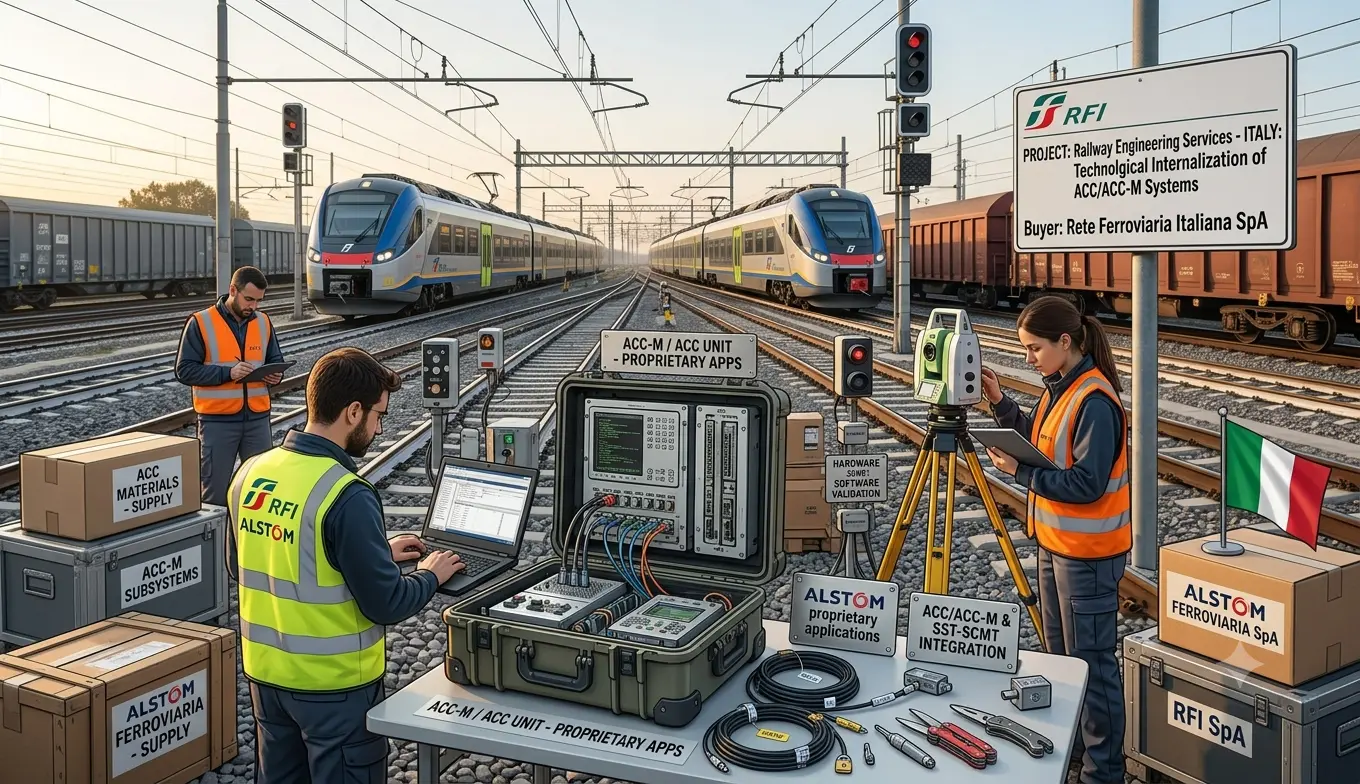
Italy's Rail Network Hands Alstom a EUR 14.9 Million Framework to Bring Signalling Technology In-House
08 Oct 2026
Standfirst Rete Ferroviaria Italiana, the company that manages Italy's rail infrastructure, has awarded a framework agreement to Alstom Ferroviaria S.p.A. for hardware and software components used in its ACC and ACC-M signalling systems. The framework has a maximum value of EUR 14,892,265.88 and runs for 36 months from 1 October 2026. It was awarded without a call for competition, on the grounds that the technology is proprietary to Alstom, and only one tender was received. Introduction Railway signalling is one of the least visible and most safety-critical technologies in modern transport. It determines whether trains can move, how fast they can go, and how far apart they must be. When signalling fails, trains stop. When signalling is inadequate, capacity falls and delays multiply. When signalling is designed badly, accidents happen. Italy's rail network is managed by Rete Ferroviaria Italiana, or RFI, a subsidiary of the state-owned Ferrovie dello Stato Italiane group. RFI owns and maintains the tracks, stations and signalling systems that carry trains operated by Trenitalia, Italo and regional operators. Its signalling systems include ACC, an Italian acronym for a computer-based centralised control system, and ACC-M, a variant used in specific contexts. RFI has now awarded a framework agreement to Alstom Ferroviaria S.p.A., the Italian subsidiary of the French rail equipment group Alstom, for the supply of hardware and software components needed to bring the technology of its ACC and ACC-M systems in-house. The framework has a maximum value of EUR 14.9 million and runs for 36 months. The contract was awarded without competition, on the grounds that the technology is proprietary to Alstom. Only one tender was received. The framework is the mechanism through which RFI will acquire the components it needs, and it signals a strategy of reducing dependence on the supplier for ongoing technical support. This article explains what was procured, who was involved, how the procurement was justified and what the award signals for suppliers in the Italian and European railway signalling market. Why This Contract Matters This contract matters because it is about technological sovereignty over a critical national infrastructure. Signalling systems control train movements on a network that carries millions of passengers and vast volumes of freight every year. If RFI depends entirely on a single supplier for the technology that runs those systems, it has limited control over its own operations. The contract is specifically about "internalizzazione tecnologica" — technological internalisation. In plain terms, RFI wants to bring the technology in-house, meaning it wants to acquire the hardware and software components, along with the design, verification and validation services, that will allow it to operate and maintain the ACC and ACC-M systems more independently. It is not buying a new signalling system. It is buying the components and know-how needed to take greater control of the systems it already has. It also matters because of the direct award. Direct awards are exceptional in EU procurement, permitted only in narrowly defined circumstances. In this case, RFI has justified the award on technical grounds: the ACC and ACC-M systems use technology that is proprietary to Alstom, and the components are integrated into Alstom's own ACC applications. In practice, no other supplier can provide them. Finally, the contract matters because of its structure. It is a framework agreement without reopening of competition, meaning RFI can place orders directly with Alstom under the framework without re-competing. That gives RFI a predictable supply route, but it also means Alstom faces no competition for the specific components covered by the framework. Contract Timeline Winner selected: 11 September 2026 Contract concluded: 1 October 2026 Framework start date: 1 October 2026 Notice dispatched: 7 October 2026 Notice published: 8 October 2026 Framework duration: 36 months Contract Overview The framework agreement covers the supply of ACC materials, optional basic and detailed design, verification and validation, and the hardware and software components necessary for the technological internalisation of the ACC/ACC-M systems and the related SST-SCMT integrated into Alstom's proprietary ACC applications. It is classified as a services contract, with supplies as an additional nature. The main CPV code is 71311230 (railway engineering services), and the additional CPV code is 34632000 (railways traffic-control equipment). It is a single-lot procurement, identified as LOT-0001, with the internal identifier LOTTO 1 and the procedure reference DAC.0300.2026. The CIG code is BB6FA45858. The place of performance is Italy, anywhere in the country. The framework starts on 1 October 2026 and runs for 36 months. The maximum value of the framework agreement is EUR 14,892,265.88, which is also the value of the winning tender. The procurement was conducted as a negotiated procedure without prior call for competition — a direct award. The legal basis is Directive 2014/25/EU, the EU directive on procurement by entities operating in the water, energy, transport and postal services sectors, which applies to RFI as a railway infrastructure manager. The framework is covered by the Government Procurement Agreement. The award criterion was the lowest price. The framework is a framework agreement without reopening of competition, meaning orders will be placed directly with the supplier. It does not use a dynamic purchasing system. Key Contract Details Notice ID 692947-2026 OJ S issue 195/2026 Publication date 8 October 2026 Contracting authority Rete Ferroviaria Italiana S.p.A. Contract type Services, with supplies as additional nature Main CPV code 71311230 – Railway engineering services Additional CPV code 34632000 – Railways traffic-control equipment Procedure type Negotiated without prior call for competition (direct award) Legal basis Directive 2014/25/EU Lot LOT-0001 Winner ALSTOM FERROVIARIA S.P.A. Winning tender EUR 14,892,265.88 Maximum framework value EUR 14,892,265.88 Number of bids 1 Award criterion Lowest price Framework duration 36 months from 1 October 2026 Framework type Framework agreement without reopening of competition Dynamic purchasing system No GPA covered Yes Subcontracting Yes, declared; value and percentage not known Review body Tribunale Amministrativo Regionale del Lazio Project Scope The scope is the supply of ACC materials and related design, verification and validation services, together with the hardware and software components needed for the technological internalisation of the ACC/ACC-M systems and the related SST-SCMT integrated into Alstom's proprietary ACC applications. ACC stands for "Apparato Centrale Computerizzato," a computer-based centralised control system used in Italian railway signalling. It is a type of interlocking, the system that controls signals, points and train routes to ensure safe separation of trains. ACC-M is a variant of the same technology. SST-SCMT refers to a subsystem within the signalling architecture, related to the control and management of the system. The term "internalizzazione tecnologica" is central to understanding the scope. RFI is not simply buying spare parts. It is acquiring the components and technical services necessary to bring the technology in-house — that is, to build up its own capability to manage, maintain and potentially modify the ACC and ACC-M systems. That is a significant strategic step, because signalling systems are usually maintained by their manufacturers under long-term support contracts. The scope includes optional basic and detailed design work, verification and validation. Design work would cover the adaptation or configuration of components for RFI's specific needs. Verification and validation are the formal processes by which signalling systems are proven to meet safety and performance requirements. These are essential in railway signalling, where safety standards are stringent and any change must be validated before it is deployed. The notice does not disclose which specific ACC or ACC-M installations are covered, how many components will be supplied, what the delivery schedule is, or how the design and validation work will be divided between RFI and Alstom. The contracting authority has not disclosed this information. The winning tenderer declared subcontracting, but the value and percentage of subcontracting are not known. The notice does not identify the subcontractors. The contracting authority has not disclosed this information. About the Contracting Authority The buyer is Rete Ferroviaria Italiana S.p.A., known as RFI. It is classified as a public undertaking with railway services as its main activity. Its registration number is 01585570581, and its address is Via dello Scalo Prenestino n. 25, Roma, postcode 00159, in the Roma NUTS region (ITI43). RFI is the Italian railway infrastructure manager. It owns and maintains the national rail network, including tracks, stations, signalling and telecommunications systems. It is part of the Ferrovie dello Stato Italiane group, which is wholly owned by the Italian state. Its role in this procurement is as buyer, as the organisation providing additional information about the procedure and offline access to the procurement documents. Its contact point for this procurement is Annachiara Cerabona, who is identified as the responsible officer for the award phase. Its email address is rfi-dac.asi@pec.rfi.it, and its telephone number is 0647308841. Its procurement portal is gare.rfi.it. RFI's decision to internalise the ACC technology reflects a broader trend among infrastructure managers towards greater control over their critical systems. By acquiring the components and design capability, RFI reduces its dependence on a single supplier for the long-term maintenance and evolution of its signalling systems. About the Organisations Involved Rete Ferroviaria Italiana S.p.A. RFI is the contracting authority. It is Italy's railway infrastructure manager, responsible for the national rail network. Its role in this procurement is as buyer, manager of the framework agreement and provider of information about the procedure. It is registered in Rome, with registration number 01585570581. It operates the ACC and ACC-M signalling systems that are the subject of the framework, and it will use the framework to acquire the components and services it needs to internalise the technology. ALSTOM FERROVIARIA S.P.A. Alstom Ferroviaria S.p.A. is the winning supplier. It is classified as a large economic operator. Its registration number is 02791070044, and its address is Via Ottavio Moreno, 23, Savigliano (CN), postcode 12038, in the Cuneo NUTS region (ITC16). Its email address is alstomferroviaria.pec@actaliscertymail.it, and its telephone number is 0510464900. Alstom Ferroviaria is the Italian subsidiary of Alstom, a French multinational rail equipment manufacturer. Alstom is one of the world's largest suppliers of rolling stock, signalling systems and rail infrastructure. In Italy, Alstom Ferroviaria has supplied signalling systems, including ACC technology, to RFI and other operators. The company submitted the only tender for LOT-0001, identified as DAC.0300.2026, with a value of EUR 14,892,265.88. It declared subcontracting, but the value, percentage and identity of the subcontractors are not known. Its role is as tenderer and winner of LOT-0001. It will supply the ACC components, design, verification and validation services under the framework. Tribunale Amministrativo Regionale del Lazio The Tribunale Amministrativo Regionale del Lazio, the Regional Administrative Court of Lazio, is listed as the review organisation and the organisation providing more information on review procedures. It is based in Rome, postcode 00196. Its email address is urp.rm@giustizia-amministrativa.it, and its telephone number is 0632872517. Its role is to hear appeals from suppliers who believe a procurement has been conducted improperly. In a direct award, the scope for challenge is narrower than in a competitive procedure, but suppliers can still challenge the legality of the direct award if they believe the conditions for it were not met. No complaints were recorded in this procurement. Other organisations The notice does not list any other tenderers, consortium members, framework participants or subcontractors. Only one tender was received, from Alstom Ferroviaria. No other organisation materially affects the understanding of this award. Procurement Analysis The procurement was conducted as a negotiated procedure without prior call for competition, which is a direct award. This is an exceptional procedure under EU procurement rules, permitted only when specific conditions are met. RFI justified the direct award on technical grounds: the contract can be provided only by a particular economic operator because of an absence of competition for technical reasons. The notice adds a brief further justification: "Tecnologia proprietaria" — proprietary technology. The reasoning is straightforward. The ACC and ACC-M systems are built around technology that is proprietary to Alstom. The hardware and software components covered by the framework are integrated into Alstom's own ACC applications. No other supplier can provide components that are compatible with those systems, because no other supplier has access to the design, the source code or the technical data. In practice, therefore, only Alstom can supply the components and services that RFI needs. This is a common pattern in railway signalling procurement. Signalling systems are highly integrated, safety-critical and long-lived. They are built by a small number of manufacturers, and once installed, they are maintained and updated by their original suppliers. That creates a natural sole-source relationship, which is recognised in EU procurement law through the technical grounds for direct awards. Only one tender was received, from Alstom Ferroviaria, which is consistent with a direct award. No complaints were recorded. That suggests that no other supplier believed it could have supplied the components, or that any challenge would have been unsuccessful. The award criterion was the lowest price. In a direct award with a single bidder, the price criterion serves mainly to document the basis on which the contract was concluded rather than to compare competing offers. The winning tender was valued at EUR 14,892,265.88, which is also the maximum value of the framework agreement. That means the framework covers the full amount of the winning tender, and the value of individual call-offs will be drawn from that total. The framework is a framework agreement without reopening of competition. That means RFI can place orders directly with Alstom under the framework without re-competing. That gives RFI a predictable supply route and avoids the administrative burden of running mini-competitions for each order. But it also means Alstom faces no competition for the specific components covered by the framework. The framework runs for 36 months from 1 October 2026. That is a relatively short term for a signalling framework, but it is long enough to cover the initial phase of the internalisation programme. The contract is covered by the Government Procurement Agreement, which means it is open to suppliers from GPA member countries on the same terms as EU suppliers. In practice, however, the proprietary nature of the technology means that only Alstom can supply the components. The winning tenderer declared subcontracting, but neither the value nor the percentage is known, and the subcontractors are not identified. That means part of the work will be delivered by other companies, but the notice does not say who or what they will do. The contracting authority has not disclosed this information. Additional Procurement Facts Legal basis: Directive 2014/25/EU (procurement in the water, energy, transport and postal services sectors). Procedure: Negotiated without prior call for competition (direct award). Justification: Technical reasons — the ACC and ACC-M technology is proprietary to Alstom, and only Alstom can supply compatible components. Award criterion: Lowest price. Number of tenders: 1. Maximum framework value: EUR 14,892,265.88. Winning tender value: EUR 14,892,265.88. Framework duration: 36 months from 1 October 2026. Framework type: Framework agreement without reopening of competition. GPA: Covered by the Government Procurement Agreement. Dynamic purchasing system: None. Subcontracting: Declared by the winner; value, percentage and subcontractor identity not known. Review body: Tribunale Amministrativo Regionale del Lazio. Complaints: None recorded. Market & Industry Perspective The European railway signalling market is dominated by a small number of suppliers. Alstom, Siemens Mobility, Hitachi Rail and CAF are the main players, alongside a handful of national specialists. These companies supply interlockings, train control systems, level crossing equipment and signalling components to infrastructure managers across Europe and beyond. Signalling systems are highly integrated and safety-critical. They are built around proprietary hardware, software and communication protocols, and they must comply with stringent European standards for railway safety, including the Common Safety Method for risk evaluation and assessment. Once a system is installed, it is typically maintained and updated by its original supplier, because only that supplier holds the design authority, the software source code and the technical data. That creates a long-term sole-source relationship between infrastructure managers and signalling suppliers. It also creates a strategic dependency. If the infrastructure manager wants to modify the system, add capacity or extend its life, it must work with the original supplier, often on the supplier's terms. RFI's decision to internalise the ACC technology is a response to that dependency. By acquiring the components and the design, verification and validation capability, RFI is building its own ability to manage and evolve the system. That does not mean it will stop working with Alstom — the framework is awarded to Alstom, after all. But it does mean that RFI will have greater control over its own signalling technology, and less reliance on the supplier for every change. This approach is becoming more common among infrastructure managers. In the UK, Network Rail has developed in-house signalling capability. In France, SNCF Réseau has invested in its own engineering resources. The logic is the same: signalling is too important to be left entirely to external suppliers. The use of the utilities directive, rather than the general public sector directive, is also significant. Directive 2014/25/EU applies to procurement by entities operating in the water, energy, transport and postal services sectors, and it gives them more flexibility than the general directive, including broader scope for negotiated procedures and direct awards. RFI, as a railway infrastructure manager, falls within its scope. Economic Significance At EUR 14.9 million over 36 months, this framework is a significant contract in the Italian railway signalling market. It represents a substantial commitment to the internalisation of ACC technology and provides Alstom with a predictable revenue stream over the framework period. The economic significance extends beyond the framework value itself. If RFI succeeds in internalising the ACC technology, it will reduce its long-term dependence on Alstom for routine maintenance and modifications. That could reduce costs over the life of the systems, and it could improve RFI's ability to respond quickly to operational needs. The framework also has an economic effect on the wider supply chain. Alstom declared subcontracting, which means part of the work will be delivered by other companies. The notice does not identify them or quantify their share, but the subcontracting will spread some of the economic benefit beyond Alstom itself. For the Italian rail network, the framework supports the continued operation and evolution of the ACC and ACC-M systems. Those systems are essential to the safe and efficient movement of trains on the national network. Any improvement in RFI's ability to manage them contributes to the reliability and capacity of the railway, which has economic value across the transport sector. Future Procurement Opportunities The most immediate future opportunities are the individual call-offs under the framework. RFI will place orders with Alstom for ACC materials, design work, verification and validation services as its internalisation programme progresses. The value and timing of those call-offs will depend on RFI's programme schedule. There may also be opportunities for subcontractors. Alstom declared subcontracting, which suggests that part of the scope will be delivered by other companies. Suppliers with capability in railway signalling components, design, verification or validation may find opportunities through Alstom's supply chain. Beyond this framework, RFI is likely to need further support as it internalises the ACC technology. If the initial framework is successful, RFI may extend it or procure additional services. It may also need training, technical documentation, software tools and other resources to build its in-house capability. More broadly, other railway infrastructure managers in Europe face similar challenges with their own signalling systems. Suppliers with capability in signalling technology and technology transfer may find opportunities across the European market. Opportunities for Suppliers Alstom's supply chain: Alstom declared subcontracting. Suppliers with capability in railway signalling components, design or validation may find opportunities through its supply chain. Signalling component suppliers: The framework covers hardware and software components. Suppliers of compatible components may find opportunities, though the proprietary nature of the technology limits the field. Design and validation specialists: The framework includes optional basic and detailed design, verification and validation. Suppliers with these capabilities may find opportunities through Alstom. Training and technical documentation: As RFI builds its in-house capability, it may need training, documentation and technical support. Suppliers with these capabilities may find opportunities. Other infrastructure managers: Other European railway infrastructure managers face similar dependency challenges. Suppliers with technology transfer experience may find opportunities across Europe. Monitoring RFI: RFI publishes its procurement notices through its portal at gare.rfi.it and through TED. Suppliers should monitor them for future opportunities. What Businesses Should Watch How the framework is used: The value and timing of call-offs will indicate how quickly RFI is progressing with its internalisation programme. Whether the framework is extended: The framework runs for 36 months. Suppliers should watch for any extension or follow-on procurement. Whether subcontractors are disclosed: Alstom declared subcontracting but did not identify the subcontractors. Suppliers should watch for further disclosure. Whether the internalisation succeeds: If RFI succeeds in building its in-house capability, it may reduce its future reliance on Alstom, which could affect future procurement patterns. Whether other signalling systems are included: The framework covers ACC and ACC-M. If RFI decides to internalise other signalling technologies, that could create further opportunities. Whether other infrastructure managers follow suit: If RFI's internalisation approach works well, other European infrastructure managers may adopt similar strategies. ItalyTenders.com Procurement Intelligence This framework represents a broader trend in European railway procurement: infrastructure managers are seeking to reduce their dependence on signalling suppliers by internalising critical technology. Signalling systems are highly integrated, proprietary and safety-critical, and once installed, they are typically maintained by their original manufacturers. That creates a long-term sole-source relationship that gives the supplier significant leverage. RFI's decision to acquire the components, design, verification and validation capability for its ACC and ACC-M systems is an attempt to rebalance that relationship and to build its own capability to manage and evolve the technology. The award is strategically important because it combines two objectives. First, it ensures continuity of supply: RFI needs the components and services covered by the framework to keep its ACC and ACC-M systems running. Second, it enables technological internalisation: by acquiring the components and the design and validation capability, RFI is building its own ability to manage the systems in the future. The framework is therefore both an operational necessity and a strategic investment. Suppliers can learn several things from this procurement. First, in railway signalling, proprietary technology creates durable sole-source relationships. Suppliers that own the technology have a strong position; suppliers that do not are largely excluded from the market. Second, direct awards are a legitimate route in this sector where technical grounds justify them, and the utilities directive gives infrastructure managers more flexibility than the general public sector directive. Third, technology transfer is a growing market. Infrastructure managers that want to internalise critical technology need support from the original supplier, and that support can be procured under frameworks like this one. Fourth, subcontracting opportunities exist even in sole-source contracts, as Alstom's declared subcontracting shows. Fifth, framework agreements without reopening of competition give the supplier predictable volume but also limit the buyer's flexibility to re-compete. Suppliers should position themselves accordingly. Companies that own signalling technology should recognise that their position is strong but that buyers are increasingly seeking to reduce their dependence, and they should be prepared to support technology transfer as a commercial service. Companies that supply components or services to signalling manufacturers should build relationships with the primes, because that is where the work flows. And companies that operate in adjacent areas, such as training, documentation or validation, should look for opportunities created by internalisation programmes. Future contracts in this market are likely to evolve in two directions. First, more infrastructure managers will seek to internalise critical signalling technology, creating a steady pipeline of technology transfer and component supply contracts. Second, signalling suppliers will need to adapt their business models to support that trend, offering not just products but also the design, validation and training services that buyers need to build their own capability. Suppliers that can combine proprietary technology with technology transfer services will be well positioned. Suppliers that cannot will find themselves increasingly constrained by buyers who want more control over their own infrastructure. Supplier Takeaways RFI awarded a framework agreement to Alstom Ferroviaria for ACC and ACC-M hardware and software components and related design, verification and validation services. The framework has a maximum value of EUR 14,892,265.88 and runs for 36 months from 1 October 2026. The contract was awarded without a call for competition, on the grounds that the technology is proprietary to Alstom. Only one tender was received, and no complaints were recorded. The framework is a framework agreement without reopening of competition, so orders will be placed directly with Alstom. The award criterion was the lowest price. The legal basis is Directive 2014/25/EU, the utilities directive, not the general public sector directive. The winning tenderer declared subcontracting, but the value, percentage and subcontractor identity are not known. The framework supports RFI's strategy of technological internalisation — building its own capability to manage and evolve the ACC and ACC-M systems. The review body is the Tribunale Amministrativo Regionale del Lazio. Key Takeaways Rete Ferroviaria Italiana awarded a 36-month framework agreement to Alstom Ferroviaria S.p.A. for ACC and ACC-M signalling components and related services. The framework has a maximum value of EUR 14,892,265.88. The contract was awarded without competition on technical grounds: the technology is proprietary to Alstom. Only one tender was received, and no complaints were recorded. The framework covers the supply of ACC materials, optional design, verification and validation, and hardware and software components for technological internalisation. The framework is a framework agreement without reopening of competition, meaning direct orders will be placed with Alstom. The award criterion was the lowest price. The framework is governed by Directive 2014/25/EU and is covered by the Government Procurement Agreement. The winning tenderer declared subcontracting, with value and percentage not known. The review body is the Tribunale Amministrativo Regionale del Lazio. Conclusion Rete Ferroviaria Italiana has taken a significant step towards reducing its dependence on Alstom for the technology that runs its ACC and ACC-M signalling systems. The framework agreement, worth up to EUR 14.9 million over 36 months, gives RFI a route to acquire the hardware, software, design, verification and validation services it needs to internalise the technology. It was awarded without competition, on the grounds that the technology is proprietary to Alstom and no other supplier can provide compatible components. The framework is both an operational necessity and a strategic investment. Operationally, it ensures that RFI can continue to supply and maintain its ACC and ACC-M systems. Strategically, it allows RFI to build its own capability to manage and evolve those systems, reducing its long-term reliance on a single supplier. That is a goal shared by many infrastructure managers across Europe, who are increasingly seeking to internalise critical technologies. For suppliers, the contract reinforces the importance of proprietary technology in railway signalling and the growing market for technology transfer services. For RFI, the challenge will be to use the framework effectively to build genuine in-house capability, rather than simply buying components. For Alstom, the framework provides a predictable revenue stream and an opportunity to support its customer's strategic objectives. The notice leaves some questions unanswered — the specific components, the delivery schedule, the subcontractors — but the core award is clear: Alstom will supply the technology, and RFI will use it to take greater control of its own signalling systems. Source: Tenders Electronic Daily (TED), Contract Award Notice 692947-2026, Official Journal of the European Union, OJ S 195/2026, published on 8 October 2026.
View Details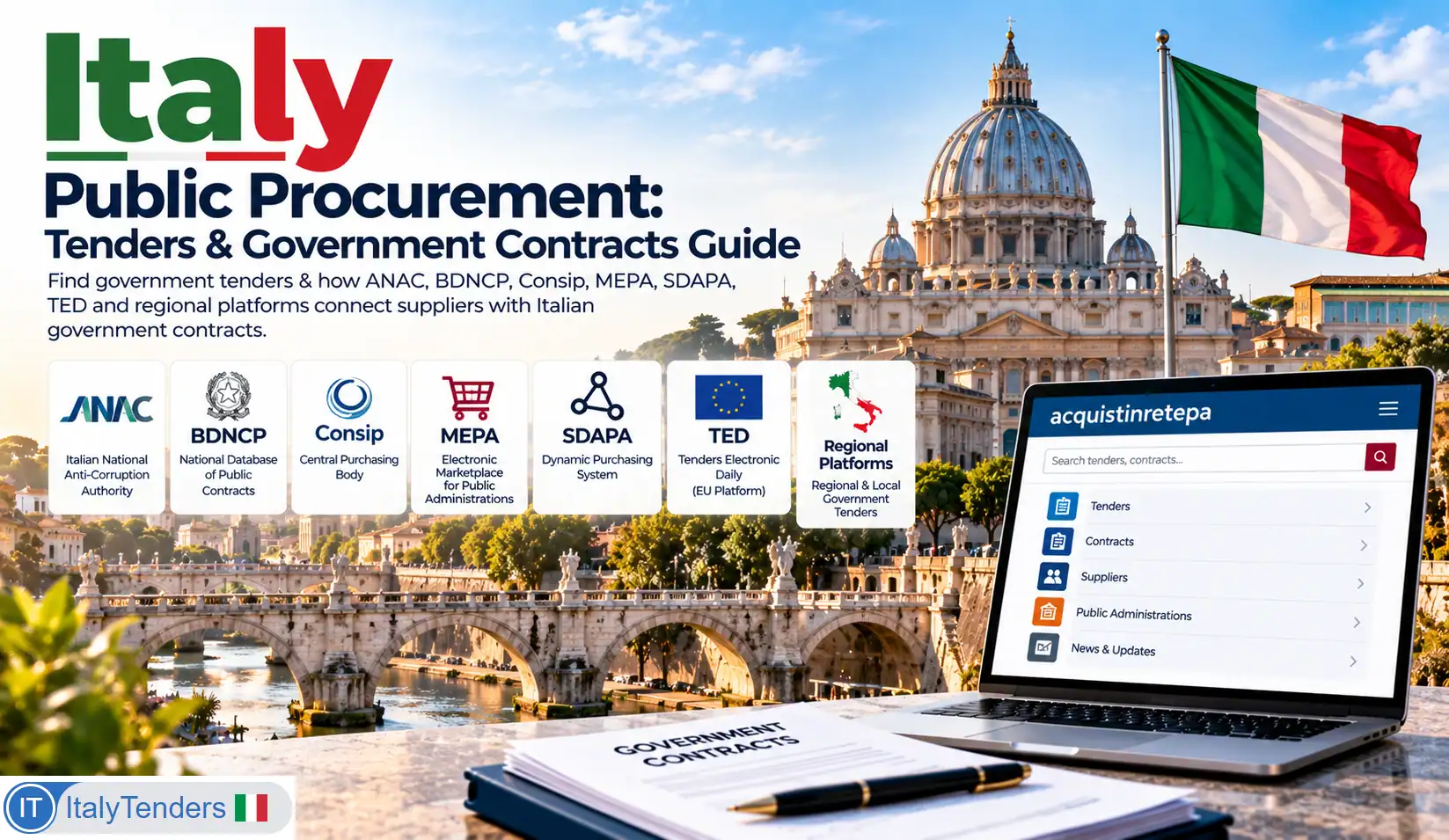
Italy Public Procurement: Complete Beginner's Guide to Tenders and Government Contracts
07 Oct 2026
Published on Italytenders.com | Category: Italy Public Procurement | Reading Time: 10-12 min Introduction Italy has one of Europe's largest and most diverse public procurement markets, covering government departments, municipalities, regions, public healthcare organisations, universities, transport authorities, utilities, infrastructure bodies and other public-sector organisations. For businesses, this market creates opportunities across construction, engineering, information technology, healthcare, professional services, energy, transport, facilities management, manufacturing, consulting, security, environmental services and thousands of other procurement categories. However, finding and winning public contracts in Italy requires more than searching for the phrase “Italy tenders.” The Italian procurement environment uses a combination of national databases, digital procurement platforms, European tender publication systems, Consip purchasing tools and regional or sector-specific platforms. Italian procurement terminology also differs from the terminology commonly used by international suppliers. A company searching only for “government tenders in Italy” can therefore miss opportunities described as appalti pubblici, gare d'appalto, bandi di gara, gare telematiche or other Italian procurement terms. This guide explains how the Italian public procurement market works, where tenders are published, how companies can identify relevant opportunities, what major procurement platforms mean, what terminology suppliers need to understand and how procurement intelligence can improve tender discovery and bid planning. The legal foundation is the Italian Public Contracts Code, Decreto Legislativo 31 March 2023, n. 36, which governs the public procurement framework and has been updated over time. The current official text includes provisions covering principles, digitalisation, procurement planning, contracting authorities, tender procedures, bidder documentation, participation requirements, award and contract execution. Table of Contents What Is Public Procurement in Italy? Why the Italian Procurement Market Matters How the Italian Public Procurement Ecosystem Works Where to Find Government Tenders in Italy ANAC, BDNCP and the National Procurement Data Infrastructure Consip and Acquisti in Rete MEPA and SDAPA TED and European Public Procurement Opportunities Regional and Local Procurement Platforms Italian Tender Terminology Every Supplier Should Know How Companies Can Find the Right Italy Tenders How to Prepare for the Italian Procurement Market Using Procurement Intelligence to Find Better Opportunities Can Foreign Companies Bid for Italian Government Contracts? Finding and Monitoring Italy Tender Opportunities Conclusion What Is Public Procurement in Italy? Public procurement in Italy refers to the process through which public authorities and other eligible contracting entities purchase works, goods and services from economic operators. In Italian procurement language, some of the most important terms are appalti pubblici, meaning public contracts, and gare d'appalto, commonly used for competitive tender procedures. Procurement can involve a relatively small supply requirement for a municipality or public institution, a technology service for a government department, a healthcare supply contract, a regional framework agreement or a major infrastructure project. The opportunity may be published through a national, regional, sector-specific or European procurement system depending on the contracting authority, procurement method and applicable rules. The Italian system is increasingly digital. The Public Contracts Code introduced a digital approach to the complete contract lifecycle, while ANAC's infrastructure connects procurement platforms with national procurement data and services. This means that modern Italian tendering should be understood as a digital procurement ecosystem rather than a traditional paper-based tender process. Why the Italian Procurement Market Matters Italy represents a major commercial market for companies seeking public-sector customers. ANAC's analysis of 2025 procurement recorded 287,421 public procurement procedures with a total value of approximately €309.7 billion for procedures of €40,000 or more. Around €20.8 billion was associated with procurement financed by PNRR resources. The number of procedures increased by 7.6% compared with 2024, while their total value increased by 13.9%. The market is also diverse. In 2025, ANAC recorded more than 100,000 supply procedures, more than 123,000 service procedures and more than 64,000 works procedures within the analysed €40,000-plus market. By value, supplies represented the largest share of the market, followed by services and works. For suppliers, this means that Italy should not be treated as a single-sector tender market. A software company may find opportunities in digital transformation and public administration. An engineering company may target infrastructure and public works. A healthcare supplier may monitor hospitals and regional healthcare organisations. Professional service firms may identify consultancy, legal, financial, training and technical-service contracts. There is also a strong geographical dimension. ANAC's 2025 data shows significant procurement activity across regions, with Lazio, Lombardia and Veneto among the regions with the highest numbers of procedures. How the Italian Public Procurement Ecosystem Works One of the biggest mistakes international suppliers make is assuming that Italy has one website containing every public tender. In reality, procurement information is distributed across interconnected systems. ANAC and BDNCP provide the national procurement-data and transparency infrastructure. The Piattaforma Contratti Pubblici supports digital contract lifecycle services and connects with the Banca Dati Nazionale dei Contratti Pubblici. ANAC's infrastructure also supports functions relating to the virtual economic operator file and legal publication of procurement acts. Consip and Acquisti in Rete operate an important national e-procurement environment for public administrations and businesses. Through the system, public administrations can use tools such as conventions, framework agreements, MEPA, SDAPA and other electronic procurement mechanisms. TED provides the European-level publication and search environment for public procurement notices subject to European publication requirements. It allows businesses to search by country, region, sector, CPV and other criteria. Regional and local platforms are another important layer. Depending on the region, contracting authority and procurement arrangement, businesses may encounter dedicated electronic procurement platforms and regional purchasing systems. The practical lesson is simple: successful Italy tender research requires multi-source procurement discovery, not dependence on one portal. Where to Find Government Tenders in Italy Companies searching for Italian government contracts should build their search strategy around several source categories. National procurement and transparency infrastructure: ANAC, BDNCP and related public procurement services. National e-procurement: Consip and the Acquisti in Rete PA ecosystem. MEPA and SDAPA: digital procurement markets and dynamic purchasing mechanisms operated through Acquisti in Rete. European procurement: TED for European-level procurement notices. Regional procurement: regional e-procurement platforms and purchasing agencies. Municipal and institutional sources: cities, provinces, universities, hospitals, public utilities and individual contracting authorities. Procurement intelligence platforms: commercial databases that aggregate, classify, search and monitor tender and award information. Official sources are particularly important for verifying tender details, deadlines, documents and procurement status. However, a commercial intelligence platform can add value by bringing fragmented information into a searchable workflow and allowing suppliers to filter opportunities according to their business needs. ANAC, BDNCP and the National Procurement Data Infrastructure ANAC, the Autorità Nazionale Anticorruzione, is a central institution in the Italian public procurement ecosystem. The BDNCP, or Banca Dati Nazionale dei Contratti Pubblici, is the national contracts database through which procurement lifecycle information is collected and made available through the relevant services. The Piattaforma Contratti Pubblici managed by ANAC enables digital procurement lifecycle services and supports access to BDNCP, FVOE and legal-publication functions. ANAC documentation explains that procurement information is collected from contracting authorities and economic operators and made available through data interfaces, open data and APIs. This is important for procurement intelligence because tender discovery is only one part of the opportunity. Historical procurement data can help businesses understand which authorities buy particular products or services, how frequently they procure, the procurement category involved and how a market develops over time. ANAC's current advanced search environment also provides procurement-oriented filtering such as contracting authority and CPV, illustrating how procurement data can be analysed beyond simple keyword searches. Consip and Acquisti in Rete Consip plays a major role in Italy's public purchasing system. The Ministry of Economy and Finance's procurement rationalisation programme, implemented through Consip, provides public administrations with tools for purchasing goods, services and works. The Acquisti in Rete portal is the operational environment through which activities such as tendering, business enablement, catalogue publication and public-sector purchasing are carried out. Its procurement instruments include ready-to-use contracts such as conventions and framework agreements as well as negotiation tools including MEPA, SDAPA and electronic tendering mechanisms. The scale of the ecosystem demonstrates why suppliers should understand it. Acquisti in Rete reports hundreds of thousands of enabled users and hundreds of thousands of contracts across its procurement instruments, while Consip reported €25.8 billion in public purchases through the programme as of November 2025. For companies entering Italy's government procurement market, Consip and Acquisti in Rete should therefore be treated as core components of the opportunity landscape rather than optional procurement resources. MEPA and SDAPA MEPA, the Mercato Elettronico della Pubblica Amministrazione, is a digital marketplace used for public-sector purchasing. It allows enabled suppliers to offer goods, services and works to public administrations through catalogue and negotiation mechanisms. SDAPA, the Sistema Dinamico di Acquisizione della Pubblica Amministrazione, is a dynamic purchasing system through which economic operators can qualify for relevant categories and participate in specific competitions. Consip states that companies can enable themselves for MEPA and SDAPA and participate in procurement activities conducted by public administrations. Its current information indicates that more than 200,000 companies are already enabled for these digital markets. These platforms deserve dedicated analysis because supplier registration, catalogue management, qualification, negotiation and bidding can involve specific requirements. Later guides in this Italy procurement series will examine MEPA, SDAPA and supplier registration in much greater detail. TED and European Public Procurement Opportunities TED, Tenders Electronic Daily, is the online version of the Supplement to the Official Journal of the European Union dedicated to European public procurement. It provides free access to procurement opportunities and allows users to search notices by country, region, business sector and other criteria. TED is particularly important for companies targeting larger European procurement opportunities. Its search system supports CPV-based sector searches, geographical searches and advanced queries. The platform also provides access to historical procurement notices and allows users to create personalised search profiles and alerts. For Italy-focused tender research, TED should be used as a complementary source rather than assumed to represent the entire Italian market. National, regional and local procurement activity can exist outside the scope of European-level publication requirements. Regional and Local Procurement Platforms Italy's procurement market has a strong regional and local dimension. Businesses may need to monitor regional purchasing systems, municipalities, provinces, public healthcare organisations, universities, transport bodies and other contracting authorities. This creates an important SEO and procurement-intelligence opportunity because suppliers often search for tenders using a combination of country + region + sector rather than country alone. Examples include Lombardia tenders, Lazio tenders, Milan public tenders, Rome government contracts, Veneto procurement, Emilia-Romagna tenders and Toscana public procurement. Regional procurement research can also reveal local buying patterns that are difficult to identify from a national-level keyword search. A supplier targeting healthcare, construction, IT or environmental services may achieve better results by identifying the authorities and procurement platforms most relevant to its geographic strategy. Italian Tender Terminology Every Supplier Should Know Understanding Italian procurement vocabulary is essential for both search visibility and tender discovery. International suppliers should not rely exclusively on English terminology. Appalti pubblici: public procurement or public contracts. Gara d'appalto: competitive tender or procurement procedure. Bando di gara: tender notice or procurement notice. Stazione appaltante: contracting authority. Operatore economico: economic operator or supplier. Gare telematiche: electronic or online tender procedures. Affidamento diretto: direct award mechanism under applicable rules. Procedura aperta: open procedure. Procedura ristretta: restricted procedure. Procedura negoziata: negotiated procedure. Esito di gara: tender outcome or result. Aggiudicazione: award or contract award decision. CPV: Common Procurement Vocabulary classification used to identify procurement subject matter. CIG: Codice Identificativo Gara, the procurement identification code used within the Italian procurement framework. These terms are not merely language translations. They are useful search signals. A supplier that understands both “Italy government tenders” and “gare d'appalto” can construct a much broader procurement-search strategy. How Companies Can Find the Right Italy Tenders The best tender search strategy begins with the company's commercial capability rather than a generic search for every available tender. Start by defining the products or services you can deliver. Then identify relevant procurement sectors, CPV categories, Italian terminology, target regions, buyer types and contract sizes. This creates a structured search profile. A practical Italy tender search workflow can include: Define core products and services. Identify relevant CPV codes and Italian procurement terminology. Choose target regions and cities. Identify relevant public authorities and buyer categories. Monitor national, regional and European procurement sources. Track active tenders, upcoming procurement and pre-information notices where available. Review tender documents before deciding whether to bid. Monitor amendments, clarifications and deadline changes. Analyse previous awards and competitors before investing significant bid resources. This approach is more effective than simply searching for “Italy tenders” because it transforms a large procurement market into a manageable opportunity pipeline. How to Prepare for the Italian Procurement Market Before bidding, suppliers should assess whether they meet the applicable legal, technical, financial and administrative requirements. Depending on the type and value of procurement, requirements may involve professional qualifications, previous experience, financial capacity, technical capability, certifications, declarations, guarantees or other evidence. Construction companies may encounter qualification requirements such as SOA certification for relevant public works. Other suppliers may need to complete platform-specific registration or qualification processes. Digital readiness is equally important. Italy's procurement framework has moved strongly toward digital procurement. From 1 January 2024, the digitalisation provisions of the Public Contracts Code became effective, with procurement lifecycle activities conducted through certified digital procurement platforms and interoperable services. For foreign suppliers, the preparation stage should also include understanding electronic submission requirements, company documentation, applicable declarations, language requirements, digital identity or signature requirements where relevant and the specific platform used by the contracting authority. Using Procurement Intelligence to Find Better Opportunities Tender searching tells a company what is being advertised. Procurement intelligence attempts to answer the more valuable questions: who is buying, what are they buying, how often do they buy, who has won before, what is the competitive environment and where is future demand likely to emerge? For example, a company selling cybersecurity services could search only for active IT tenders. A stronger procurement-intelligence approach would identify public authorities repeatedly purchasing cybersecurity services, analyse their previous tenders, review awarded suppliers, monitor upcoming procurement planning and track related CPV categories. Historical award intelligence is particularly valuable. A tender result can reveal the winning company, procurement authority, contract subject, award information and other data that may help a supplier understand the competitive landscape. This is where Italy's growing digital procurement data infrastructure becomes commercially important. ANAC's BDNCP ecosystem provides procurement data and supports open data and API access, while commercial intelligence platforms can aggregate and organise information for business users. Italian procurement competitors are already positioning around this intelligence layer. For example, Telemat combines tender discovery with business intelligence and AI-assisted document analysis, demonstrating that the Italian market is moving beyond basic tender listings toward data-supported bid decisions. Can Foreign Companies Bid for Italian Government Contracts? International companies can consider the Italian public procurement market, but participation should be approached as a compliance and market-entry project rather than simply translating an offer into Italian. Foreign suppliers should identify the applicable procurement procedure, understand the contracting authority's requirements, verify eligibility and qualification conditions, prepare the required corporate and technical documentation and determine which digital procurement platform must be used. European companies may already operate within EU procurement frameworks, while suppliers from outside the EU should pay particular attention to applicable rules concerning eligibility, international procurement access, documentation, establishment, equivalence of qualifications and other tender-specific requirements. For international businesses, the biggest opportunity is often not trying to monitor every Italian tender. A better strategy is to identify a limited number of sectors, authorities, regions and procurement categories where the company's capabilities provide a realistic competitive advantage. Finding and Monitoring Italy Tender Opportunities A dedicated tender intelligence platform can make the discovery process easier by bringing relevant procurement opportunities, contract awards and buyer information into a single research workflow. For businesses looking for Italy tenders, government contracts, public procurement opportunities, tender results and procurement intelligence, ItalyTenders.com can be used as a dedicated source for exploring and monitoring the Italian tender market. Search Italy Tenders can be used to explore available tender opportunities, while Italy Contract Awards can support research into procurement outcomes and awarded contracts. Businesses that want access to the platform can use ItalyTenders Registration or ItalyTenders Login. Companies requiring assistance can use Contact ItalyTenders. Procurement professionals can also explore the Italy Procurement Authority section to support authority-focused tender research. The strongest workflow combines platform-based discovery with official-source verification. Official ANAC, Consip, Acquisti in Rete and TED resources remain essential for checking procurement information, while structured tender intelligence can help suppliers reduce search time and identify patterns across the market. Conclusion Italy's public procurement market is large, digital and highly distributed. Companies seeking government contracts need to understand more than individual tender notices. They need to understand the ecosystem connecting ANAC, BDNCP, digital procurement platforms, Consip, Acquisti in Rete, MEPA, SDAPA, TED and regional procurement systems. The opportunity is substantial: ANAC's latest market analysis recorded €309.7 billion in public procurement procedures of €40,000 or more during 2025, with significant activity across supplies, services and works. For suppliers, the winning approach is therefore a combination of accurate tender discovery, Italian procurement terminology, CPV-based searching, authority intelligence, regional monitoring, qualification readiness and contract-award analysis. This guide provides the foundation. The next steps are to understand exactly where Italian tenders are published, how ANAC and BDNCP work, how suppliers use Consip and Acquisti in Rete, how MEPA and SDAPA operate, how Italian tender procedures differ and how companies can search, qualify and submit bids efficiently.
View Details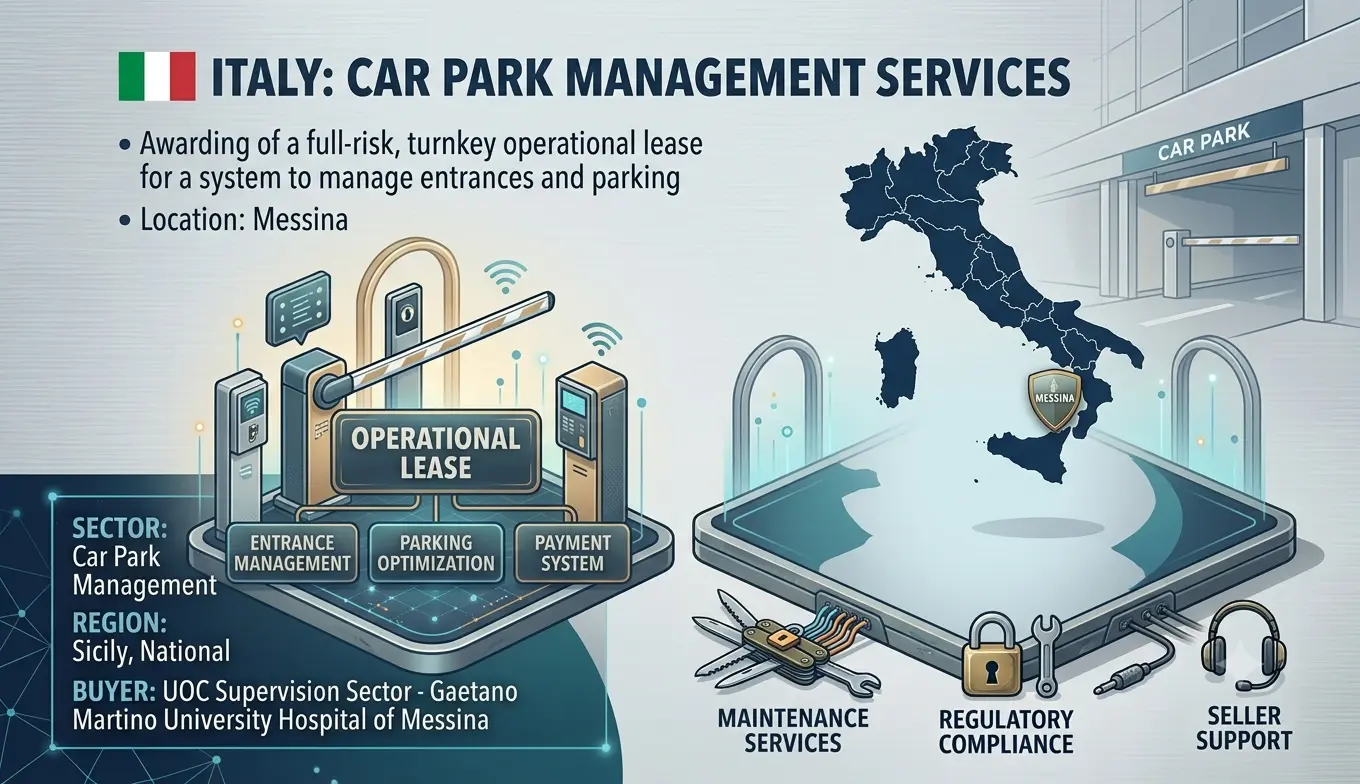
Messina Hospital Signs a Nine-Year Parking and Access Control Deal Worth EUR 623,000
07 Oct 2026
Standfirst The Azienda Ospedaliera Universitaria Policlinico Gaetano Martino in Messina has awarded a nine-year contract for a full-risk operational lease of an access and parking management system. The contract went to Park It Srl, a medium-sized Italian company based in Perugia, at a value of EUR 622,657.34. Four bids were received, and the award was decided through a heavily quality-weighted evaluation in which price accounted for only 30%. The system covers vehicle entry control, parking management, ANPR licence plate recognition, security and an improved access portal for the hospital. Introduction Hospitals are among the most complex traffic environments in any city. Thousands of people arrive every day — patients, visitors, staff, suppliers, ambulances — and they all need to park, enter the right building and leave again without chaos. For a large university hospital, managing that flow is not a minor administrative matter. It affects patient access, staff punctuality, security and the hospital's relationship with the surrounding community. The Azienda Ospedaliera Universitaria Policlinico Gaetano Martino in Messina, one of the largest hospital complexes in Sicily, has decided to replace and modernise its access and parking management arrangements. Rather than buying the system outright, it has chosen a full-risk operational lease model: the supplier provides, installs, operates and maintains the entire system for nine years, and takes on the performance risk. The contract has been awarded to Park It Srl, an Italian company based in Perugia that specialises in parking and access management. The value is EUR 622,657.34, against an estimated value of EUR 1,130,000. The procurement attracted four bids and was decided through a detailed evaluation in which technical quality, innovation, security and architectural design together outweighed price. This article examines what was procured, who was involved, how the procurement was structured and what the award signals for suppliers in the Italian public sector parking and access-control market. Why This Contract Matters This contract matters because it shows how a large public hospital is approaching the management of vehicle access and parking. Rather than treating parking as a simple service, the hospital has procured an integrated system that covers entry control, licence plate recognition, parking management, security, energy efficiency and user experience. That is a more sophisticated approach than many public buyers take. It also matters because of the contract model. A nine-year full-risk operational lease means the supplier takes on the risk of system performance over a long period. The hospital pays for the service, and the supplier is responsible for making it work. That shifts the burden of maintenance, upgrades and operational reliability onto the supplier, and it requires the supplier to have the capability and financial strength to support a long-term commitment. The procurement also matters because of its evaluation structure. Price carried only 30% of the score, while quality criteria accounted for 70%. That is a strong signal that the hospital was not simply looking for the cheapest bid. It was looking for a system that would improve security, reduce energy consumption, integrate with third-party systems and present a high-quality architectural solution at the hospital's access points. Finally, the contract matters because of the competition. Four bids were received, which is a healthy outcome for a specialist procurement of this kind. It shows that the Italian market for hospital parking and access systems is competitive, and that suppliers were willing to invest in bidding for a nine-year contract. Contract Timeline Winner selected: 4 August 2026 Contract concluded: 5 October 2026 Notice dispatched: 5 October 2026 Notice published: 7 October 2026 Contract duration: 9 years Options: Possible technical extension of 6 months plus a fifth-of-obligation provision Contract Overview The contract covers the full-risk operational lease of a system for managing vehicle entries and parking within the hospital's premises, for a duration of nine years. It is a services contract, classified under CPV 98351000 (car park management services). It is a single-lot procurement, identified as LOT-0001. The place of performance is the Azienda Ospedaliera Universitaria "G. Martino" in Messina, in the Messina NUTS region (ITG13), Italy. The estimated value excluding VAT was EUR 1,130,000, and the awarded value was EUR 622,657.34. The procurement was conducted as an open procedure above the EU threshold, under Article 71 of Italian Legislative Decree No. 36/2023, which is Italy's public contracts code. The legal basis is Directive 2014/24/EU. The contract is not a framework agreement and does not use a dynamic purchasing system. It is not financed with EU funds and is not covered by the Government Procurement Agreement. The contract includes options for a possible technical extension of six months and a "quinto d'obbligo" provision, which in Italian procurement allows the contracting authority to require additional supplies or services up to a fifth of the original contract value, on the same terms. The maximum number of renewals is zero, but the extension and fifth-of-obligation provisions give the hospital some flexibility beyond the initial nine-year term. Key Contract Details Notice ID 689679-2026 OJ S issue 194/2026 Publication date 7 October 2026 Contracting authority U.O.C. Settore Provveditorato – Azienda Ospedaliera Universitaria Policlinico Gaetano Martino di Messina Contract type Services Main CPV code 98351000 – Car park management services Procedure type Open procedure above EU threshold Legal basis Directive 2014/24/EU; Italian Legislative Decree No. 36/2023, Article 71 Lot LOT-0001 Winner Park It Srl Winning bid EUR 622,657.34 Estimated value excluding VAT EUR 1,130,000.00 Number of bids 4 Award criteria Price – 30%; quality criteria – 70% (overall project quality 20%, hardware technology improvements 8%, software functionality and interoperability 8%, improved SLAs and operational continuity 7%, IT security and data protection 5%, architectural quality of access portals 8%, innovation and user experience 4%, environmental sustainability and energy efficiency 3%, other documented improvements 7%) Contract duration 9 years Options Possible technical extension of 6 months; fifth-of-obligation provision Framework agreement No Dynamic purchasing system No EU funding No GPA covered No Subcontracting Yes, declared by the winner; value and percentage not known Contract identifier 202 Project Scope The scope is the full-risk operational lease of a system for managing entries and parking within the hospital's premises. The notice describes it in Italian as "noleggio operativo chiavi in mano full risk di un sistema per la gestione degli ingressi e dei parcheggi all'interno dell'area aziendale" — a turnkey, full-risk operational lease of a system for managing access and parking within the company's area. "Full risk" means the supplier bears the risk of system performance. If the system fails, underperforms or needs upgrading, that is the supplier's responsibility, not the hospital's. "Turnkey" means the supplier is responsible for delivering a complete, working system, from design and installation through to operation and maintenance. The award criteria reveal the technical priorities in some detail. The largest single quality criterion, worth 20%, is the overall quality of the technical and design proposal. That suggests the hospital wanted a well-conceived solution, not just a compliant one. The remaining quality criteria cover specific areas. Hardware technology improvements, worth 8%, reward advanced ANPR (automatic number plate recognition), additional sensors, smart technologies and performance improvements. Software functionality and interoperability, also 8%, reward advanced dashboards, open APIs, integration with third-party systems, analytics and advanced reporting. Improved SLAs and operational continuity, worth 7%, reward faster intervention times, remote control and predictive maintenance. IT security and data protection, worth 5%, reward disaster recovery, geographic backup and advanced cyber systems. Architectural quality of the access portals, worth 8%, rewards aesthetic and functional quality of the proposed access gateways, including the hospital's logo and name, integration with the surrounding context, material quality, visual impact, lighting and institutional recognisability. Innovation and user experience, worth 4%, rewards advanced ticketless systems, space booking, user apps and wayfinding. Environmental sustainability and energy efficiency, worth 3%, rewards reduced energy consumption and environmental improvements. Finally, other documented improvements, worth 7%, allow bidders to earn points for specific additional enhancements. The notice does not disclose the specific products, technologies or suppliers involved in the winning bid, beyond Park It Srl itself. The contracting authority has not disclosed this information. About the Contracting Authority The buyer is the U.O.C. Settore Provveditorato of the Azienda Ospedaliera Universitaria Policlinico Gaetano Martino di Messina. It is classified as a body governed by public law, with health as its main activity. Its registration number is 03051890832, and its address is Via Consolare Valeria n. 1, Messina, postcode 98125, in the Messina NUTS region (ITG13). The hospital, known locally as Policlinico Gaetano Martino, is a university hospital and one of the main healthcare providers in Sicily. It combines clinical services, teaching and research. Its procurement department, the U.O.C. Settore Provveditorato, handled this tender. The hospital's contact email is protocollo@pec.polime.it, and its telephone number is +39 0902213970. Its website is polime.it. It is both the buyer and the organisation providing additional information about the procurement procedure and more information on review procedures. The hospital's decision to procure a nine-year full-risk operational lease rather than buy the system outright reflects a preference for transferring performance risk to the supplier. Over nine years, the hospital will pay for the service, and the supplier will be responsible for keeping the system running and up to date. About the Organisations Involved U.O.C. Settore Provveditorato – Azienda Ospedaliera Universitaria Policlinico Gaetano Martino di Messina The hospital is the contracting authority. It is a public university hospital in Messina, Sicily, providing healthcare, teaching and research. Its role in this procurement is as buyer, signatory of the contract and provider of additional information about the procedure and review procedures. It is registered under number 03051890832, with its address at Via Consolare Valeria n. 1, 98125 Messina. It ran the open procedure, evaluated the four bids and concluded the contract with Park It Srl. It will manage the contract over its nine-year term and will rely on the supplier to keep the access and parking system operating. Park It Srl Park It Srl is the winning bidder. It is classified as a medium-sized economic operator. Its registration number is 02770660542, and its registered office is at Via Guido Rossa n. 40, Santa Sabina, Perugia, postcode 06132, in the Perugia NUTS region (ITI21). Park It is an Italian company specialising in parking and access management. It submitted the winning tender for LOT-0001, valued at EUR 622,657.34. It declared subcontracting, but the value and percentage of subcontracting are not known. The notice does not disclose which subcontractors it will use or what parts of the scope they will deliver. The company's role is as tenderer and winner of LOT-0001. It will design, install, operate and maintain the access and parking management system at the hospital for nine years, taking on the full-risk operational lease obligations. Because the contract is a full-risk lease, Park It bears the risk of system performance over the contract term. It is notable that the winner is based in Perugia, in central Italy, while the hospital is in Messina, Sicily. That shows that the contract attracted bidders from outside the local area, and that regional presence was not a barrier to winning. TAR Sicilia – Catania The Tribunale Amministrativo Regionale per la Sicilia, Catania section, is listed as the review organisation. Its registration number is 93159470876, and its address is Via Istituto Sacro Cuore n. 22, Catania, postcode 95100, in the Catania NUTS region (ITG17). The TAR is the regional administrative court that hears challenges to public procurement decisions in Sicily. Suppliers that believe the procurement was conducted improperly can bring a case before the TAR. The notice refers to the review deadlines provided by law. Other organisations The notice does not identify the three non-winning bidders by name. It records that four tenders were received, but only the winner is named. No consortium members, framework participants or subcontractors are disclosed. No other organisation materially affects the understanding of this award. Procurement Analysis The procurement was conducted as an open procedure above the EU threshold, under Article 71 of Italian Legislative Decree No. 36/2023. The open procedure is the standard route for a contract of this size and allows any qualifying supplier to bid. The evaluation was structured around nine criteria. Price carried 30% of the score. The remaining 70% was distributed across eight quality criteria, the largest of which was overall project quality at 20%. This is a strongly quality-weighted evaluation. In most Italian public sector service contracts, price carries a larger share. Here, the hospital chose to prioritise technical quality, innovation, security, architecture and sustainability over cost. That reflects the nature of the contract: a nine-year full-risk operational lease of a system that must work reliably and present well at the hospital's entrances. The architectural quality criterion is particularly notable. Worth 8%, it rewards the aesthetic and functional quality of the proposed access portals, including the hospital's logo and name, integration with the surrounding context, material quality, visual impact, lighting and institutional recognisability. That is unusual in a parking contract, and it shows that the hospital viewed the access points as part of its public image, not just as functional infrastructure. The IT security and data protection criterion, worth 5%, is also notable. It rewards disaster recovery, geographic backup and advanced cyber systems. For a system that will handle vehicle data, ANPR images and access records, security is a genuine operational requirement, not a box-ticking exercise. Four bids were received. That is a healthy level of competition for a specialist procurement of this kind, and it suggests that the contract terms and the evaluation model were attractive to suppliers. The winning bid of EUR 622,657.34 came in well below the estimated value of EUR 1,130,000. The awarded value is approximately 55% of the estimate, a significant difference. The notice does not explain this gap. It may be that the hospital's estimate was conservative, that competition drove the price down, or that the winning bid offered a different scope or commercial structure than the estimate assumed. The contracting authority has not disclosed this information. The contract includes an option for a six-month technical extension and a fifth-of-obligation provision. The fifth-of-obligation, or "quinto d'obbligo," allows the contracting authority to require additional supplies or services up to 20% of the original contract value on the same terms. Together with the six-month extension, these provisions give the hospital flexibility if its needs change or if the transition to a new arrangement is delayed. The winning bidder declared subcontracting, but neither the value nor the percentage is known. That means part of the work will be delivered by another company or companies, but the notice does not say who or what they will do. The contracting authority has not disclosed this information. The contract is not covered by the Government Procurement Agreement and is not financed with EU funds. It is not a framework agreement and does not use a dynamic purchasing system. Additional Procurement Facts Legal basis: Directive 2014/24/EU; Italian Legislative Decree No. 36/2023, Article 71. Procedure: Open procedure above the EU threshold, not accelerated. Award criteria: Price 30%; quality criteria 70% across eight sub-criteria. Number of bids: 4. Estimated value: EUR 1,130,000 excluding VAT. Awarded value: EUR 622,657.34. Contract duration: 9 years. Options: Possible technical extension of 6 months; fifth-of-obligation provision. EU funding: The procurement project is not financed with EU funds. GPA: Not covered by the Government Procurement Agreement. Framework agreement: None. Dynamic purchasing system: None. Subcontracting: Declared by the winner; value and percentage not known. Review body: TAR Sicilia – Catania. Value gap: The awarded value is approximately 55% of the estimated value. The notice does not explain the difference. Market & Industry Perspective Italy's public sector parking and access management market is served by a mix of specialist companies, technology providers and facility management firms. Hospitals, universities, airports and municipal authorities are the main buyers, and they typically procure either a service contract, a concession or an operational lease. The full-risk operational lease model used here is increasingly common in Italian public procurement for technology-intensive services. Under this model, the supplier finances, installs and operates the system, and the buyer pays a periodic fee. The supplier bears the risk of performance and the cost of maintenance and replacement. For the buyer, this converts a capital expenditure into an operating expenditure and transfers technical risk to the supplier. For the supplier, it requires financial strength and a long-term operational capability. This contract reflects several trends in the market. First, ANPR and smart parking technologies are becoming standard requirements, not optional extras. Second, integration and interoperability are increasingly important, as buyers want parking systems to connect with other hospital or municipal systems. Third, security and data protection are rising up the agenda, particularly for systems that capture vehicle data and images. Fourth, user experience — ticketless systems, apps, space booking — is becoming a differentiator. Fifth, environmental sustainability and energy efficiency are now scored criteria in many Italian public procurements. The strong quality weighting in this procurement is notable. It suggests that the hospital was not looking for the cheapest system, but for a system that would work well, look good and remain secure over nine years. That is a more sophisticated approach than price-driven procurement, and it favours suppliers that can offer a genuinely better solution rather than simply a cheaper one. The fact that the winner is based in Perugia, while the hospital is in Messina, shows that the Italian market for this kind of contract is national rather than purely regional. Suppliers with strong technical proposals can win contracts outside their home region. Economic Significance At EUR 622,657.34 over nine years, this contract represents an annual value of roughly EUR 69,000. That is modest in absolute terms, but the contract is significant for the supplier because it provides a nine-year revenue stream and a reference customer in a large Sicilian hospital. The contract also has an economic significance for the hospital. By choosing a full-risk operational lease rather than outright purchase, the hospital converts a large capital cost into a predictable annual operating cost. That is easier to budget for and avoids the need for a significant upfront investment in parking infrastructure. The system itself has economic value beyond its cost. Better access and parking management reduces congestion at the hospital's entrances, improves staff punctuality, reduces the time visitors spend looking for parking, and improves security. Those benefits translate into a better experience for patients and staff, and potentially into reduced operational costs for the hospital. The environmental sustainability criterion, though worth only 3%, reflects a broader trend in Italian public procurement toward greener solutions. If the winning system reduces energy consumption and uses more efficient technologies, that contributes to the hospital's environmental objectives. The subcontracting declared by the winner means that part of the economic benefit flows to other companies, though the notice does not identify them or quantify the share. That is a missed opportunity for transparency, but it is common in Italian procurement notices. Future Procurement Opportunities The most immediate future opportunity is the possible technical extension of six months and the fifth-of-obligation provision. If the hospital exercises either, that would generate additional work for Park It Srl on the same terms. The notice does not disclose whether the hospital expects to use these provisions, but they provide flexibility if the transition to a new arrangement is delayed or if needs change. Beyond the current contract, the hospital will need to re-procure the system when the nine-year term ends. That would create a new opportunity for suppliers, though the incumbent, Park It Srl, would have the advantage of experience and knowledge of the hospital's environment. More broadly, other hospitals and public bodies in Sicily and across Italy have similar needs for access and parking management systems. Suppliers with a successful reference at Messina would be well positioned to bid for those contracts. The trend toward full-risk operational leases, ANPR technology and integrated security systems is likely to continue, creating a pipeline of similar procurements. Suppliers should also monitor the Italian public procurement portal and TED for future notices from the hospital and from other Sicilian health authorities. Opportunities for Suppliers Parking and access management specialists: Suppliers with capability in ANPR, access control, parking management and integrated security are the most likely candidates for similar contracts. Software and integration providers: The contract rewards open APIs, integration with third-party systems, analytics and advanced reporting. Suppliers with strong software capability are better positioned. Security and data protection providers: Disaster recovery, geographic backup and advanced cyber systems are scored. Suppliers with these capabilities can differentiate themselves. Architectural and design firms: The architectural quality of access portals is worth 8%. Design partners may find opportunities working with system suppliers. Energy efficiency specialists: Environmental sustainability and energy efficiency are scored, albeit at 3%. Suppliers with green technologies may have an edge. Subcontractors: The winner declared subcontracting. Suppliers in the parking, security or technology ecosystem may find opportunities through Park It Srl's supply chain. Monitoring the buyer: Suppliers should monitor the hospital's future notices and the Italian public procurement portal for similar opportunities. What Businesses Should Watch Whether the extension and fifth-of-obligation are used: The contract includes a six-month technical extension and a fifth-of-obligation provision. Suppliers should watch for any additional work awarded under these provisions. Whether the system performs as promised: The contract is a full-risk operational lease. If the system underperforms, the hospital may need to enforce the SLA or reconsider the arrangement. Whether the value gap is explained: The awarded value is approximately 55% of the estimate. Suppliers should watch for any clarification of this difference. Whether subcontractors are disclosed: The winner declared subcontracting but did not name the subcontractors. Suppliers should watch for further disclosure. Whether other Sicilian hospitals follow suit: If the Messina model works well, other hospitals in Sicily may procure similar systems. Whether the quality weighting becomes standard: The 70% quality weighting is notable. Suppliers should watch whether other Italian public buyers adopt similar evaluation models. ItalyTenders.com Procurement Intelligence This contract represents a broader procurement trend in Italian public services: the shift from buying equipment to buying a service outcome through a full-risk operational lease. Rather than purchasing a parking system outright, the hospital has contracted for a nine-year service in which the supplier finances, installs, operates and maintains the system and bears the performance risk. That model is increasingly common in Italian public procurement for technology-intensive services, and it changes the economics for both buyer and supplier. For the buyer, it converts capital expenditure into operating expenditure and transfers technical risk. For the supplier, it requires financial strength, long-term operational capability and a willingness to accept performance risk. The award is strategically important because it shows how a large Sicilian hospital is approaching the management of access and parking. The hospital did not simply buy the cheapest system. It weighted quality at 70% and price at 30%, and it scored criteria as diverse as ANPR technology, software interoperability, cyber security, architectural quality and environmental sustainability. That is a sophisticated evaluation model, and it signals that the hospital wanted a system that would work well, look good and remain secure over nine years. The award to Park It Srl, a specialist based in Perugia, shows that the Italian market for this kind of contract is national and competitive. Suppliers can learn several things from this procurement. First, quality matters more than price in this segment. With 70% of the score determined by quality, suppliers that compete only on cost will struggle. Second, technical breadth matters. The evaluation covers hardware, software, security, architecture, user experience and sustainability. Suppliers must be able to offer a complete solution, not just a product. Third, long-term operational capability matters. A nine-year full-risk lease requires the supplier to sustain performance over a long period. Fourth, integration and open APIs matter. The hospital explicitly rewards interoperability with third-party systems. Fifth, competition is real. Four bids were received, so suppliers cannot assume they will win by default. Suppliers should position themselves accordingly. They should build integrated parking and access management capability that spans hardware, software, security and design. They should be able to commit to measurable SLAs and take on performance risk over a multi-year term. They should develop open, interoperable platforms rather than closed proprietary systems. And they should be prepared to compete on quality as well as price, because the evaluation model rewards technical excellence. Future contracts in this market are likely to evolve in two directions. First, more public buyers will adopt full-risk operational lease models for technology-intensive services, following the logic of transferring risk and converting capital expenditure into operating expenditure. Second, quality criteria will become more detailed and more weighted, particularly around security, interoperability, sustainability and user experience. Suppliers that can demonstrate excellence across these dimensions, and that have the financial and operational strength to sustain long-term contracts, will be well positioned. Suppliers that compete on price alone will find themselves increasingly uncompetitive in a market that values performance over cost. Supplier Takeaways Quality carried 70% of the evaluation, price only 30%. Suppliers must compete on technical excellence, not just cost. The contract is a nine-year full-risk operational lease. The supplier bears the risk of system performance over the contract term. ANPR, smart technologies, open APIs, integration, security and user experience are all scored criteria. The architectural quality of the access portals is worth 8%, which is unusual in a parking contract. Four bids were received, so competition was genuine. The awarded value (EUR 622,657.34) is approximately 55% of the estimated value (EUR 1,130,000). The notice does not explain this gap. The winner, Park It Srl, is based in Perugia, not Sicily. Regional presence is not a barrier to winning Sicilian contracts. The winner declared subcontracting, but the value, percentage and identity of subcontractors are not known. The contract includes a six-month technical extension option and a fifth-of-obligation provision. The review body is TAR Sicilia – Catania. Key Takeaways The Azienda Ospedaliera Universitaria Policlinico Gaetano Martino di Messina awarded a nine-year contract for a full-risk operational lease of an access and parking management system to Park It Srl. The contract value is EUR 622,657.34, against an estimated value of EUR 1,130,000. Four bids were received. The award was decided through an evaluation in which price carried 30% and quality criteria carried 70%. The quality criteria covered overall project quality, hardware technology, software functionality and interoperability, SLAs and operational continuity, IT security, architectural quality of access portals, innovation and user experience, environmental sustainability, and other documented improvements. The procurement was an open procedure above the EU threshold under Italian Legislative Decree No. 36/2023, Article 71. The contract includes a possible six-month technical extension and a fifth-of-obligation provision. The contract is not a framework agreement, not a dynamic purchasing system, not EU-funded and not GPA-covered. The winning bidder, Park It Srl, declared subcontracting, with value and percentage not known. The system covers vehicle entry control, parking management, ANPR licence plate recognition, security and an improved access portal for the hospital. The review body is TAR Sicilia – Catania. Conclusion The Policlinico Gaetano Martino in Messina has taken a sophisticated approach to managing vehicle access and parking at its hospital campus. Rather than buying a system outright, it has awarded a nine-year full-risk operational lease to Park It Srl, transferring performance risk to the supplier and converting a capital cost into a predictable operating cost. The contract, worth EUR 622,657.34, covers entry control, parking management, ANPR, security and an improved access portal. The procurement was competitive, with four bids received, and the evaluation was heavily weighted toward quality. Price accounted for only 30% of the score, while technical quality, innovation, security, architecture and sustainability accounted for 70%. That is a clear signal that the hospital wanted a system that would work well and look good over the long term, not just the cheapest available option. For suppliers, the contract reinforces the importance of technical breadth, quality differentiation and long-term operational capability in the Italian public sector parking and access market. For the hospital, the challenge will be to ensure that the system delivers the promised performance over nine years, and that the supplier meets its full-risk obligations. The notice leaves some questions unanswered — the value gap between estimate and award, the identity of subcontractors, the specific technologies involved — but the core award is clear: Park It Srl will design, install, operate and maintain the hospital's access and parking system for the next nine years. Source: Tenders Electronic Daily (TED), Contract Award Notice 689679-2026, Official Journal of the European Union, OJ S 194/2026, published on 7 October 2026.
View Details